

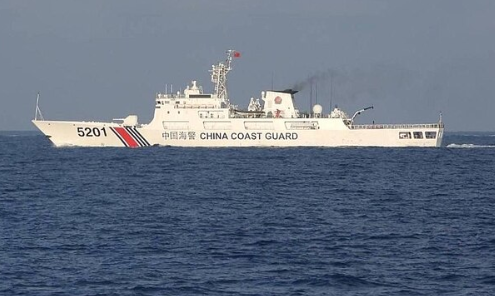
The Philippines accused Chinese coast guard and naval vessels of blocking a routine resupply mission to Filipino troops stationed at Second Thomas Shoal in the South China Sea. The confrontation happened on September 24 and forced the Philippine mission to be temporarily suspended. No collision or injuries were reported, but Philippine officials said Chinese vessels created a serious risk at sea.
The mission was headed toward the BRP Sierra Madre, an aging Philippine Navy ship that has been grounded on the shoal since 1999. Manila keeps a small military force aboard the ship to maintain its presence in the disputed area. Food, water, equipment and replacement personnel must be brought to the vessel by sea.
The Philippine News Agency reported that eight Chinese vessels interfered with the operation. Philippine military officials said the group included three People's Liberation Army Navy warships and five China Coast Guard vessels. Two of the naval ships were described as Houbei-class missile boats.
The Philippine mission included the M/V Lapu-Lapu, along with three Philippine Navy and Coast Guard support vessels. Officials said the interference occurred from about 8:35 p.m. until 11 p.m. while the Philippine ships were roughly 60 nautical miles from Ayungin Shoal, the Philippine name for Second Thomas Shoal.
Philippine military spokesperson Rear Admiral Roy Vincent Trinidad said the Chinese vessels made repeated radio calls, monitored the Philippine ships and moved close to them. The Philippines suspended the mission because officials believed continuing could create a dangerous confrontation.
The National Task Force for the West Philippine Sea said the China Coast Guard and People's Liberation Army Navy had obstructed a lawful humanitarian and sustainment operation. The task force said the actions put Filipino personnel at risk and called on China to stop interfering with Philippine resupply missions.
The incident did not result in the kind of violent confrontation seen during several earlier encounters in the area.
Reuters reported that Philippine Coast Guard spokesperson Jay Tarriela said there was no collision and nobody was injured. However, he said the maneuvers by Chinese Coast Guard vessels created a serious danger of a collision.
China gave a different account of the encounter. China Coast Guard spokesperson Jiang Lue said the Philippines ignored Chinese warnings when it sent the resupply vessel toward the grounded ship. He said Chinese forces responded with on-site monitoring and verbal warnings.
Beijing claims sovereignty over Second Thomas Shoal, which China calls Ren'ai Jiao, and says Philippine activities there violate Chinese sovereignty. China has repeatedly demanded that the Philippines remove the BRP Sierra Madre.
Manila rejects that position and says the shoal lies within the Philippines' exclusive economic zone.
The dispute has become one of the most persistent points of tension between China and the Philippines. Second Thomas Shoal is part of the Spratly Islands area, where several governments have overlapping claims. China claims large portions of the South China Sea, including waters also claimed by the Philippines, Vietnam, Malaysia, Brunei and Taiwan.
The BRP Sierra Madre plays an unusual role in the dispute. The vessel was originally built for the United States during World War II and later served in the Philippine Navy. The Philippines intentionally grounded it at Second Thomas Shoal in 1999 and has kept troops aboard ever since.
China has tried for years to restrict Philippine access to the outpost. Encounters around the shoal have included blocking maneuvers, water cannons and close approaches by ships.
A particularly serious clash occurred in June 2024 during another Philippine resupply operation. Chinese personnel boarded or confronted Philippine boats near the shoal, equipment was damaged and a Filipino sailor suffered a serious hand injury. The episode sharply increased concerns that another encounter could escalate into a broader crisis.
After that confrontation, Manila and Beijing reached a provisional arrangement in July 2024 covering resupply missions to the Sierra Madre. The details were not fully made public. Both governments said at the time that the arrangement was intended to reduce the risk of confrontations while allowing humanitarian supplies to reach the Philippine personnel.
For a period, the agreement appeared to reduce tensions during resupply operations.
The latest incident raises questions about how well that arrangement is still working. Philippine officials said the September 24 mission was legitimate and that interference by Chinese forces violated the country's rights under international law. China maintains that Philippine vessels must follow conditions set by Beijing for activities around the shoal.
The legal dispute has another important background.
A tribunal in The Hague ruled in 2016 on a case brought by the Philippines under the United Nations Convention on the Law of the Sea. Permanent Court of Arbitration records show that the tribunal rejected the legal basis for China's sweeping historic-rights claims within much of the South China Sea. The tribunal also found that Second Thomas Shoal lies within the Philippines' exclusive economic zone for purposes addressed in the case.
China did not participate in the arbitration and has rejected the ruling. Beijing continues to say its sovereignty claims in the region are based on history and international law.
The disagreement therefore involves both control of small maritime features and a much larger struggle over access, jurisdiction and military influence in one of the world's busiest waterways.
The South China Sea carries major international shipping traffic and is strategically important to several countries. The United States is not a claimant in the territorial disputes, but it has a defense treaty with the Philippines and regularly states that freedom of navigation must be protected.
That alliance adds another layer of risk to confrontations involving Philippine government vessels and Chinese forces.
Washington has said in previous South China Sea disputes that the U.S.-Philippines Mutual Defense Treaty can apply to armed attacks on Philippine armed forces, public vessels and aircraft in the Pacific, including in the South China Sea. That makes even a local confrontation potentially important beyond the Philippines and China.
Both Manila and Beijing have continued to say they want to manage their differences through dialogue. Officials from China and Southeast Asian countries have also continued talks toward a regional code of conduct for the South China Sea.
At the same time, confrontations at sea have continued.
For the Philippines, maintaining regular access to the Sierra Madre is a practical and symbolic priority. Without resupply missions, the small group of personnel aboard the old ship cannot remain there indefinitely.
For China, allowing unrestricted Philippine operations around the shoal could weaken Beijing's effort to enforce its own territorial position.
The September 24 encounter ended without injuries or a collision, but it showed how quickly the two countries can again find themselves in a dangerous standoff. The immediate question is when the Philippines will attempt another resupply mission and whether Chinese forces will again try to block it.