

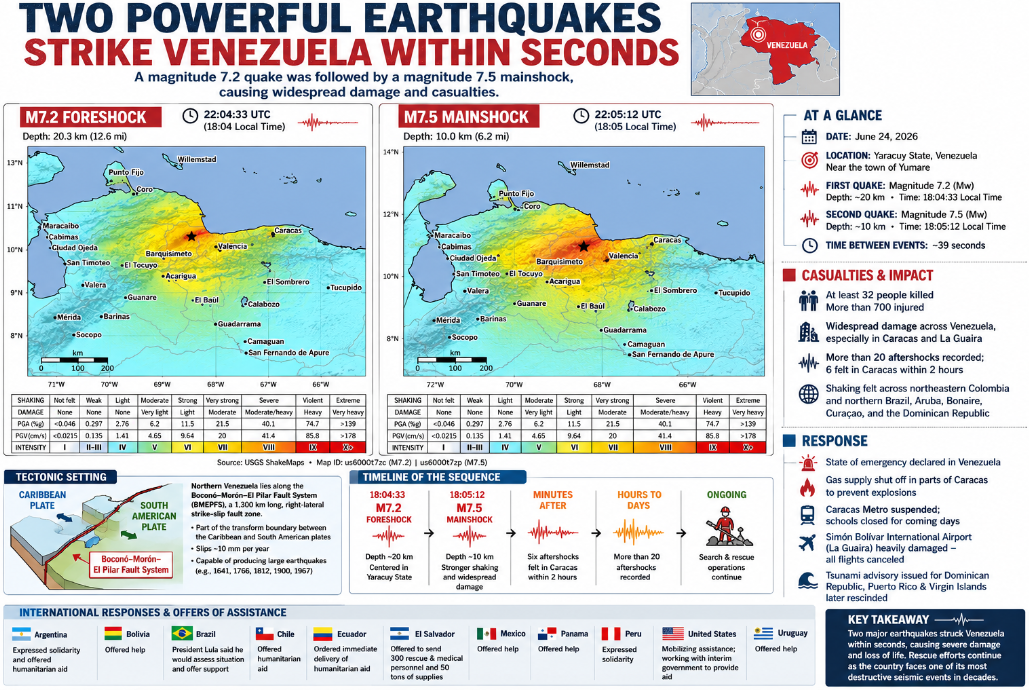
Two powerful earthquakes struck Venezuela within seconds of each other on June 24, causing widespread damage across the country and raising fears that the death toll could climb sharply as rescue crews reach collapsed buildings.
The first quake, measured at magnitude 7.2, was followed less than a minute later by a stronger magnitude 7.5 earthquake. Both were centered in northwestern Venezuela, west of Caracas, and were felt across a wide region. Reuters reported that at least 32 people had been confirmed dead and more than 700 others were injured, while the U.S. Geological Survey warned that casualties could eventually reach into the thousands.
Caracas was among the hardest-hit areas. Dozens of buildings were reported damaged or collapsed, and residents rushed into the streets as shaking moved through the capital. ABC News reported that the two quakes struck back-to-back, with one measuring 7.2 and the second 7.5.
Officials said damage was especially severe in La Guaira, the coastal state north of Caracas that includes the main airport serving the capital. Reuters reported that rescue efforts were underway amid collapsed buildings, while hospitals prepared for a surge of injured people. Schools were closed, the Caracas Metro was suspended, and flights were disrupted after damage was reported at the airport.
Venezuela declared a state of emergency after the earthquakes. Acting President Delcy Rodríguez said the government would seek support from multilateral organizations for search and rescue operations. Interior Minister Diosdado Cabello said several states were affected, and authorities ordered gas service shut off in parts of Caracas to reduce the risk of explosions in damaged buildings.
The earthquakes struck on a national holiday, when many people were at home rather than at work. That timing has raised concern that more victims may be found inside residential buildings as crews search through debris.
The U.S. Geological Survey’s PAGER system warned that “high casualties and extensive damage are probable,” according to reports. The agency’s early fatality estimates showed a significant chance of thousands of deaths, though official confirmed numbers remained far lower as communications and damage assessments continued.
The quakes were felt well beyond Venezuela. Reports said shaking reached parts of Colombia and the Caribbean, and a tsunami advisory was briefly issued for Puerto Rico, the Dominican Republic, and the Virgin Islands before being canceled.
Northern Venezuela sits along a complex boundary where the Caribbean and South American plates interact. The region is crossed by major fault systems capable of producing large earthquakes, including the Boconó–Morón–El Pilar fault system. Venezuela has experienced destructive earthquakes in the past, including major events in 1812, 1900, and 1967.
International offers of assistance began arriving soon after the disaster. Reuters reported that several governments offered humanitarian support, including the United States, as rescue teams searched for survivors and officials assessed the full scale of the damage.
The immediate focus remains search and rescue. In Caracas and surrounding areas, emergency workers and volunteers were reported digging through rubble as hospitals treated the injured. Authorities warned residents to stay away from unstable structures as aftershocks continued.