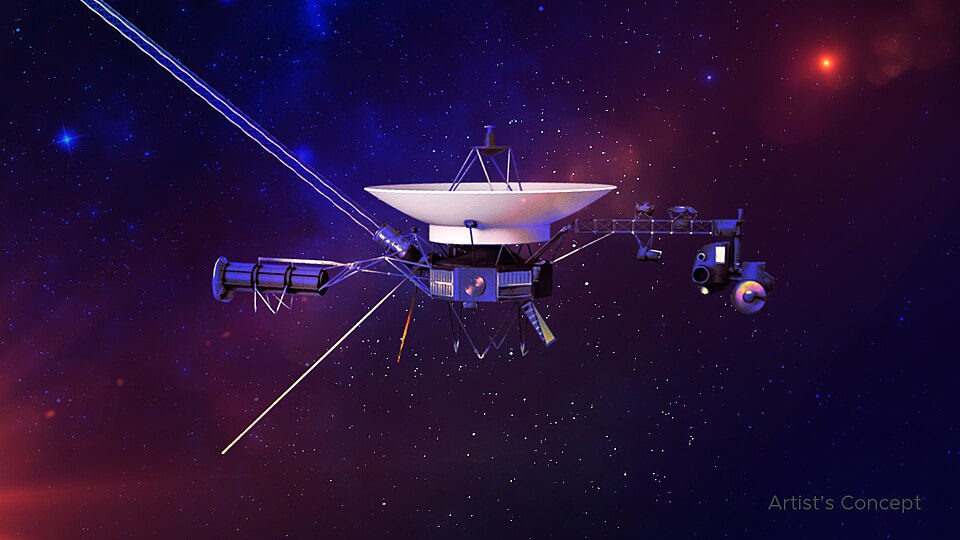
Nearly half a century after launching from Cape Canaveral on what was supposed to be a five-year mission, Voyager 1 is running out of power. This week, NASA announced it had shut down one of the spacecraft's remaining science instruments — not because the mission has failed, but to squeeze a little more life out of humanity's most distant emissary.
Voyager 1, a robotic probe roughly the weight of a mid-size sedan, launched on September 5, 1977, and has been operating almost without interruption ever since. Its origins lie in an astronomical coincidence: a rare alignment of the outer planets that wouldn't repeat for 175 years, allowing the spacecraft to slingshot from one giant planet to the next using gravity assists. The probe flew past Jupiter in 1979, revealing active volcanoes on the moon Io — the first volcanic activity ever observed beyond Earth — and then reached Saturn in 1980, studying its rings and the moon Titan in unprecedented detail, according to NPR.
That close encounter with Titan tilted the spacecraft's trajectory upward, out of the plane of the solar system and toward the stars. In 2012, Voyager 1 crossed the heliopause — the boundary where the sun's charged-particle wind gives way to interstellar space — becoming the first human-made object to enter the void between star systems.
Now the engineers at NASA's Jet Propulsion Laboratory who tend to the spacecraft face an agonizing reality. The probe's power supply, generated by decaying plutonium, has been steadily declining for decades. Each instrument shutdown buys more time for the remaining ones, but the choices are getting harder. The latest decision reflects a strategy of managed sacrifice: keeping Voyager 1 communicating and collecting at least some data for as long as possible, rather than letting it go dark all at once.
The spacecraft remains more than 15 billion miles from Earth, so distant that its radio signals, traveling at the speed of light, take nearly a full day to arrive. That it functions at all is a testament to the engineers who built it and those who continue to coax performance from hardware designed in the 1970s. Originally funded for a simple fly-by of Jupiter and Saturn, the Voyager program has now lasted nearly ten times its intended lifespan — and its caretakers intend to keep it going as long as they possibly can.