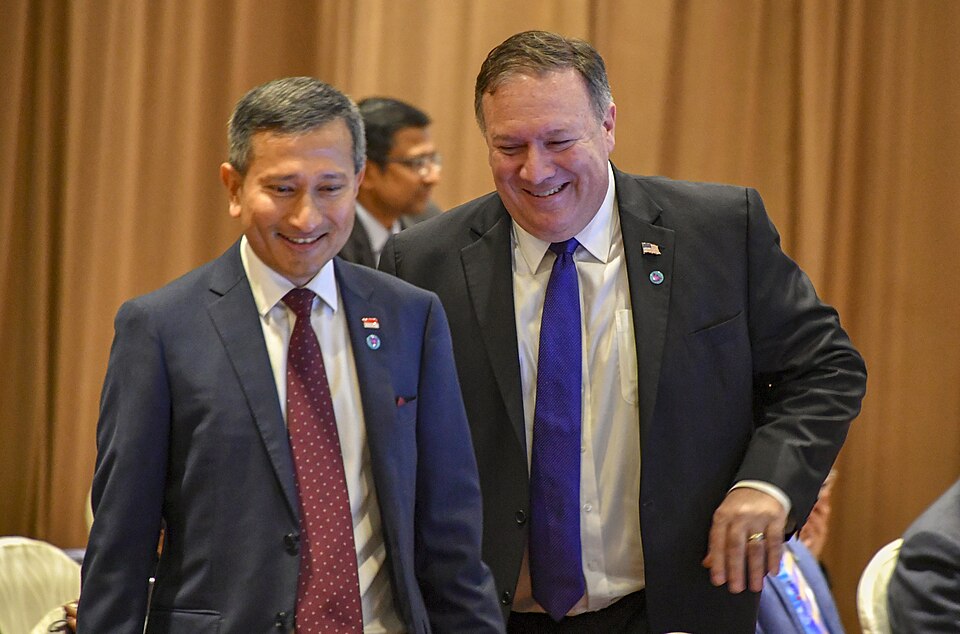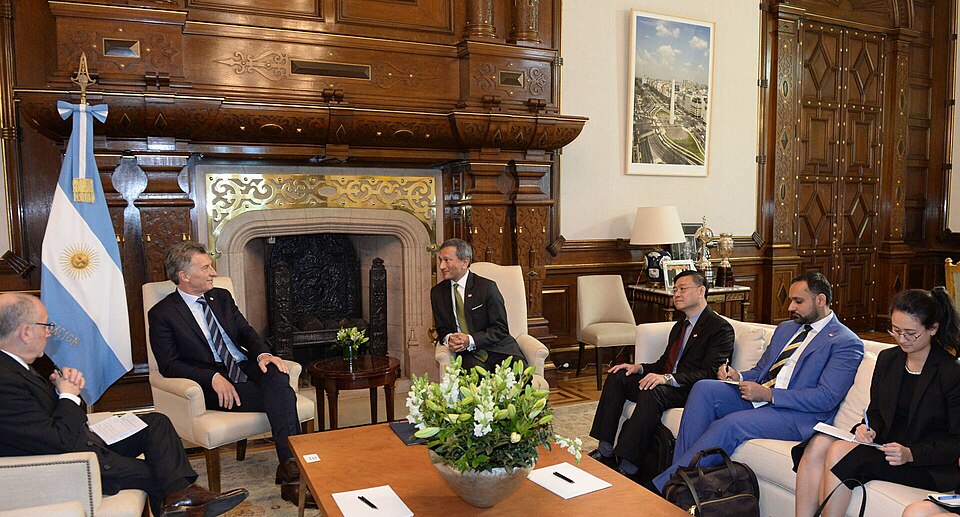
Singapore's foreign minister issued a stark warning Wednesday about the consequences of a U.S.-China war in the Pacific, telling a business conference that the ongoing disruption at the Strait of Hormuz would look minor by comparison.
"What you are seeing in the Strait of Hormuz will be a dry run," Foreign Minister Vivian Balakrishnan said at CNBC's CONVERGE LIVE event in Singapore. He made the remark while responding to a question about whether Singapore was under pressure from Washington or Beijing to pick sides in the intensifying rivalry between the two powers.
Singapore is unusually exposed to both. The U.S. is the city-state's largest foreign investor, with roughly 6,000 American companies operating there. Singapore also runs a goods trade deficit with the U.S. of about $3.6 billion, according to the office of the U.S. Trade Representative. At the same time, China is Singapore's largest trading partner, and Singapore is China's largest foreign investor. Balakrishnan said the city-state would refuse to choose between them. "We will be useful, but we will not be made use of," he said.
The minister's Hormuz warning came as Bloomberg reported that President Trump has extended a truce with Iran but is maintaining a naval blockade, saying the U.S. would not launch fresh attacks while blocking ships linked to Tehran "until discussions are concluded, one way or the other." That standoff has rattled shipping markets and refocused attention on the world's critical maritime chokepoints.
Balakrishnan addressed that directly. He said the Middle East conflict had shown that "chokepoints matter," pointing to Singapore's own position astride the Strait of Malacca. At its narrowest, the Malacca strait is just two nautical miles wide, compared to 21 nautical miles at the Strait of Hormuz. Iran's government has been preparing legislation to impose tolls on ships passing through Hormuz, state media reported in March. Balakrishnan acknowledged the risk that other nations might consider similar moves, but he was explicit about Singapore's position. "We will not participate in any attempts to close or interdict or to impose tolls in our neighborhood," he said, citing Singapore's obligations under UNCLOS, the United Nations Convention on the Law of the Sea.
The investment picture for Southeast Asia remains complicated but not collapsing. Carol Fong, CEO of CGS International Group, told Bloomberg on Wednesday that investors are pausing risk-taking because of the Middle East conflict, but capital continues to flow into the region. Singapore, she said, is seeing the strongest inflows. Fong also discussed a new private equity vehicle her firm is launching to target opportunities along the China-ASEAN corridor, suggesting that institutional investors still see the region as a destination even as global tensions rise.
Balakrishnan's bluntest line came in describing how Singapore navigates pressure from major powers. "The way we conduct our affairs is we assess what is in Singapore's long term national interests, and if I have to say no to Washington or Beijing or anyone else, we don't flinch from that," he said.