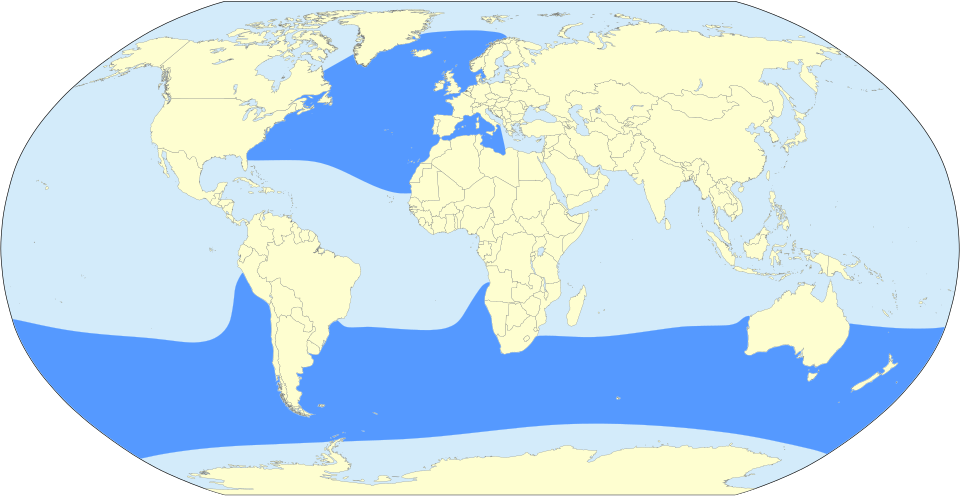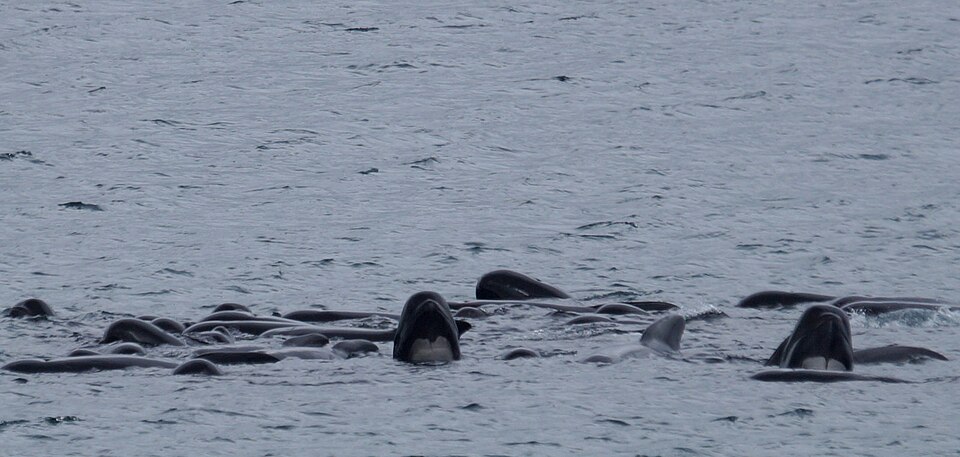
In July 2023, 55 long-finned pilot whales beached themselves on the Isle of Lewis in Scotland, the largest mass stranding the country had seen in recent memory. All died. Post-mortems showed the animals were in good health. Now a new study has traced where they had been and what they had been eating in the weeks before the event.
The research, published in PLOS One and led by the Scottish Marine Animal Stranding Scheme based at the University of Glasgow, used stable isotope analysis to reconstruct the pod's feeding history from chemical signatures preserved in skin tissue. The technique can reveal an animal's dietary movements over weeks without requiring direct observation, which matters because deep-water cetaceans like pilot whales are extremely difficult to study in the wild.
The isotopic data showed the whales had been feeding primarily along the continental shelf edge and slope, deep offshore habitats that support large populations of fish and squid during spring and early summer. The animals were well-nourished. Their stomachs, however, were empty at the time of death, suggesting they had not fed in the immediate period before stranding.
The study marks the first direct evidence that long-finned pilot whales use shelf-slope habitats as important seasonal feeding grounds. That finding carries a specific risk: those productive feeding zones sit close to rapidly shallowing coastal waters. The proximity may mean that healthy, actively foraging whales are routinely near conditions that could lead them ashore under the wrong circumstances.
A prior investigation by the Scottish Government's Marine Directorate had already identified a likely trigger for the 2023 event. The group, which is highly social, appears to have followed a female experiencing a difficult birth into dangerously shallow water. Pilot whales are known for this kind of tight social cohesion, which can turn a single animal's distress into a group catastrophe.
The new study does not contradict that finding. Instead it fills in the weeks before the social crisis, showing a pod that was healthy, well-fed, and foraging in areas that placed it close to shore. The researchers say understanding these seasonal feeding patterns, and how they may be shifting in response to broader environmental changes, is essential for anticipating future stranding risk.
Mass strandings of pilot whales are not rare globally, but events of this size remain relatively unusual in Scottish waters. The Isle of Lewis stranding drew significant public attention and prompted multiple parallel investigations. The PLOS One paper adds a layer of behavioral and ecological context that earlier post-mortem work could not provide.
The research team noted that the combination of factors — feeding location, social behavior, and a medical emergency within the group — likely converged to produce the outcome. No single cause, they concluded, fully explains why 55 animals died on a Scottish beach on a July morning.