Western El Salvador sits on one of the most geologically active stretches of land in the Western Hemisphere, where two towering volcanoes, a geothermal power plant, and a history of deadly steam explosions occupy a landscape that has been restless for centuries.
NASA's Earth Observatory released a new satellite image this week showing the area around the city of Ahuachapán, a region pockmarked with craters, recent lava flows, and mineral pools fed by superheated groundwater. The area forms part of the Central American Volcanic Arc, a chain of volcanic terrain running more than 1,000 kilometers along the Pacific coast from Guatemala to Panama.
The dominant landmark on the right side of the image is Santa Ana, El Salvador's tallest volcano at 2,381 meters above sea level. Its summit holds several crescent-shaped ridges enclosing a hot, acidic crater lake. Santa Ana has produced small to moderate explosive eruptions since the 16th century. Its most recent significant eruption, in 2005, sent a dense column of gas and ash into the sky and launched lahars down its slopes.
Izalco, a steep-sided stratovolcano that grew on Santa Ana's southern flank starting in 1770, earned a more colorful reputation. Sailors reported seeing its glow from the sea during its frequent Strombolian eruptions and lava fountains, earning it the nickname "Lighthouse of the Pacific." The lighthouse dimmed after 1966, when Izalco last showed significant activity.
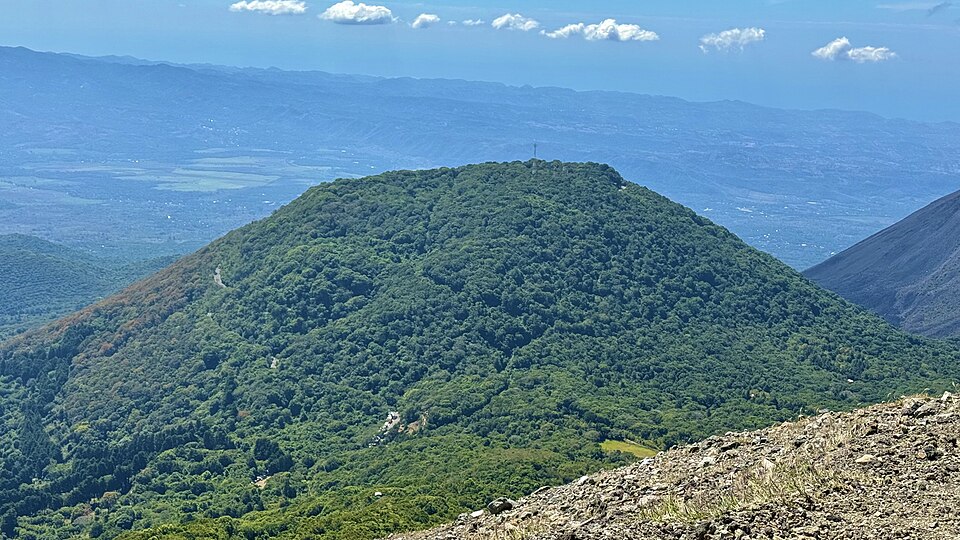
Running across the scene is the Apaneca Range, a line of forested stratovolcano peaks with no recorded eruptions in the past 11,700 years. The range is not dormant in any practical sense. Fumaroles, hot springs, and steam vents remain active throughout the area. A sudden steam explosion near the range's Laguna Verde volcano killed people in October 1990. More recently, a 2025 steam eruption near a popular hot springs facility forced evacuations and damaged infrastructure.
The same underground heat that produces these hazards also powers the Ahuachapán Geothermal Power Plant, which has been running since 1975. The plant taps groundwater naturally heated to around 250 degrees Celsius through local fault systems. By the early 1980s it was generating 40 percent of El Salvador's total electricity output — a remarkable share for a single facility, and one that came during a period scholars have linked to civil unrest and rapid population growth in the region.
The plant recently marked its 50th year of continuous operation, a milestone documented in proceedings from the 2025 Workshop on Geothermal Reservoir Engineering.