

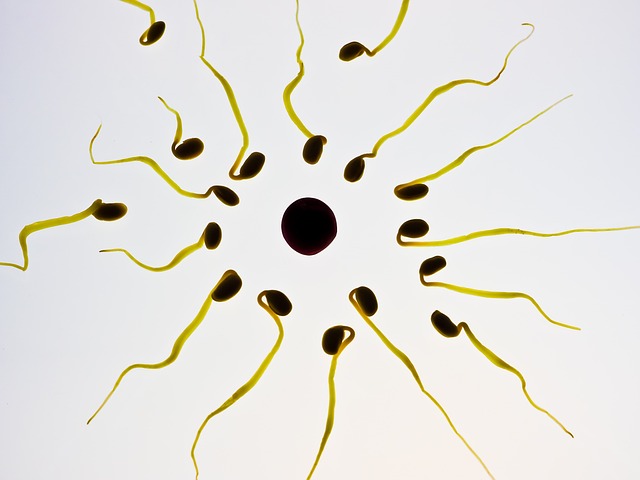
Fertilization has long been described as a race, with millions of sperm competing to reach a single egg first. New research says that picture is incomplete. In many species, sperm do not race alone. They form coordinated groups, and cooperation may matter as much as speed.
A team of evolutionary biologists from Syracuse University, the University of Siena in Italy, and the University of Szeged in Hungary studied sperm behavior across arthropods, the large and diverse group of animals that includes spiders, crabs, insects, and centipedes. Their findings, published in Nature Communications, show that a process called sperm conjugation, where sperm cells bind together into structured groups, is widespread across the arthropod family tree and has evolved and disappeared many times over hundreds of millions of years.
According to Phys.org, the researchers found that sperm conjugation first appeared hundreds of millions of years ago and that the ancestor of all insects had conjugated sperm. The trait has been gained and lost repeatedly across different species and lineages, suggesting it offers real reproductive advantages in some environments and contexts, even if it is not universal.
"Fertilization is often viewed as a competition among individual sperm, but in many species we see cells working together in ways that can influence reproductive success," says Steve Dorus, professor of biology at Syracuse University's College of Arts and Sciences and co-author of the study.
To picture what sperm conjugation looks like, the researchers suggest thinking of a coordinated team of rowers. Rather than each cell navigating independently through the complex environment of the female reproductive tract, grouped sperm may move more efficiently, coordinate their function, or gain other advantages that a single cell cannot achieve alone. The result is reproduction as a collective effort rather than a solo race.
A substance called sperm-associated material, or SAM, appears to play a central role in making conjugation possible. SAM is a membrane-bound substance that can bind sperm together or form external structures that organize them into groups. Researchers believe SAM may have been the key to how sperm conjugation first evolved, originally appearing as a way to package or protect sperm before being co-opted to organize them into functional teams.
The study drew on a large-scale comparative analysis of sperm structure across arthropods, pulling together decades of published research and comparing sperm traits across hundreds of diverse species. That broad survey is what allowed the team to trace the evolutionary history of conjugation across the arthropod tree and identify how often it has appeared and disappeared.
Although sperm conjugation was first described more than a century ago, it was long considered rare. The new analysis challenges that assumption directly. The pattern that emerged from the data suggests conjugation is a recurring evolutionary strategy, one that different lineages have discovered and used independently across deep time.
The implications go beyond arthropod biology. If collective behavior among sperm cells can meaningfully influence reproductive success, then standard models of fertility that focus entirely on individual sperm performance may be missing an important variable. Researchers studying reproduction in other animal groups may need to look more carefully at whether similar cooperative behaviors exist elsewhere in the animal kingdom.
Dorus and his colleagues are expected to continue investigating the molecular mechanisms behind SAM and how the physical structure of conjugated sperm groups translates into reproductive advantages in different species.