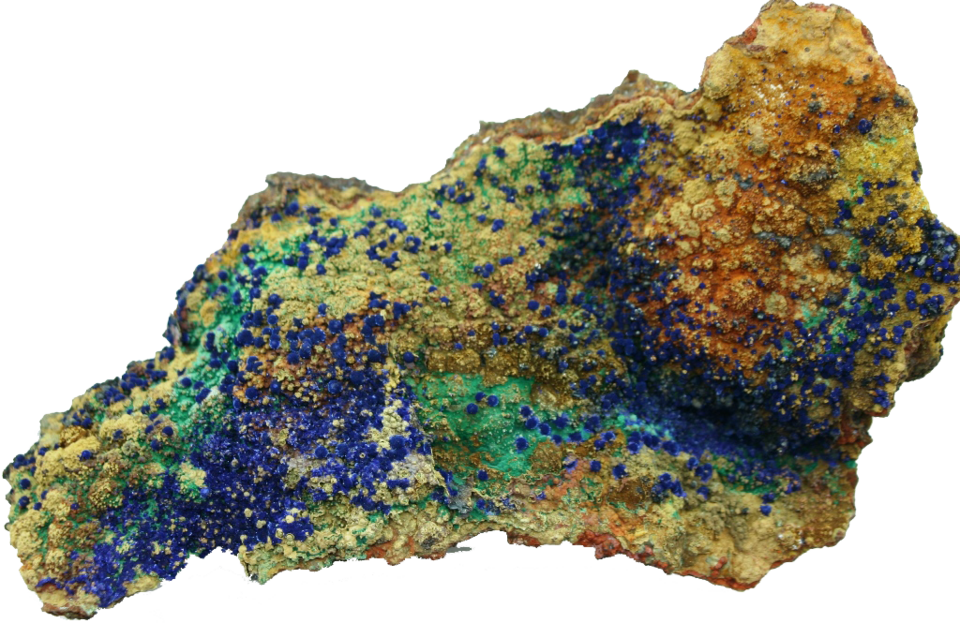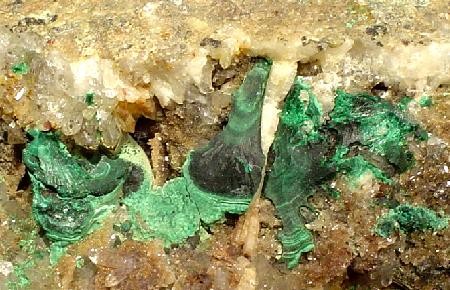
A cave high in the Spanish Pyrenees has yielded close to 200 fragments of vivid green rock, dozens of prehistoric fireplaces, human remains, and a child's finger bone and baby tooth — evidence that prehistoric people climbed to 2,235 meters above sea level repeatedly over thousands of years to smelt copper from malachite.
The findings, published Tuesday in the journal Frontiers in Environmental Archaeology, challenge a long-held assumption that prehistoric communities only passed briefly through high mountain terrain rather than exploiting it as a working resource.
"For a long time, high-mountain environments were seen as marginal, places prehistoric communities passed through occasionally," said Prof. Carlos Tornero of the Catalan Institute of Human Paleoecology and Social Evolution, the study's lead author. "But we found a really rich archaeological sequence, including multiple combustion structures and a very large number of green mineral fragments."
The site, known as Cave 338, sits in the Freser Valley in the Spanish province of Girona, near the mountainous border with France. Archaeologists excavated a six-square-meter section at the cave's entrance and identified four distinct occupation layers. The deepest and oldest layer contained only charcoal, dated to roughly 6,000 years ago. The two middle layers were the most productive: 23 hearths packed with crushed, thermally altered green mineral fragments that researchers believe are malachite, a copper-carbonate mineral not naturally found in the cave.
The earliest confirmed occupation dates to between 5000 and 4300 B.C., placing the site squarely within the Copper Age, or Chalcolithic, which stretched across prehistoric Europe from about 5000 to 2000 B.C. During this period, people across the continent began processing natural copper sources into tools, jewelry, and vessels. The famous alpine mummy Ötzi the Iceman, who died around 3300 B.C., was carrying a copper ax when he was found.
Extracting copper from malachite is a relatively straightforward process. The mineral is heated until it releases carbon dioxide and turns into a black copper oxide residue. That residue is then exposed to a carbon source — charcoal, in prehistoric practice — which strips away the remaining oxygen and leaves a small copper nugget. The abundance of combustion pits and charcoal in Cave 338 fits this process precisely.
Co-author Julia Montes-Landa, an archaeologist at the University of Granada, said the pattern of burning was deliberate. "Many of these fragments are thermally altered, while other materials in the cave are not, which clearly suggests that fire played an important role in their processing and that there was a deliberate intention behind it," she said in a statement. "In other words, they weren't burned by accident."
Beyond the green mineral fragments and fireplaces, the cave also contained human remains, animal bones, broken ceramic vessels, and lost jewelry. The child's finger bone and baby tooth raise the possibility that Cave 338 served as a burial site in addition to a mining camp — a question researchers expect to investigate when excavations reopen this summer.
Tornero noted that the repeated nature of the visits points to organized, well-supplied expeditions rather than casual wandering. "We can't say exactly how long people stayed each time," he said, "but the repeated use of the space and the density of remains suggest occupations that were short to medium in duration, but happening again and again over long periods of time."
The full material analysis to definitively confirm the green fragments as malachite is still underway.