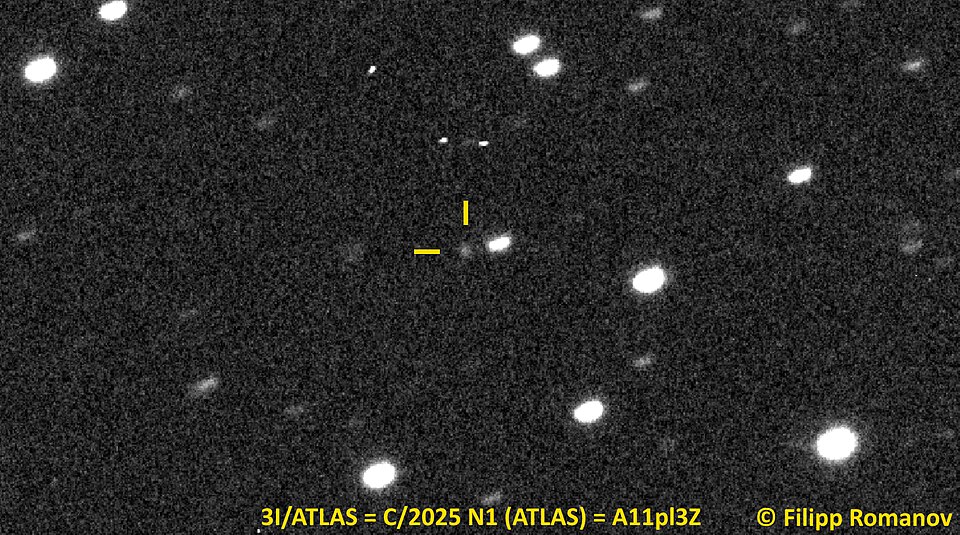
Less than a year after astronomers first spotted it crossing through our solar system, the interstellar comet known as 3I/ATLAS is revealing just how alien its birthplace was. A new study led by the University of Michigan found that the comet carries extraordinarily high levels of heavy water, a form of water containing deuterium, an isotope of hydrogen that has both a proton and a neutron in its nucleus rather than just a proton.
The deuterium ratio measured in 3I/ATLAS is about 30 times higher than what has been found in comets from our own solar system, and roughly 40 times higher than the ratio found in Earth's oceans. Those numbers place the comet in a category entirely its own, well outside anything scientists have measured in our cosmic neighborhood.
3I/ATLAS is only the third confirmed interstellar object ever detected passing through our solar system. The findings were published in the journal Nature Astronomy and received support from NASA, the U.S. National Science Foundation, and Chile's National Research and Development Agency.
"Our new observations show that the conditions that led to the formation of our solar system are much different from how planetary systems evolved in different parts of our galaxy," said Luis Salazar Manzano, lead author of the study and a doctoral student in the U-M Department of Astronomy.
Scientists use deuterium levels as a chemical fingerprint. The ratio of deuterium to ordinary hydrogen in water shifts depending on the temperature and radiation environment present when a body forms. Cold, low-radiation environments tend to produce higher deuterium concentrations. The extraordinarily high levels found in 3I/ATLAS point toward a birthplace far colder and more sheltered than the region where Earth and the other planets in our solar system took shape.
"The amount of deuterium with respect to ordinary hydrogen in water is higher than anything we've seen before in other planetary systems and planetary comets," Salazar Manzano said.
In ordinary water, hydrogen atoms carry only a single proton, giving water its familiar H2O structure. Heavy water, by contrast, substitutes one or both of those hydrogen atoms with deuterium. Small amounts of heavy water exist naturally on Earth and in comets throughout our solar system, but the concentrations seen in 3I/ATLAS are dramatically beyond that range.
The research team concluded that the comet likely formed in a region with significantly lower temperatures and lower radiation levels than the environment that produced our own planetary system. That conclusion, if confirmed through further observation, would mean the comet is a genuine piece of a very different kind of planetary system, one that evolved under conditions far removed from anything local.
The detection of 3I/ATLAS itself happened less than a year before this study was published. Its classification as an interstellar visitor, rather than a comet native to our own solar system, was established through its trajectory. Objects on interstellar paths move at speeds and angles inconsistent with having originated here, and 3I/ATLAS fit that profile clearly.
The study adds to a small but growing body of knowledge about objects that have crossed into our solar system from somewhere else. The first confirmed interstellar visitor, 'Oumuamua, was detected in 2017 and remains a subject of debate among astronomers due to its unusual shape and motion. The second, Borisov, arrived in 2019 and showed a more conventional comet-like composition. 3I/ATLAS now stands as the most chemically distinctive of the three.