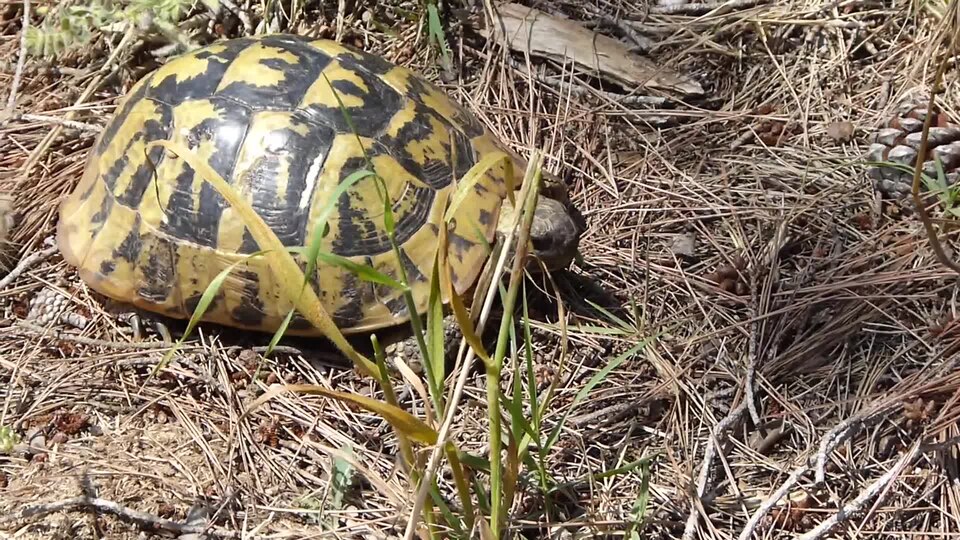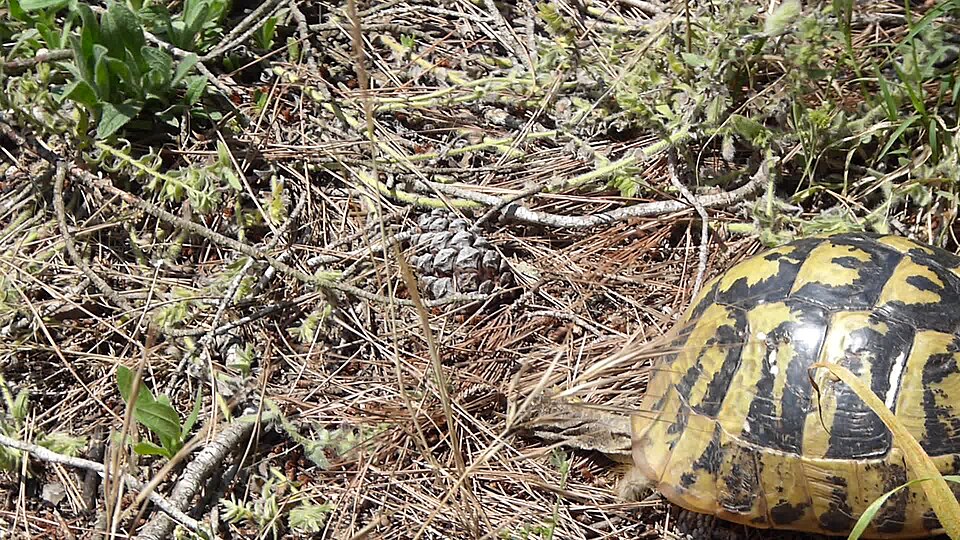
On a small, strictly protected island in a North Macedonian lake, one of the world's densest tortoise populations is collapsing from within. The cause is not disease, predators, or habitat loss. It is the tortoises themselves.
According to a report by Phys.org, researchers studying Hermann's tortoises on the island of Golem Grad in Lake Prespa have documented what they describe as the only known case of demographic suicide in the wild. The population has reached a sex ratio of roughly 100 males for every female capable of laying eggs, a imbalance driven by prolonged and violent courtship behavior that exhausts females and frequently ends with males pushing them off the island's cliffs.
Golem Grad would appear, at first glance, to be an ideal refuge. The island sits at an altitude of 850 meters and offers a mild Mediterranean microclimate. Wild boars, dogs, rats, and humans are all absent. The plateau is wooded, the meadows are open, and the adults face no predators. These conditions have produced a tortoise population density of approximately 50 individuals per hectare, the highest ever recorded for the species.
A field monitoring program has been running since 2008, the result of a scientific collaboration between North Macedonia, Serbia, and France. The program was awarded the CNRS's SEE-Life label in 2023. Over nearly 20 years, researchers have collected demographic, behavioral, physiological, and experimental data on the population.
What that data shows is that the population is in a critical state. Males pursue females through prolonged courtship that is physically exhausting for the females. Males also frequently push females off the steep cliffs that line the island. Because females are dying faster than they are being replaced, the proportion of males in the population keeps rising. As the sex ratio grows more skewed, the surviving females face increasing harassment from a growing pool of males, accelerating the cycle.
The researchers describe this as demographic suicide, a process they call strange and counterintuitive. For it to occur, specific conditions must align: a high-density population in which violent sexual behavior is so prevalent that it threatens female survival, which then gradually skews the sex ratio, which then increases pressure on the remaining females. The island of Golem Grad has met all of those conditions.
For long-lived species like tortoises, population stability depends on high adult survival rates. When adults begin dying faster than they reproduce, populations can decline sharply even in otherwise protected environments. The researchers noted that the population on Golem Grad is highly active both sexually and reproductively, which makes the trajectory all the more unexpected.
No other population in the wild has been documented going through this process. The research team continues its long-term monitoring of the island.