A new species of mosasaur stretching up to 43 feet long has been identified from fossils found primarily in northern Texas, making it one of the largest mosasaurs known to science. The creature, named Tylosaurus rex, lived approximately 80 million years ago and has been described by researchers at the American Museum of Natural History, the Perot Museum of Nature and Science in Dallas, and Southern Methodist University.
According to a report published in the Bulletin of the American Museum of Natural History, the discovery began when Amelia Zietlow, a research associate at the American Museum of Natural History and now at the History Museum at the Castle in Wisconsin, found a mosasaur fossil in the museum's collection that appeared to have been misidentified as Tylosaurus proriger, a previously known species.
After comparing the specimen to T. proriger's holotype fossil, which was described more than 150 years ago and is housed at the Harvard Museum of Comparative Zoology, Zietlow and her colleagues concluded that the American Museum specimen, along with more than a dozen similar fossils held at other institutions, belonged to a different animal entirely. The fossils were larger than T. proriger and had finely serrated teeth, a trait uncommon among mosasaurs. While most T. proriger specimens come from what is now Kansas and date to around 84 million years ago, these fossils were predominantly from Texas and are 4 million years younger.
"Everything is bigger in Texas and that includes the mosasaurs, apparently," said Zietlow, the lead author of the study.
The name T. rex was chosen as an homage to paleontologist John Thurmond, who first noted in the late 1960s that tylosaurs from northeast Texas appeared unusually large and might represent a new species. Thurmond informally called them "Tylosaurus thalassotyrannus," meaning "sea tyrant."
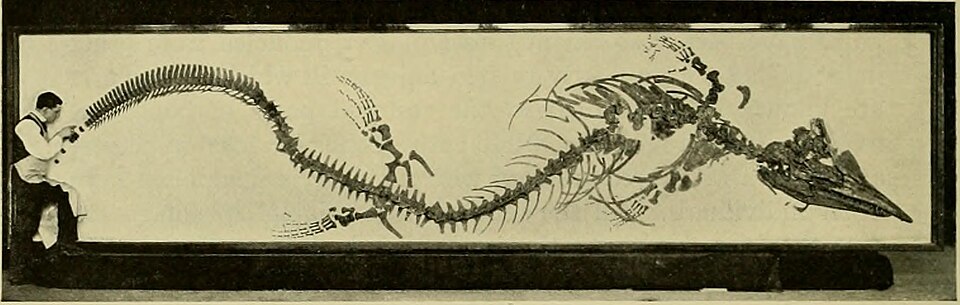
The holotype specimen for the newly described T. rex is a giant fossil now on display at the Perot Museum. It was first discovered in 1979 near an artificial reservoir outside Dallas. The species ranged in length from 25 feet to 43 feet, roughly the length of a school bus, and had physical adaptations suggesting exceptionally powerful jaw and neck muscles.
"Besides being huge, roughly twice the length of the largest great white sharks, T. rex appeared to be a much meaner animal than other mosasaurs," said study co-author Ron Tykoski, vice president of research at the Perot Museum.