A planet sitting comfortably in its star's habitable zone may still have no chance of supporting life if the galaxy around it is hostile enough. New research published in The Astrophysical Journal finds that supermassive black holes in an active feeding state can render exoplanets uninhabitable across enormous distances, adding a large-scale threat to a field of study that has mostly focused on a planet's relationship with its own star.
The paper, titled "The Impact of Supermassive Black Holes on Exoplanet Habitability. I. Spanning the Natural Mass Range," was led by Jourdan Waas of the Department of Aerospace, Physics and Space Sciences at the Florida Institute of Technology.
The concept of a habitable zone describes the range of distances from a star where liquid water can persist on a planet's surface. Too close, and water boils away. Too far, and it freezes. But that framework treats a solar system in isolation. This research asks what happens when the galaxy itself becomes a factor.
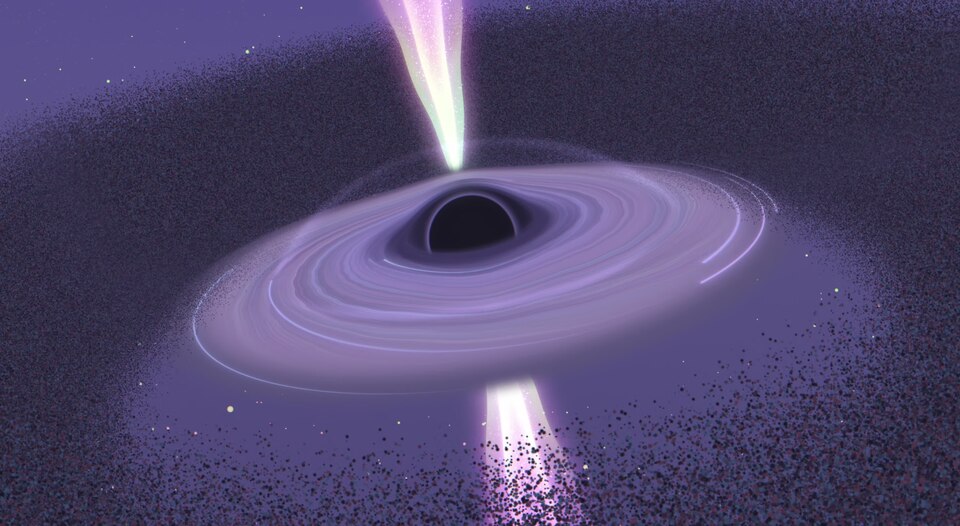
Supermassive black holes sit at the centers of most large galaxies, including the Milky Way. They can reach masses billions of times greater than the sun. When actively consuming surrounding matter, they become what astronomers call active galactic nuclei, or AGN. An AGN does not release energy in a single burst the way a supernova does. Instead, it sustains extreme output over long periods. "A clear understanding of the myriad roles of SMBH activity on galactic habitability would help pave the way for gauging the prospects for extraterrestrial habitability and life in the universe," the authors write.
Supernovae have long been a central concern in habitability research. Their radiation bursts can sterilize planetary surfaces, and their shock waves can strip away atmospheres or destroy planets outright. That is part of why scientists have questioned whether the densely packed central bulge of the Milky Way, where supernova rates are higher, could support life at all. But the new research argues that an actively feeding supermassive black hole can be far more energetic than a supernova on a sustained basis, making it a more persistent and potentially more damaging threat.
"In recent years, considerable attention has been devoted to understanding the role of high-energy astrophysical events in shaping the habitability of galaxies," the authors write. "Supernovae have long captured the attention of researchers due to their profound implications for planetary habitability."
Planetary atmospheres are what make life as we know it possible. They regulate temperature, shield surfaces from radiation, and maintain conditions for liquid water. An active galactic nucleus produces powerful winds and high-energy radiation capable of stripping those atmospheres away. The research examines how this threat scales across the full natural mass range of supermassive black holes, from the relatively smaller ones to the most massive objects of their kind known to exist.
The findings suggest that habitability in any galaxy cannot be assessed by looking at individual stars and their planets alone. The galactic environment, including the activity level of whatever supermassive black hole anchors the galaxy's center, plays a direct role in whether any given planet can hold onto the atmospheric conditions life requires.