

SEC commissioner Greg Sankey is not backing down from his league's standing, even with the numbers stacked against him.
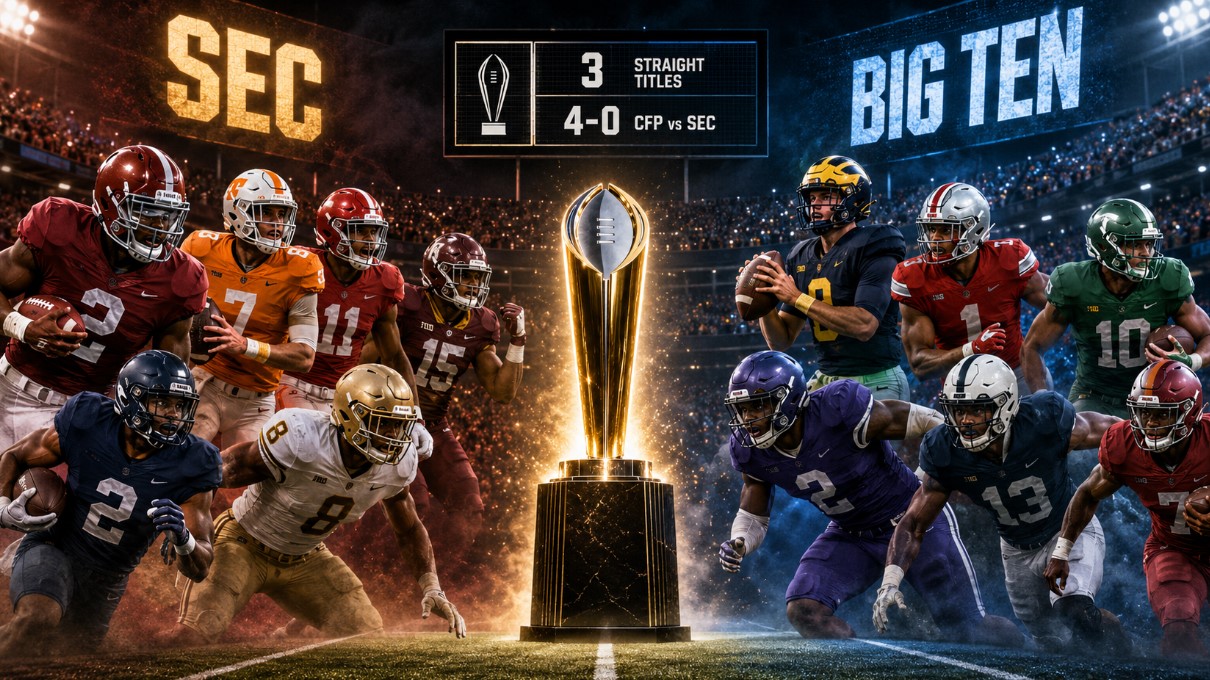
According to ESPN, Sankey said his league still "stands alone" despite the Big Ten winning the past three national titles and holding a 4-0 record against the SEC over the past three seasons in head-to-head College Football Playoff matchups.
Sankey did not offer specific metrics to support the claim in the report, but his position reflects a long-held belief within the SEC that the conference's overall depth, recruiting, and history place it above any competitor regardless of recent CFP results.
The Big Ten's recent dominance in the playoff represents a direct challenge to that narrative. Three consecutive national titles and a perfect record against the SEC in postseason play mark a clear shift in on-field results between the two conferences. Whether Sankey's confidence reflects genuine competitive standing or institutional loyalty is a question the 2026 season will eventually help answer.
The SEC has 16 football members. ESPN’s current SEC team page lists Alabama, Arkansas, Auburn, Florida, Georgia, Kentucky, LSU, Mississippi State, Missouri, Oklahoma, Ole Miss, South Carolina, Tennessee, Texas A&M, Texas, and Vanderbilt.
The Big Ten has 18 football members. Its current setup includes Illinois, Indiana, Iowa, Maryland, Michigan, Michigan State, Minnesota, Nebraska, Northwestern, Ohio State, Oregon, Penn State, Purdue, Rutgers, UCLA, USC, Washington, and Wisconsin. The Big Ten expanded to 18 schools after adding Oregon, UCLA, USC, and Washington from the Pac-12.
The comparison now stretches across two super-sized conferences. The SEC has 16 football members: Alabama, Arkansas, Auburn, Florida, Georgia, Kentucky, LSU, Mississippi State, Missouri, Oklahoma, Ole Miss, South Carolina, Tennessee, Texas A&M, Texas, and Vanderbilt. The Big Ten has 18: Illinois, Indiana, Iowa, Maryland, Michigan, Michigan State, Minnesota, Nebraska, Northwestern, Ohio State, Oregon, Penn State, Purdue, Rutgers, UCLA, USC, Washington, and Wisconsin.
The Big Ten’s current lineup reflects its West Coast expansion, while the SEC’s current lineup reflects the additions of Texas and Oklahoma. That makes the Sankey argument larger than a simple regional debate. It is now a national fight over which conference has the strongest top teams, the deepest middle, and the best claim to being the center of college football.