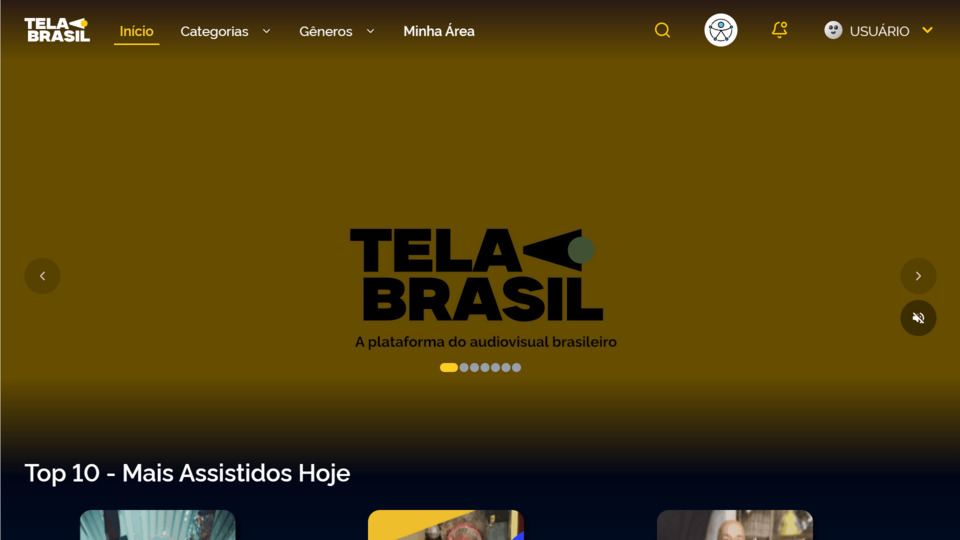
Brazil now has its own free public streaming service. President Luiz Inácio Lula da Silva announced the launch of Tela Brasil, or Screen Brazil, on May 30 at Rio2C, the country's major creative industries conference held in Rio de Janeiro.
According to Variety, the platform launches with an initial catalog of 555 Brazilian productions, accessible to anyone with an account on Gov.br, the official digital platform of the Brazilian federal government. The catalog includes 139 feature films, 85 medium-length films or television movies, 267 short films and 64 series produced locally between 1910 and 2025.
"Tela Brasil will help people better understand a country like Brazil. I hope Tela Brasil becomes an important platform for bringing Brazilians closer to their own culture. It's very important for us to get to know our own people," Lula said at the launch ceremony. "You will find an outstanding and vibrant selection of programming on Tela Brasil."
Lula made the announcement alongside film and television industry representatives and government officials, including Margareth Menezes, Brazil's minister of culture and a well-known singer, Eduardo Cavaliere, mayor of Rio de Janeiro, and Ricardo Couto, interim governor of the State of Rio.
During the ceremony, the Ministry of Culture and the Brazilian Communication Company, known as EBC, signed an agreement for EBC's catalog of more than 150 titles to join the platform. That catalog represents approximately 3,000 hours of content, including the talk show Sem Censura.
Films currently available on Tela Brasil span decades of Brazilian cinema. They include Glauber Rocha's Black God, White Devil from 1964, Cacá Diegues' Xica da Silva from 1976, Suzana Amaral's Hour of the Star from 1985, Fábio Barreto's Oscar-nominated O quatrilho from 1995, Bruno Barreto's Oscar-nominated Four Days in September from 1997, Hector Babenco's Carandiru from 2003, Jayme Monjardim's Olga from 2004 and Lúcia Murat's Almost Brothers from 2005.
The federal government invested R$9 million, approximately $1.8 million, in 2024 and 2025 to create the platform. That investment covered content licensing, technological development, accessibility features, curation and project management. The platform's technology was developed by the Ministry of Culture and the Federal University of Alagoas.
"Culture opens minds, broadens horizons and helps us see further. We must create opportunities for Brazilians to have access to everything," Lula said. "We have extraordinary artists. Why shouldn't we be proud to showcase what we create? Our country must undergo a transformation so that it can, once and for all, chart its own course and fully assert its independence."
Brazil's minister of industry, commerce and services, Márcio Elias Rosa, said during the ceremony that the audiovisual industry has been included in New Industry Brazil, the federal government's umbrella program for industrial development. A working group within the ministry has identified 11 priorities for expanding Brazil's audiovisual sector.