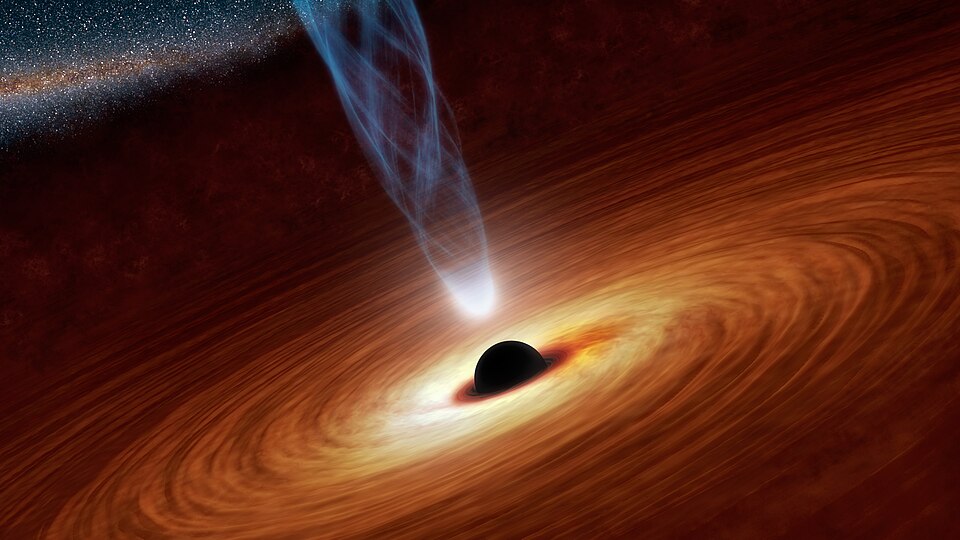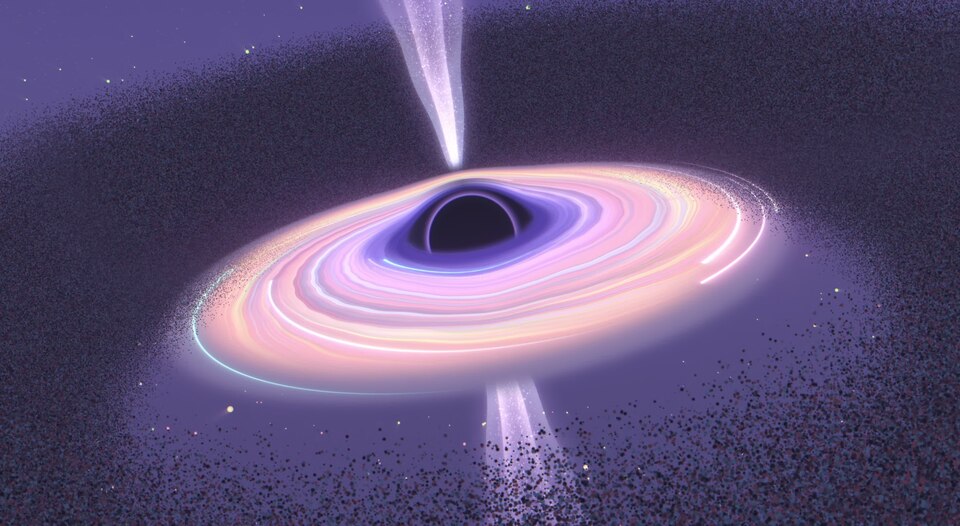
When two galaxies collide, the supermassive black holes at their centers eventually merge. That merger, according to Einstein's theory of general relativity, can produce a powerful kick that sends the resulting black hole flying out of the galactic center at hundreds or even thousands of kilometers per second. Tracking down these recoiling black holes has been one of the harder problems in cosmology. Now, an international team of researchers says they have found statistical evidence that it is actually happening.
According to a report by Phys.org, the paper was made available on the arXiv preprint server. The team developed a method that looks at the dust surrounding quasars, the extremely luminous cores of distant galaxies powered by actively feeding black holes.
The physics behind the method depends on what happens when a black hole is kicked. The black hole drags its tightly bound inner accretion disk along with it. That inner region produces what is called the Broad Line Region, a spectroscopic signature created by extreme Doppler shifting of emission lines. The more diffuse dust clouds sitting farther out, captured by a different signature called the Narrow Line Region, are bound more to the galaxy itself than to the black hole, so they stay behind when the kick occurs.
By comparing the wavelength shifts between the Broad Line Region and the Narrow Line Region, the researchers could calculate a velocity offset for each black hole. They then combined that with a measure of how much dust surrounded each quasar. Simulations had predicted that higher-velocity black holes would be surrounded by more dust, so the team looked for that correlation in real data.
They found it. The result was a modest but statistically significant positive correlation between a quasar's velocity offset and the amount of dust around it. To check whether the result was a fluke, the team ran the same analysis using only the Narrow Line Regions against each other. Since all of those regions were expected to stay put when a black hole was kicked, the correlation should have disappeared. It did, exactly as predicted.
The test gave the researchers confidence that they were detecting a real physical signal rather than a statistical artifact.
There was one complication. Black holes that appear blue-shifted, meaning they are moving toward Earth, showed up as more dust-obscured than those moving away. The team acknowledged this asymmetry as a hiccup in the study but did not consider it fatal to the overall finding.
The broader significance of the work is that it offers a new tool for studying one of the stranger predictions of general relativity. Detecting individual recoiling black holes has proven extremely difficult. A statistical approach, applied across large samples of quasars, may allow researchers to characterize how often these kicks happen and how strong they tend to be, adding to the understanding of what occurs when the largest objects in the universe collide.