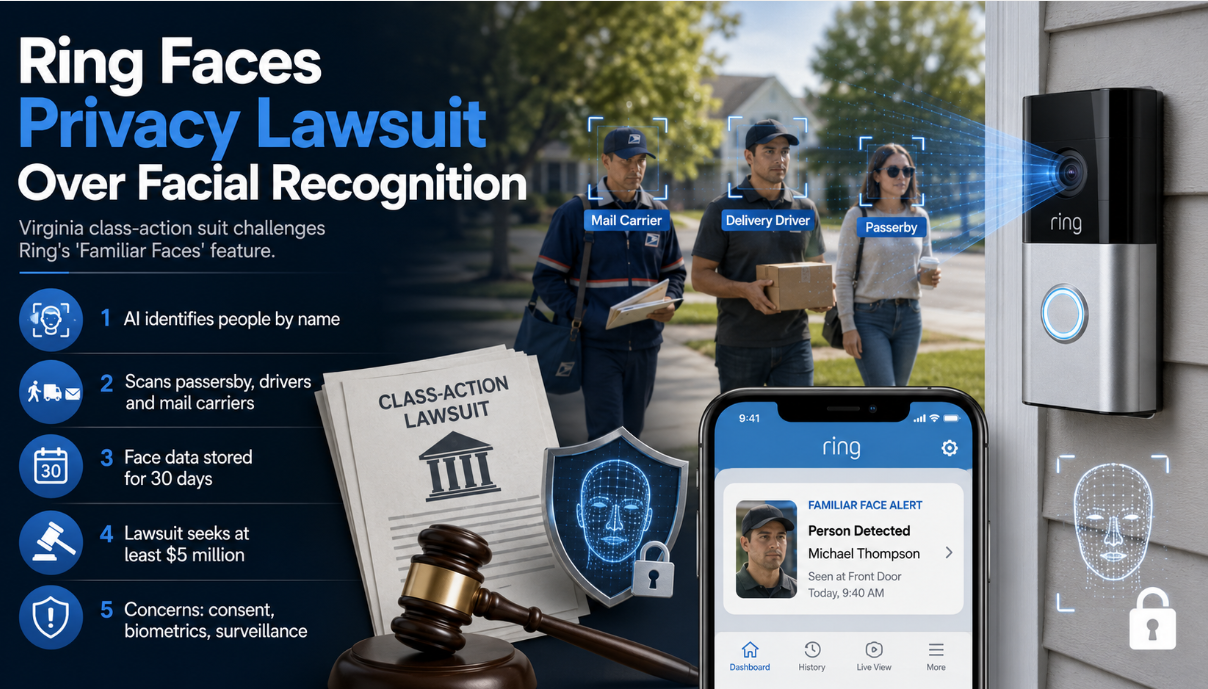
A Virginia man filed a class-action lawsuit against Amazon Ring on Monday, claiming the company's facial recognition feature violated his privacy and the privacy of millions of other Americans. According to a report by CNET, Charles Sigwalt filed the suit in Seattle federal court, seeking at least $5 million from the company.
The lawsuit centers on a Ring feature called Familiar Faces, which uses artificial intelligence to detect and remember the faces of people who appear near a Ring camera or doorbell. The feature launched in 2025 and is available to Ring subscribers who opt into both Familiar Faces and smart alerts on their devices.
When the feature is active, Ring sends personalized phone alerts that identify people by name, based on profiles users create, when those individuals approach a home. The issue raised in the lawsuit is that the software does not limit itself to recognized friends and family. It scans and categorizes the faces of anyone who passes by the camera, including mail carriers, drivers, and strangers who may simply be walking down a nearby street.
The newest Ring devices, which shoot in 2K and 4K resolution, can capture fine facial details at greater distances, expanding the range of people whose faces may be scanned without their knowledge or consent.
Sigwalt's lawsuit focuses on two issues: consent and the storage of biometric data. Laws on this vary by state and have not always kept up with the technology. In Washington state, where Amazon has one of its headquarters, consumers have certain rights over their personal data.
The Ring app does not automatically delete captured face data. Instead, it stores faces for 30 days. Ring says the data is encrypted and allows users time to build face profiles, but it is not clear whether the data can be used to train AI systems or for other purposes.
Digital rights groups have raised concerns about the feature. The Electronic Frontier Foundation noted that biometric data, including a faceprint, "are some of the most sensitive pieces of data that a company can collect." Facial recognition technology has long been associated with concerns about mass surveillance, discrimination, and data security risks such as breaches.
This lawsuit is not the first controversy Ring has faced over privacy. Earlier this year, a Super Bowl advertisement for a Ring feature called Search Party, which was marketed as able to automatically recognize lost dogs, drew significant backlash. Some users posted videos of themselves destroying their Ring cameras on social media in response.
Amazon Ring declined to comment on the lawsuit.
Ring is not alone in offering this kind of technology. Google Nest has had its own familiar face recognition feature for years, operating in a similar way with a Face Library that builds over time as new faces are detected.