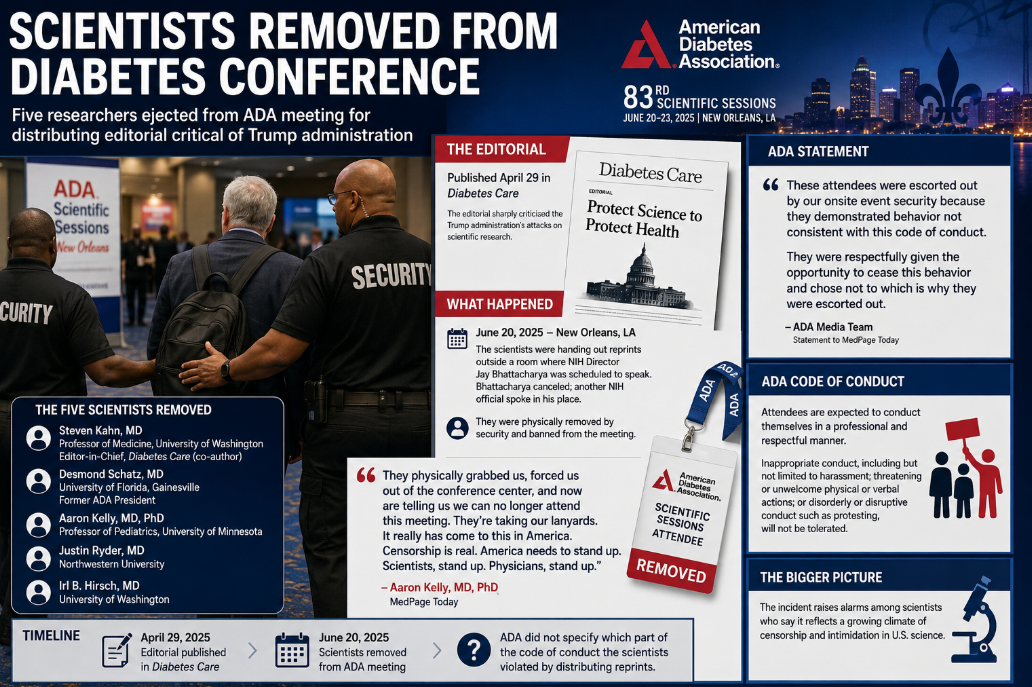
Five leading scientists were physically removed from the American Diabetes Association's annual meeting in New Orleans on Friday. Their offense, according to conference organizers, was handing out copies of a published editorial.
The editorial in question appeared in the journal Diabetes Care on April 29. According to a report by Ars Technica, it sharply criticized the Trump administration's ongoing attacks on scientific research. The five scientists were distributing reprints of the piece outside a room where NIH director Jay Bhattacharya had been scheduled to speak. Bhattacharya cancelled, and another NIH official spoke in his place.
Those removed included Steven Kahn, professor of medicine at the University of Washington and editor-in-chief of Diabetes Care, who co-authored the editorial. Also ejected were former ADA president Desmond Schatz of the University of Florida, Gainesville; Aaron Kelly, a pediatrics professor at the University of Minnesota; Justin Ryder of Northwestern University; and Irl Hirsch, also of the University of Washington.
Kelly described the removal in direct terms. "They physically grabbed us, forced us out of the conference center, and now are telling us we can no longer attend this meeting," Kelly told MedPage Today, which first reported the incident. "They're taking our lanyards. It really has come to this in America. Censorship is real. America needs to stand up. Scientists, stand up. Physicians, stand up."
The ADA confirmed to MedPage Today that five registered scientists had been removed. The organization said the scientists violated its code of conduct for conferences. "These attendees were escorted out by our onsite event security because they demonstrated behavior not consistent with this code of conduct," the ADA media team said in a statement. "They were respectfully given the opportunity to cease this behavior and chose not to which is why they were escorted out."
The ADA's code of conduct requires that attendees conduct themselves in a professional and respectful manner. The code specifically states that "inappropriate conduct, including but not limited to harassment; threatening or unwelcome physical or verbal actions; or disorderly or disruptive conduct such as protesting, will not be tolerated."
The ADA did not specify which part of the code of conduct the scientists had violated by distributing the reprints.