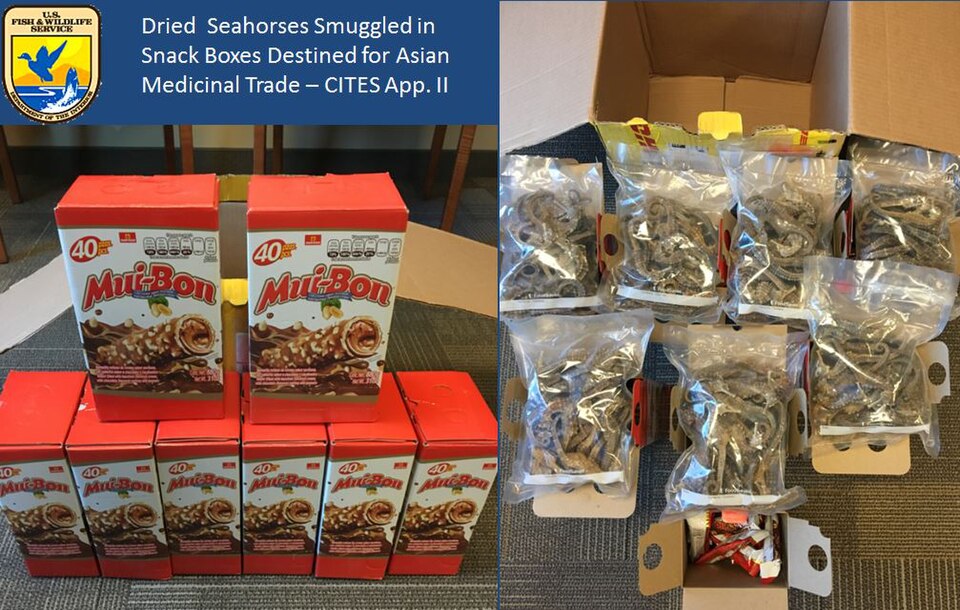
Smugglers moving marine wildlife across borders have long had an advantage: shark fins, dried seahorses, and sea cucumbers are small, easy to conceal, and rarely associated with the kind of wildlife crime that makes headlines. A new AI tool is designed to change that.
Scientists have developed an algorithm that can detect commonly trafficked sea creatures inside scanned baggage with 92 percent accuracy, according to a report by Phys.org. The tool works with existing X-ray CT scanners already deployed at airports around the world to catch explosives and biosecurity threats. Those scanners produce 3D images by taking multiple X-rays of a single object, and the research team trained a neural network to recognize smuggled marine species inside those images.
"The trade of wildlife is cruel and unethical," said Dr. Vanessa Pirotta of Macquarie University, lead author of the article in Frontiers in Ocean Sustainability. "For many, this may be the first people have heard of illegal trafficking of marine wildlife. Wildlife trafficking does not just target the species we are most familiar with, like rhino horn or ivory from elephants. We're using this World Oceans Day to bring this issue to the surface."
The illegal trade of marine wildlife is thought to be worth billions of dollars every year. It threatens endangered species through overharvesting, and animals trafficked alive risk escaping into new environments and becoming invasive species. Despite the scale of the problem, detecting trafficking in progress is difficult, which makes it hard to stop the trade or measure its full environmental impact.
The research team focused on three species. Shark fins are in high demand for food. Dried seahorses are widely traded for use in traditional medicine. Sea cucumber smuggling is less frequently documented, but the researchers believe it is more common than current records show, partly because sea cucumbers are known to be illegally overfished at significant rates.
To build and test the algorithm, scientists made 298 total scans from 68 samples: 20 of sea cucumbers, 30 of seahorses, and 18 of shark fins. Many of those samples came directly from wildlife trafficking seizures. Each sample was scanned five times in different positions and contexts, and researchers also scanned samples together in mixed groupings to simulate real smuggling scenarios.
The team went further by testing the algorithm against conditions that mimic actual smuggling tactics. Samples were wrapped in tin foil, hidden inside clothing, and concealed within children's toys. Some scans were also layered into CT images of real bags to make the simulation as realistic as possible. The algorithm held up across those conditions, which is part of what makes the 92 percent accuracy figure significant.
The system is designed to flag suspicious bags for human inspection rather than make final determinations on its own. That means it could slot into existing airport security workflows without requiring new infrastructure, since the CT scanners it relies on are already in place at many international travel hubs.
The study was published in Frontiers in Ocean Sustainability and was timed to coincide with World Oceans Day, which Pirotta and her team used as a platform to raise awareness about marine wildlife trafficking as a conservation issue that often goes unrecognized by the public.