Marine heat waves have grown longer and more frequent over the past century. They have bleached coral reefs, starved sea lions, and wiped out fish farms worth hundreds of millions of dollars. Now researchers at Michigan State University say a controversial cooling strategy could protect a large portion of the world's oceans from the worst of that overheating, though not all of them.
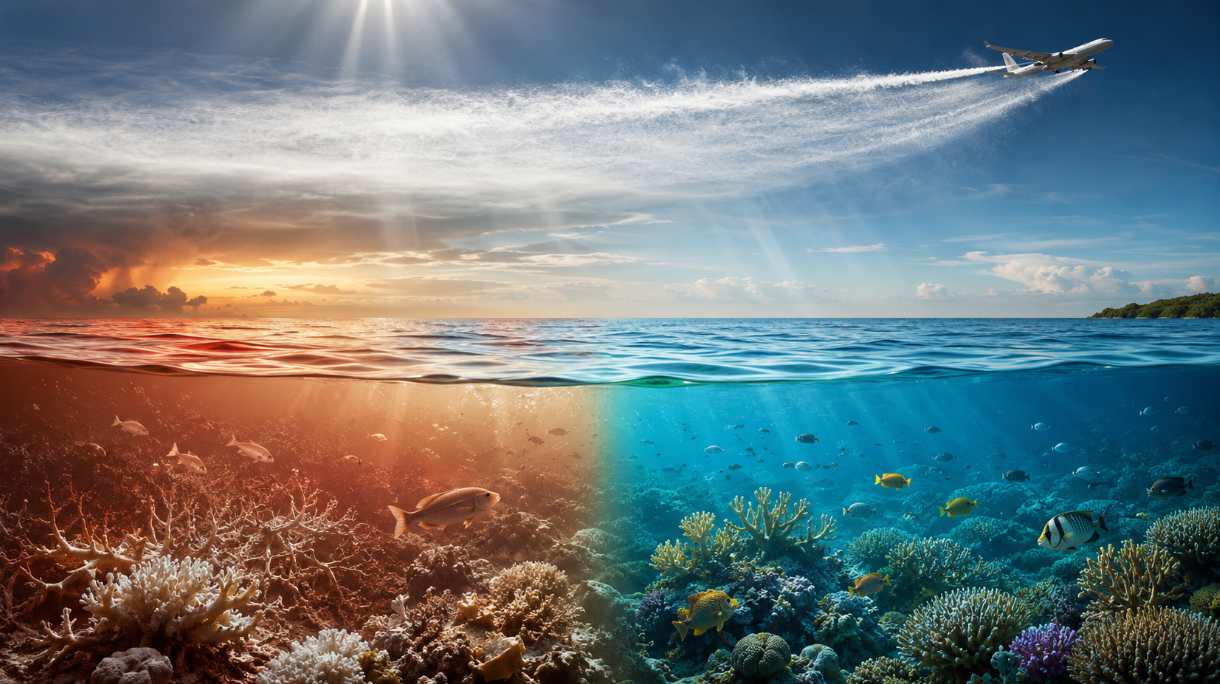
According to Phys.org, the findings appear in the journal Environmental Research: Climate. The study examined a strategy called stratospheric aerosol injection, which would involve using planes to release small particles or gases such as sulfur dioxide high above Earth into the stratosphere, where they could deflect some of the sun's rays.
The idea mimics the natural cooling effects of volcanic ash and gas. When volcanoes erupt, they launch millions of tons of sulfur dioxide and other gases miles into the sky, where they combine with water in the atmosphere to create small droplets that drift around the globe. The proposed intervention would attempt to reproduce that effect deliberately and at scale.
Models suggest the approach could shield between 25 and 75 percent of the world's seas from overheating. That also means between 25 and 75 percent of oceans would still be at risk, a finding that researchers say points to unequal protection for the communities that depend on those waters.
First author Lala Kounta began studying marine heat waves in 2020, after unusually warm waters off the coast of Senegal, where she grew up, triggered a toxic algal bloom that made hundreds of fishermen sick. "The consequences are already visible," said Kounta, a physical oceanographer and postdoctoral scholar working with professor Phoebe Zarnetske in MSU's Ecology, Evolution and Behavior Program.
The scale of damage from marine heat waves is significant. Scientists say a series of them is partly responsible for the die-off of more than half the living coral in Australia's Great Barrier Reef over the past 30 years. Sea lions and seabirds starved off the West Coast of the United States during a massive marine heat wave from 2014 to 2016 as their food species shifted to cooler waters.
In 2016, high ocean temperatures off the coast of southern Chile fueled a toxic algal bloom that wiped out 100,000 metric tons of salmon and trout, making it the largest fish farm mortality ever recorded. One study of 34 marine heat waves worldwide found that the economic toll from a single event can run into the billions of dollars.
The stratospheric aerosol injection strategy remains deeply controversial. Slow progress on cutting emissions has pushed some scientists and policymakers to explore whether technological interventions could help, but critics warn that deliberately altering the planet's atmosphere carries unknown risks, including unequal effects across different regions of the world.