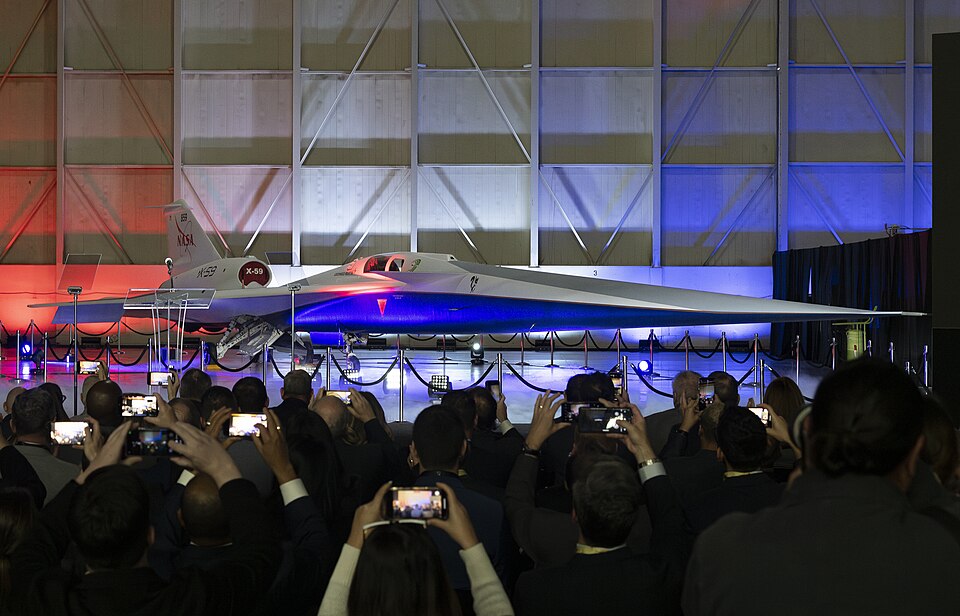
NASA's experimental X-59 aircraft flew at Mach 1.4, or about 924 mph, and reached an altitude of 55,000 feet during a test flight on Friday. The milestone came less than two weeks after the plane completed its first supersonic flight on June 5, when it reached Mach 1.1.
According to Engadget, NASA called the latest test "an even more critical step" than the one that preceded it. The X-59 hit the exact speed and altitude targets it will need to replicate during its upcoming Quesst mission, when it will fly over populated areas across the United States.
The X-59 is built around a specific goal: breaking the sound barrier without producing a traditional sonic boom. Instead of the loud crack that has long made supersonic flight over land impractical, the plane is designed to produce what NASA describes as a "quiet sonic thump." That distinction is at the center of the entire Quesst mission.
During the Quesst flights, NASA plans to collect feedback directly from people on the ground. Residents in communities where the X-59 flies overhead will be asked what the thump sounded like to them. That public data will then be provided to aviation regulators, who could use it to reconsider rules that currently ban supersonic flight over land in the United States.
The Quesst mission is still months away. Before those community overflights can begin, the X-59 must pass through an acoustic validation phase. During that phase, engineers will measure the plane's supersonic acoustic signature to confirm it is crossing the sound barrier without generating a conventional sonic boom. The results of that testing will determine whether the aircraft performs in real conditions the way its designers intended.
For now, the X-59 is flying alongside a second research aircraft during its test flights. That companion plane does produce a sonic boom, and NASA is using it to mask whatever noise the X-59 makes while the team continues its evaluations. Once acoustic validation is complete, the X-59 will fly on its own over communities.
The X-59 program represents one of NASA's most ambitious efforts in recent years to reshape commercial aviation. If the data from the Quesst mission convinces regulators to lift or loosen restrictions on supersonic overland flight, it could open the door to faster passenger air travel across the continental United States.
The next major phase for the program is the acoustic validation work, which must be completed before any community flights are scheduled.