Most people would expect a material to get weaker as it gets thinner. Less material means less strength. That assumption turns out to be wrong for a specific class of substances, and now researchers have an explanation for why.
Over the past decade, experiments and computer simulations have repeatedly shown that certain materials become dramatically more resistant to mechanical loading as they are reduced to thicknesses of only a few nanometers, or even a few atomic layers. The effect had been observed across materials as different as graphene, graphene oxide, and ultrathin polymer films. What no one had explained was why materials with completely different chemistry and structure would all behave the same way.
That question drove a new study, according to a report by Phys.org. The research, published in the journal PNAS, approached the problem not by examining the chemical details of individual materials, but by looking for a universal mechanical principle that all of them might share.
The answer came from a concept called nonaffine elasticity. In real materials, atoms and molecules do not follow an externally imposed deformation in a perfectly orderly way. They also undergo additional collective motions that help the material relax internal forces and stress. Those motions normally make a material softer. The researcher described it with an analogy: a crowd of people in a busy train station can relieve pressure by moving around in many different ways at various scales. But if movement becomes restricted, the crowd becomes stiffer and less able to adapt.
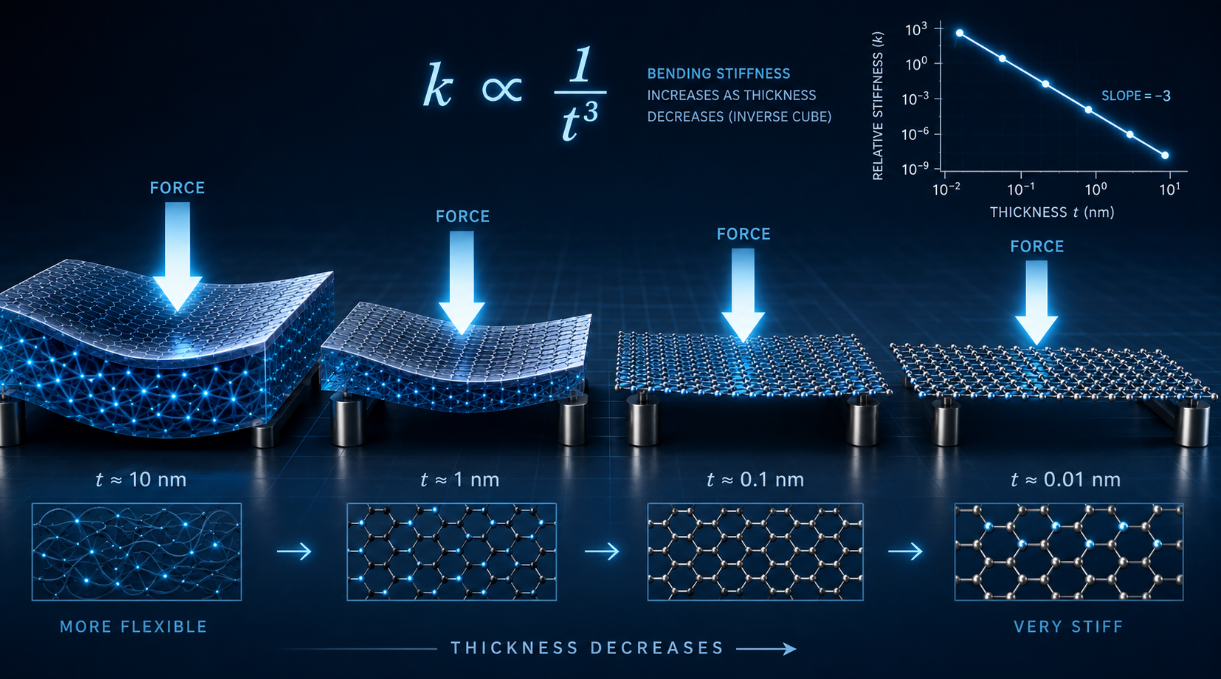
The same logic applies to ultrathin materials. When a material is confined to an extremely small thickness, many long-wavelength collective deformation modes can no longer exist. The material loses pathways that would normally allow it to deform. As a result, it becomes mechanically stiffer.
What the study found was that this effect follows a precise mathematical relationship. The confinement-induced increase in stiffness scales with the inverse cube of the thickness. In practical terms, cutting a material's thickness in half increases the confinement contribution to stiffness by roughly a factor of eight.
The same scaling law matched data from graphene, graphene oxide, and polymer thin films, despite their enormous differences in composition and structure. That consistency suggests the phenomenon has nothing to do with chemistry. It is a geometric and mechanical effect driven by confinement itself.
The finding matters for the development of next-generation materials used in electronics, coatings, and nanotechnology. Engineers working with ultrathin films have known from experiments that thinner can mean stronger, but they have not had a clear physical principle to design around. A universal scaling law gives them a predictive tool.
The research adds to a growing body of work on how the behavior of matter changes at the nanoscale, where ordinary intuitions about physical properties often break down.