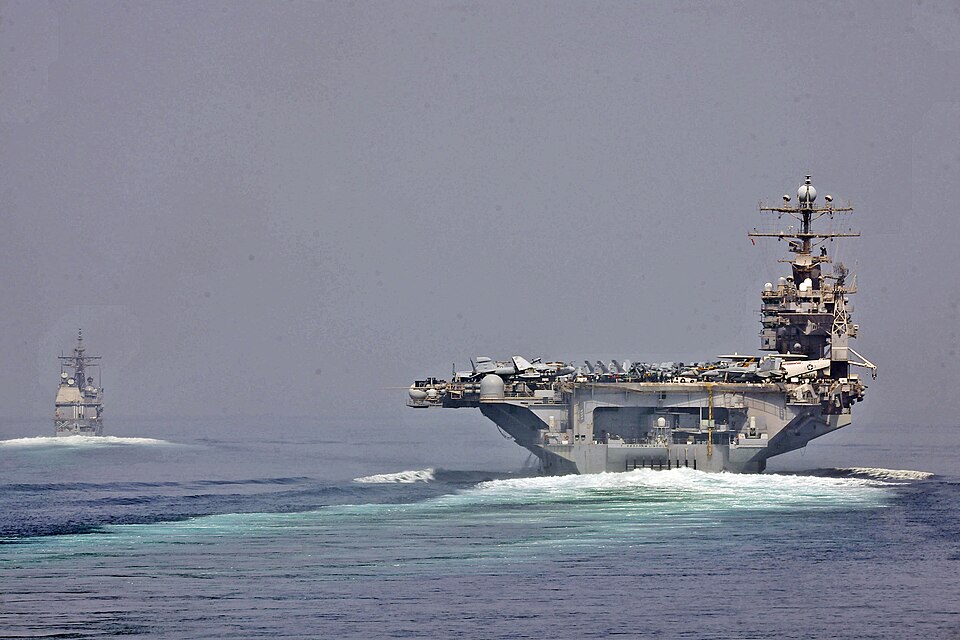
The United States dropped its naval blockade of Iran after the two countries signed a deal to end the war in the Middle East. U.S. Central Command confirmed the end of the blockade on X, stating it came "in accordance with the President's direction," and added that some U.S. vessels would remain "in the general area."
Iran's Supreme Leader Mojtaba Khamenei responded to the agreement shortly after, saying he approved the deal despite having a "different view," without elaborating. He said he allowed it to go ahead after assurances from Iran's President Masoud Pezeshkian that he would "protect the rights of the Iranian nation." Khamenei said President Trump had "out of desperation, used all kinds of leverage" to bring the deal about. He also said that while there would be "in-person negotiations in the future" between Tehran and Washington, this "will not mean acceptance of the enemy's position."
This marks the first time Khamenei has responded publicly to the agreement. He has not been seen in public since taking office in March, following the killing of his father and predecessor, Ayatollah Ali Khamenei, in the February 28 U.S.-Israeli strikes on Iran that started the regional war.
According to BBC News, the U.S.-Iran deal centers around 14 core points, including the reopening of the Strait of Hormuz, a requirement that Iran never acquire a nuclear weapon, and a commitment to a $300 billion fund for the reconstruction and economic development of Iran, though the U.S. is not required to contribute. The deal also binds both sides to reaching a final agreement within a maximum of 60 days, with the possibility of extension by mutual consent.
Trump did not directly respond to Khamenei's statement but posted on Truth Social that he expects a ceasefire to take effect "on all fronts," including between Israel and Iran-backed Hezbollah in Lebanon, and that he expects countries in the Middle East to "maintain their commitment to allowing our negotiations" to take place.
The official signing ceremony had been scheduled to take place in Switzerland on Friday, but mediator Pakistan told the BBC it was cancelled because the deal had already been signed remotely. U.S. and Iranian representatives are still expected to meet in Switzerland for further talks. A White House spokesperson said Thursday evening that Vice President JD Vance would not be departing that night. Vance told reporters earlier that he would likely travel to Switzerland for "technical negotiations" but did not confirm a date, adding that Iran was "not an easy country to get out of" and that they were "trying to figure out exactly when that was going to happen."
Trump's stated positions on Iran have shifted considerably since the war began in late February. Hours after the U.S. launched military operations, Trump pledged to "destroy their missiles," prevent Iran from rebuilding its nuclear program, and set the stage for Iranians to "take over" their government. A week into the conflict, he wrote on Truth Social: "There will be no deal with Iran except UNCONDITIONAL SURRENDER!"
The shift has been visible on specific issues. On ballistic missiles, Trump said in February: "We're going to destroy their missiles and raze their missile industry to the ground. It will be totally, again, obliterated." By June 17, his position had changed. Referring to other countries in the region that possess ballistic missiles, Trump said: "If other countries have them, it's a little bit unfair for [Iran] not to have some. A ballistic missile is not the same thing as what we're talking about, when we talk nuclear. But if Saudi Arabia and Qatar, and they all have some — in relative proportion, I think it's OK."
The memorandum of understanding, according to CBS News, makes no reference to ballistic missiles. It also leaves most specifics on the fate of Iran's nuclear program to be determined in further negotiations over the next 60 days.
Trump also expressed a changed view of Iran's current leadership. Speaking at the G7 summit in France on Tuesday, Trump said: "We're dealing with people that I think are very rational people, and they were nice to deal with. They were strong people, smart people. … They're not radicalized and they're looking to help their country."
The White House said Thursday it was "looking forward to beginning technical talks as soon as possible."