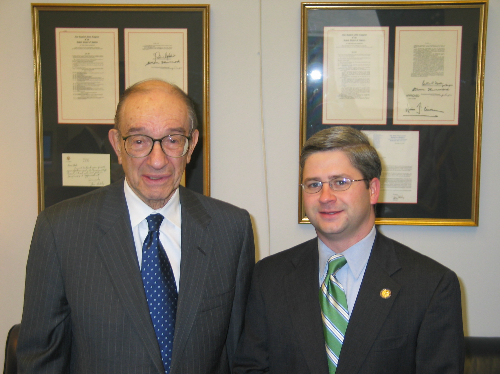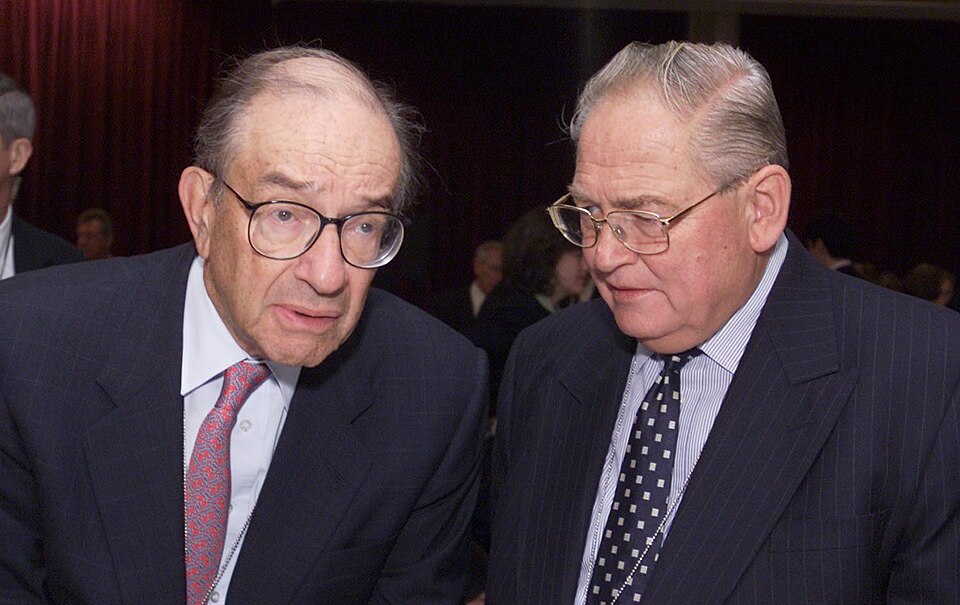
Alan Greenspan, the longtime chairman of the Federal Reserve, died Monday at his home from complications of Parkinson's disease. He was 100 years old.
"Alan passed away at our home this morning at the age of 100 from complications of Parkinson's Disease," said Andrea Mitchell, his wife and a chief correspondent at NBC News, in a statement published by the network. Greenspan is remembered for leading the American central bank through periods of historic U.S. economic expansion, though critics have also said his policies contributed to the mortgage crisis and financial crash of 2008.
According to ABC News, Greenspan became the 13th chairman of the Board of Governors of the Federal Reserve System two months before the stock market crash on October 19, 1987, known as Black Monday. He moved quickly to alleviate investor fears after the crash and was instrumental in ensuring the Federal Reserve made plenty of money available to cushion the blow to financial markets. Stocks quickly rebounded.
He was appointed Fed chair by four different presidents. Ronald Reagan appointed him first in 1987. He continued to serve under George H.W. Bush, Bill Clinton, and George W. Bush. During those years he steered the economy through the boom of the 1990s, the collapse of the dotcom bubble, and the September 11, 2001, terrorist attacks. His final term ended January 31, 2006.
Under his leadership, the Fed promoted very low interest rates in the early 2000s and fostered a general resistance to regulation. Critics say those two factors helped inflate a housing bubble that eventually burst and sent shockwaves through the global economy. Before that crisis arrived, however, the nation experienced one of the longest periods of economic growth in its history.
Greenspan was born March 6, 1926, in New York City, the only child of Herbert Greenspan, a stockbroker, and Rose Goldsmith Greenspan, a retail worker. His parents divorced when he was four, and he was raised mainly by his mother and grandparents.
He first pursued music, attending Juilliard for a year and playing saxophone and clarinet before dropping out and enrolling at New York University. He eventually earned his bachelor's, master's, and doctoral degrees in economics from NYU. He also did graduate work at Columbia University, where he studied under economist Arthur Burns. Though his music career was brief, Greenspan later viewed the move into economics as a natural progression, seeing the organization of economic data into fiscal modeling as similar to arranging musical notes into tunes, according to his biographer.