When two galaxies collide, the result is not always a burst of new stars and cosmic renewal. Sometimes the collision generates winds so powerful that they strip away the very gas needed to form stars, effectively killing both galaxies in the process.
New observations from the James Webb Space Telescope, reported by Live Science, are providing the clearest evidence yet of how this process works in the early universe. Researchers studied a merging galaxy system called CRISTAL-02 as it appeared just one billion years after the Big Bang, and what they found was striking.
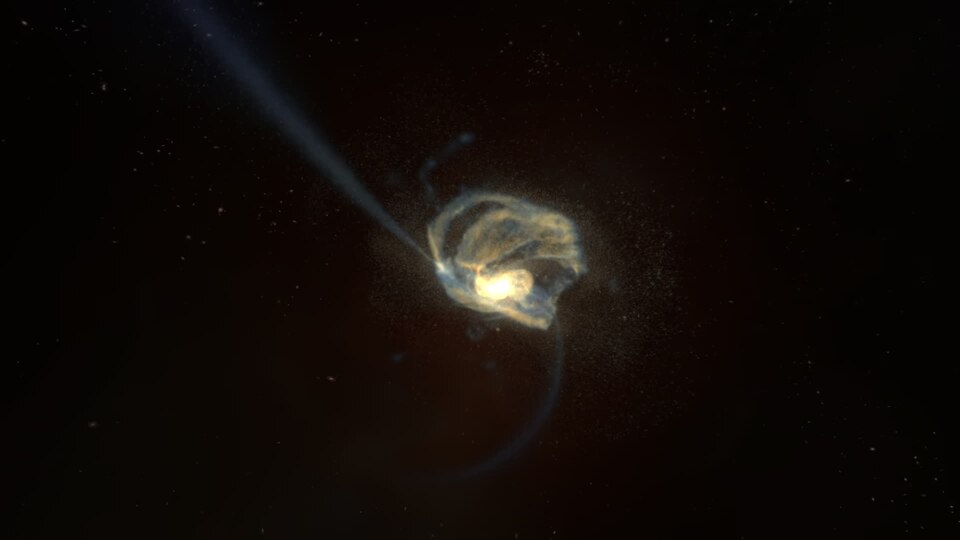
CRISTAL-02 carries a stellar mass roughly 10 billion times greater than the sun. It also has an enormous plume of gas, nearly as long as the galaxy system itself, escaping into space at hundreds of miles per second. That outflow contains approximately 1.5 billion solar masses of material.
"The galaxy has a powerful wind that is ejecting material twice as fast as the galaxy forms stars," said first author Rebecca Davies, an astrophysicist at the Swinburne University of Technology in Australia.
The study was published June 10 in the journal Monthly Notices of the Royal Astronomical Society. The research team used both the James Webb Space Telescope and the Atacama Large Millimeter/submillimeter Array radio telescope in Chile's Atacama Desert to make the observations.
The winds appear to be driven by two related processes that happen when galaxies collide. First, the collision compresses large clouds of gas, triggering a rapid burst of star formation. Some of those newborn stars are extremely massive and die within just a few million years in violent supernova explosions. The intense radiation released by young stars and dying older ones then energizes and disperses pockets of cool molecular gas before that gas can gravitationally collapse to form new stars. The result is a self-limiting cycle in which the collision that ignites star formation also eventually shuts it down.
This mechanism may help explain one of the more puzzling patterns that JWST has revealed about the early universe. Multiple observations have shown that galaxies grew surprisingly massive within the first billion years after the Big Bang. Equally unexpected, many of those same galaxies appear to have stopped forming stars and gone quiet only about a billion years later. Galactic winds had been proposed as one explanation, but astronomers lacked direct observational evidence that winds could suppress star formation at such an early stage of cosmic history. The CRISTAL-02 observations provide that evidence.
The findings also carry implications closer to home. Researchers note that this process may eventually apply to the Milky Way. The Milky Way is on a long-term collision course with the Andromeda galaxy, and the dynamics observed in CRISTAL-02 could preview what that merger ultimately produces. That event is not expected for several billion years, but the physics at work in CRISTAL-02 suggest that such collisions do not always end in growth.