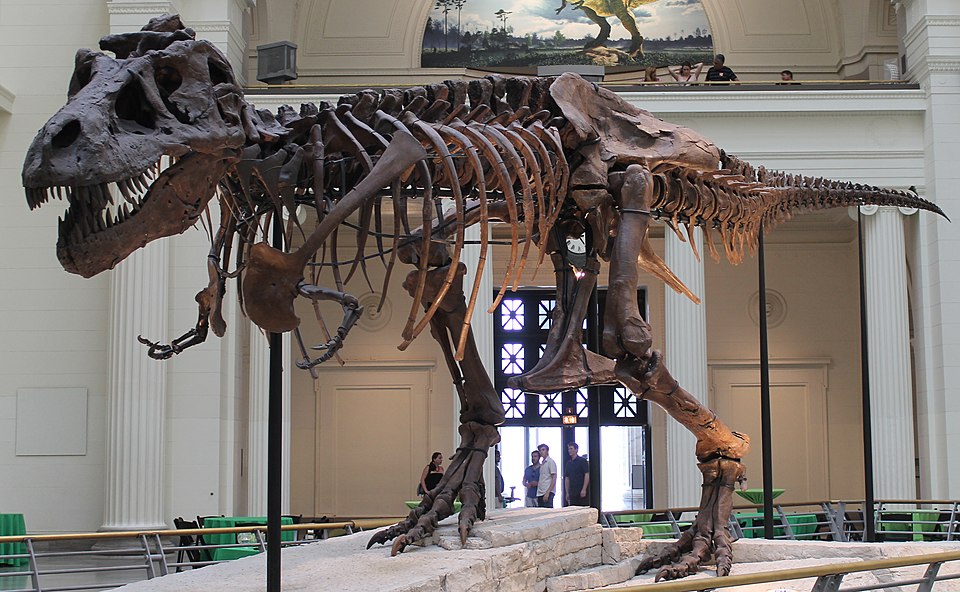
![A Tyrannosaurus rex rise up after lying on the ground, bracing the forepart of its body on its elbows while raising its hind part and tail into the air. The illustration is based on a fossilized tracks described in 2021.[1] (notice the postorbital horns, based on research by Paul).[2]
The idea that](https://freenewspress.com/media/2026/06/22/tyrannosaurus-rex-fossil-a781c5.png)
For decades, scientists believed Tyrannosaurus rex reached its full adult size around age 25. A major new study says that estimate was off by 15 years.
According to a report by Science Daily, T. rex likely kept growing for about 40 years before reaching its maximum size of roughly eight tons. The findings come from an analysis of 17 tyrannosaur fossils, ranging from young juveniles to massive adults, and represent what researchers are calling the most detailed reconstruction of T. rex growth ever assembled.
The study was published in the journal PeerJ.
To determine a dinosaur's age, paleontologists examine growth rings preserved inside fossilized bone, similar to the annual rings found inside a tree trunk. Each ring can reveal how quickly an animal was growing and how old it was when it died. But the new study went further than earlier research, using specialized lighting to detect rings that are difficult to see with standard methods.
"This is the largest data set ever assembled for Tyrannosaurus rex," said Holly Woodward, a professor of anatomy at Oklahoma State University who led the research. "Examining the growth rings preserved in the fossilized bones allowed us to reconstruct the animals' year-by-year growth histories."
One challenge the team had to overcome is that dinosaur bones do not preserve a complete growth record the way a tree stump does. A cross section of a T. rex leg bone typically captures only the final 10 to 20 years of the animal's life. To work around this, the researchers combined growth records from multiple specimens across different life stages. Statistical models then allowed them to piece together a full picture of growth across the animal's entire lifespan.
The results extended the known growth period significantly. Where earlier studies placed the end of active growth at around 25 years of age, the new analysis suggests the animal was still putting on mass well into its fourth decade of life.
The study also raises questions about how some famous fossils have been classified. The findings suggest that certain specimens traditionally assigned to T. rex may actually belong to other closely related species, or may differ for other biological reasons. The researchers did not name specific specimens in the summary, but the implication is that the tyrannosaur family tree may be more complicated than the fossil record has suggested.
The work builds on a long tradition of using bone histology, the microscopic study of bone tissue, to reconstruct dinosaur life histories. But the scale of this dataset and the precision of the methods used set it apart from previous efforts. By examining thin slices of fossil bone under specialized lighting, the team was able to detect growth rings that had been missed in earlier studies, which may explain why prior age estimates came up short.
The study does not settle every open question about T. rex biology. Researchers still debate how metabolic rate, environment, and food availability may have shaped growth patterns in individual animals. But the new dataset gives scientists a much larger sample to work with as those questions continue to be explored.