

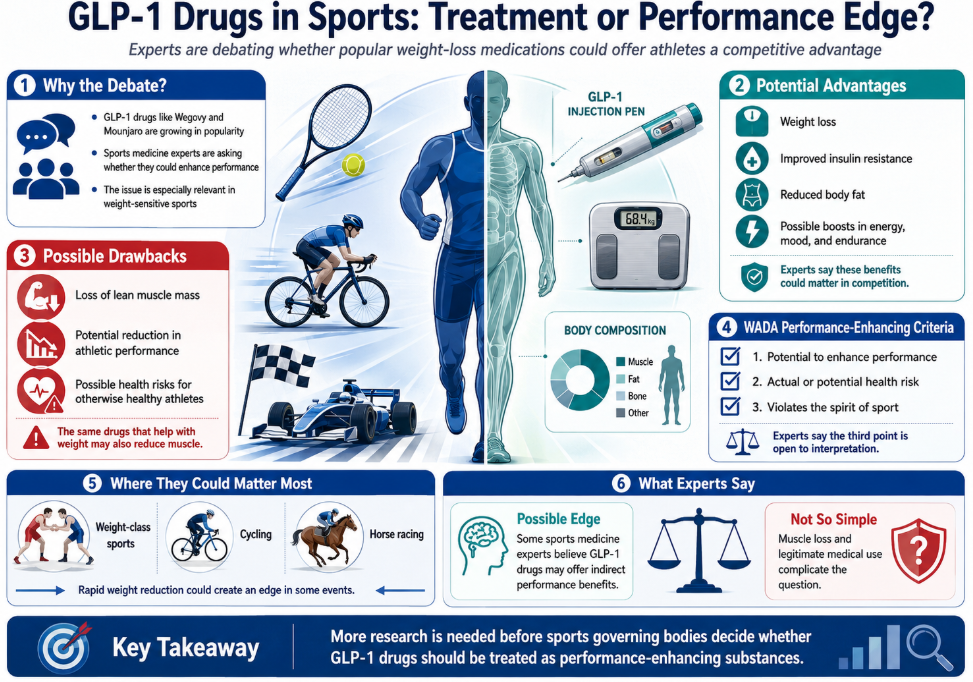
As GLP-1 drugs like Wegovy and Mounjaro grow in popularity among the general public and high-profile athletes, sports medicine experts are beginning to ask whether these medications cross a line from medical treatment into performance enhancement.
Reported by Healthline, the debate has gained visibility in part because of athletes like tennis champion Serena Williams, who has appeared in advertising for telehealth company Ro. Williams told Women's Health that "Being on a GLP-1 definitely doesn't take away from who I am as a professional athlete. In fact, I am enjoying sports now more than ever. And my body feels good doing it," adding that she would "never take a shortcut to living a healthy life."
Sergio Guiteau, MD, a board-certified family and sports medicine physician and Medical Director at South Florida Advanced Rejuvenation in Miramar, Florida, said GLP-1 drugs offer several benefits that could matter in competitive settings. These include improvements in insulin resistance, body fat composition, and weight loss, as well as indirect improvements in energy, mood, and endurance.
"While these improvements may not be as pronounced as other PED's [performance enhancing drugs], I certainly see some advantage for athletes using GLP-1's," Guiteau said.
The World Anti-Doping Agency classifies a substance as a performance-enhancing drug if it meets certain criteria. It must have the potential to enhance and actually does enhance sports performance. It must represent an actual or potential health risk to athletes. And it must violate what WADA calls the spirit of sport.
Guiteau said he believes GLP-1 drugs meet the first requirement. He also said there may be some limited health risk to athletes who are otherwise healthy. On the third point, he noted that "violates the spirit of sport" is a vague term open to interpretation.
"Point 3 will likely be met at a point in time where an athlete utilizes a GLP-1 in a manner that results in a high achievement that was met with the use of the GLP-1 to enhance that athlete's ability to achieve the result," he said.
One example Guiteau raised involves weight-class or weight-sensitive sports. An athlete could potentially use a GLP-1 drug to cut weight and gain a competitive edge in events like cycling or horse racing.
However, experts also note a complicating factor. GLP-1 drugs are associated with loss of lean muscle mass, which can reduce athletic performance. That effect may offset some or all of the competitive advantages the drugs provide. Experts also stressed the importance of accounting for the legitimate medical uses of these medications before any sports organization sets policy.
More data is needed, experts say, before governing bodies like WADA can make decisions that protect both athletes and the integrity of competition.