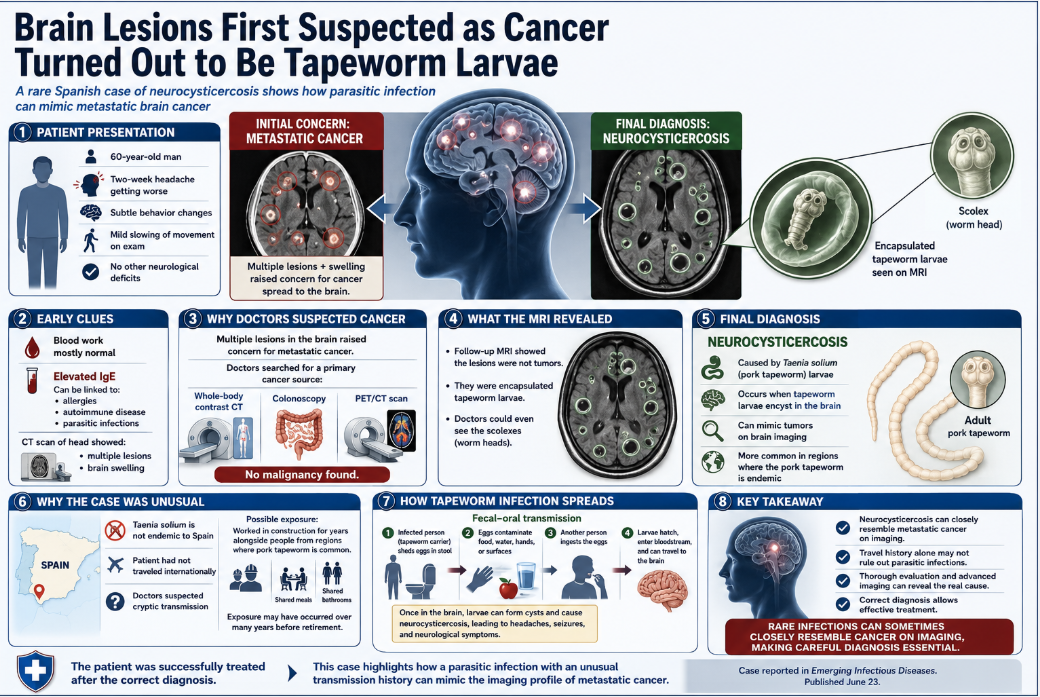
A 60-year-old man in Spain arrived at the doctor with a two-week headache that was steadily getting worse. He had also noticed subtle changes in his own behavior. What followed was a lengthy medical investigation that pointed toward brain cancer before landing on a much rarer diagnosis.
Doctors performed a neurological exam and found a mild delay in his movements but no other deficits. Blood work came back mostly normal, with one exception: elevated IgE, a marker linked to allergies, autoimmune disease, and parasitic infections. A CT scan of his head showed multiple lesions distributed throughout his brain, accompanied by swelling.
As reported by Ars Technica, doctors published the case in Emerging Infectious Diseases. Their leading suspicion at that point was metastatic cancer. The man was not immunocompromised and had never traveled internationally, two facts that complicated the picture. They put him on a corticosteroid for the headache, which brought some relief, and then began an extensive search for cancer. That included a whole-body contrast-enhanced CT scan, a colonoscopy, and a hybrid positron emission tomography/CT scan often used to map cancer spread. None of the tests revealed any malignancies.
A follow-up MRI provided a clearer look at the lesions. With more detailed imaging, doctors could see the lesions were not tumors. They were encapsulated tapeworm larvae. The MRI was detailed enough that doctors could see the worms' heads, called scolexes.
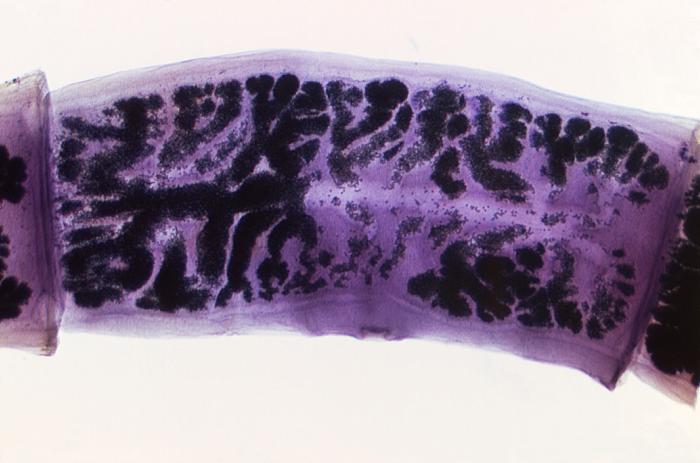
The species involved was Taenia solium, the pork tapeworm, which is not endemic to Spain. The parasitic worms spread through the fecal-oral route. The man's doctors speculated his exposure may have been a rare case of cryptic transmission. Until about ten years before his diagnosis, when he retired, he had worked in construction, regularly working alongside people who had migrated from regions where pork tapeworms are common. One of those coworkers apparently had a tapeworm infection. The doctors suggested the man may have been exposed through shared meals and bathrooms over the course of that work.
The condition, neurocysticercosis, occurs when tapeworm larvae encyst in the brain. It is typically associated with regions where Taenia solium is endemic, which made the Spanish case unusual enough to warrant the published case report.
The man's doctors were ultimately able to treat the infection after arriving at the correct diagnosis, though the case illustrates how a parasitic infection with an unusual transmission history can closely mimic the imaging profile of metastatic cancer.