

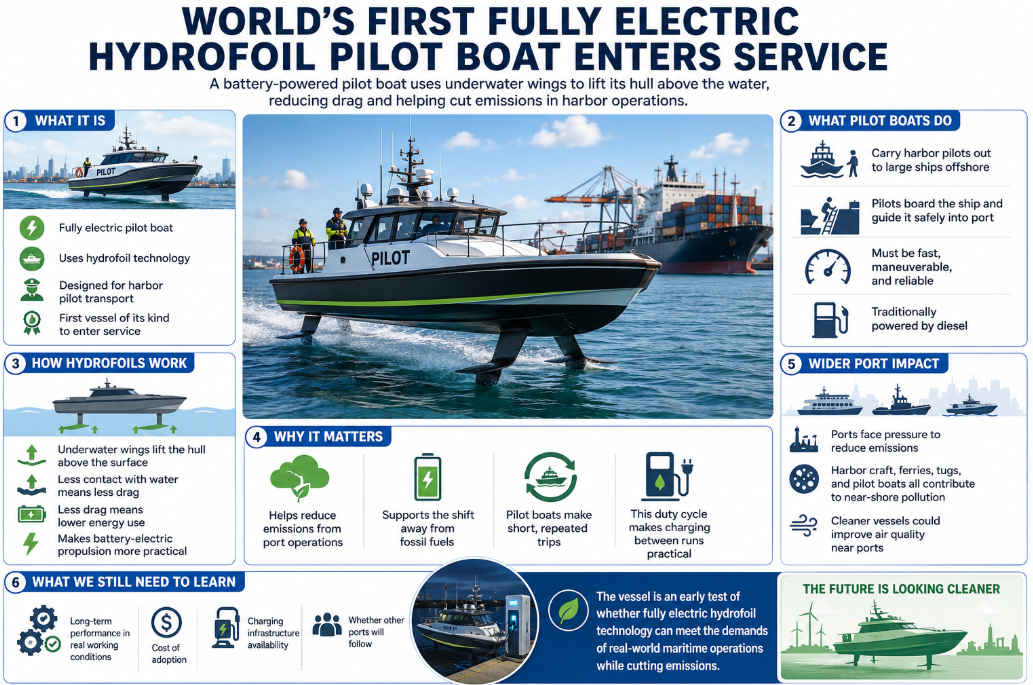
A boat that runs on battery power and lifts itself out of the water on underwater wings has entered service as the world's first fully electric hydrofoil pilot boat, according to a report by New Atlas.
Pilot boats are the small, fast vessels used to carry harbor pilots out to large ships waiting offshore. Those pilots then board the ships and guide them safely into port. The work demands boats that are fast, maneuverable, and reliable in rough conditions. Until now, those boats have run on diesel.
The new vessel changes that. By using hydrofoil technology, the hull rises above the water's surface once the boat reaches speed, reducing drag dramatically. Less drag means less energy needed to maintain speed, which makes an all-electric drivetrain practical in a working marine environment where range and reliability are not optional.
The report from New Atlas did not detail the vessel's battery capacity or maximum speed, but hydrofoil designs have proven in other commercial applications, including passenger ferries, that they can deliver competitive performance compared to conventional hull designs while consuming significantly less power.
The launch marks a milestone in efforts to reduce emissions from port and harbor operations, a sector that has lagged behind road transport in its shift away of fossil fuels. Pilot boats operate in short, repeated runs close to shore, a duty cycle that suits battery-electric propulsion well. Charging between runs is practical in a way that it would not be for vessels making long ocean crossings.
The vessel's entry into service comes as ports around the world face increasing pressure to cut emissions from the equipment and vessels that operate within their boundaries. Harbor craft, tugs, ferries, and pilot boats make frequent trips in and out of port, and their collective emissions add up in areas where air quality near shore is already a concern.
Whether other ports move to adopt similar vessels will depend on cost, available charging infrastructure, and how the boat performs over time in real working conditions. Its entry into service is the first test of whether a fully electric hydrofoil can meet the demands of professional maritime operations.