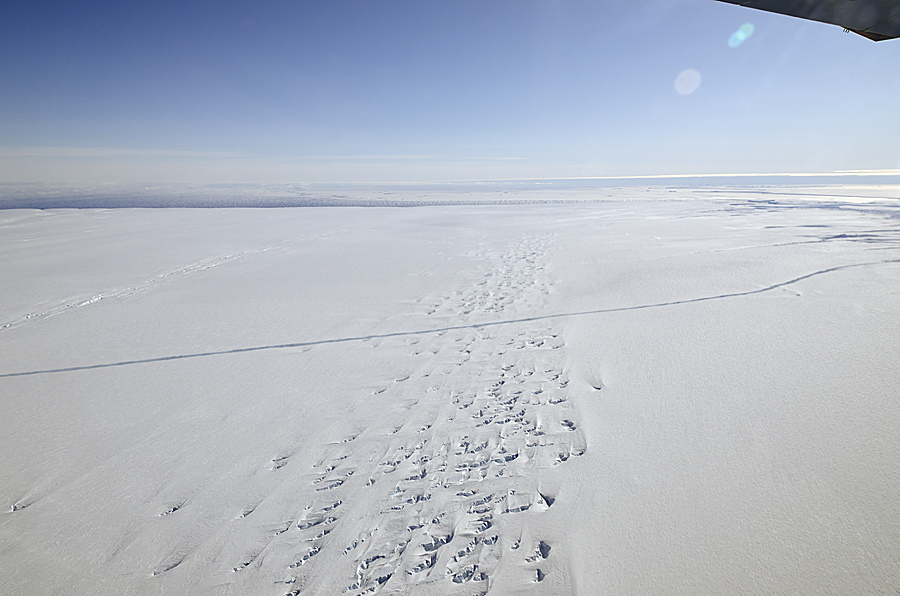
One of Antarctica's most important glaciers retreated several kilometers farther than it would have without human influence, according to new research published in The Cryosphere. The Pine Island Glacier, which drains a large portion of the West Antarctic Ice Sheet into the Amundsen Sea, is one of the biggest contributors to global sea level rise.
The study was led by scientists at King's College London and the British Antarctic Survey. It is the first study to directly attribute changes in a major Antarctic outlet glacier to human activities. The authors warn that human influence will continue to shape Antarctic ice loss for centuries.
Researchers found that greenhouse gas emissions increased the glacier's retreat by around 18 to 20 percent since the 1940s. By 2015, computer simulations that excluded human-driven warming showed around 4 kilometers, or roughly 2.5 miles, less retreat at the grounding line. That difference accounts for just under one-fifth of the glacier's total observed withdrawal.
"Our results show that climate change made the retreat of the Pine Island Glacier substantially worse," said lead author Dr. Alex Bradley of King's College London's Department of Geography. "Without sustained warming of the surrounding ocean since the mid-20th century, the glacier would not have retreated as far as it has."
Geological records show the glacier began retreating rapidly in the 1940s, likely because of stronger intrusions of warm ocean water beneath its ice shelf. Human-driven ocean warming, which researchers believe began in the 1960s, then intensified that retreat further. The research team used a glacier behavior model, constrained by observed changes in ice thickness and retreat, and ran scenarios with and without human-driven global warming to measure the difference.
Attribution studies have previously linked mountain glacier retreat to human-driven warming, but applying the same methods to Antarctic glaciers has been far more technically difficult.
"This kind of work has become common for heat waves and floods, and increasingly for mountain glaciers," Bradley said. "What's new here is showing, quantitatively, how human influence has altered the course of a major Antarctic glacier."
Mira Adhikari, an ice sheet modeler at the British Antarctic Survey, connected the findings to the broader global picture. "Our results add to growing evidence that human-driven climate change is likely affecting even the most remote regions of the planet," Adhikari said. "Changes in Antarctica have global consequences, particularly for sea level rise, highlighting the far-reaching impacts of a warming world."
The research adds to a body of work focused on understanding how much of Antarctica's observed ice loss can be traced directly to human decisions about carbon emissions. Pine Island Glacier has long been watched closely by scientists because its position and size make it a key factor in projections for future sea levels worldwide.