A 45-year-old man had no idea anything was wrong with his heart. An AI tool reading his routine electrocardiogram caught what no one else had. He went on to receive a heart transplant.
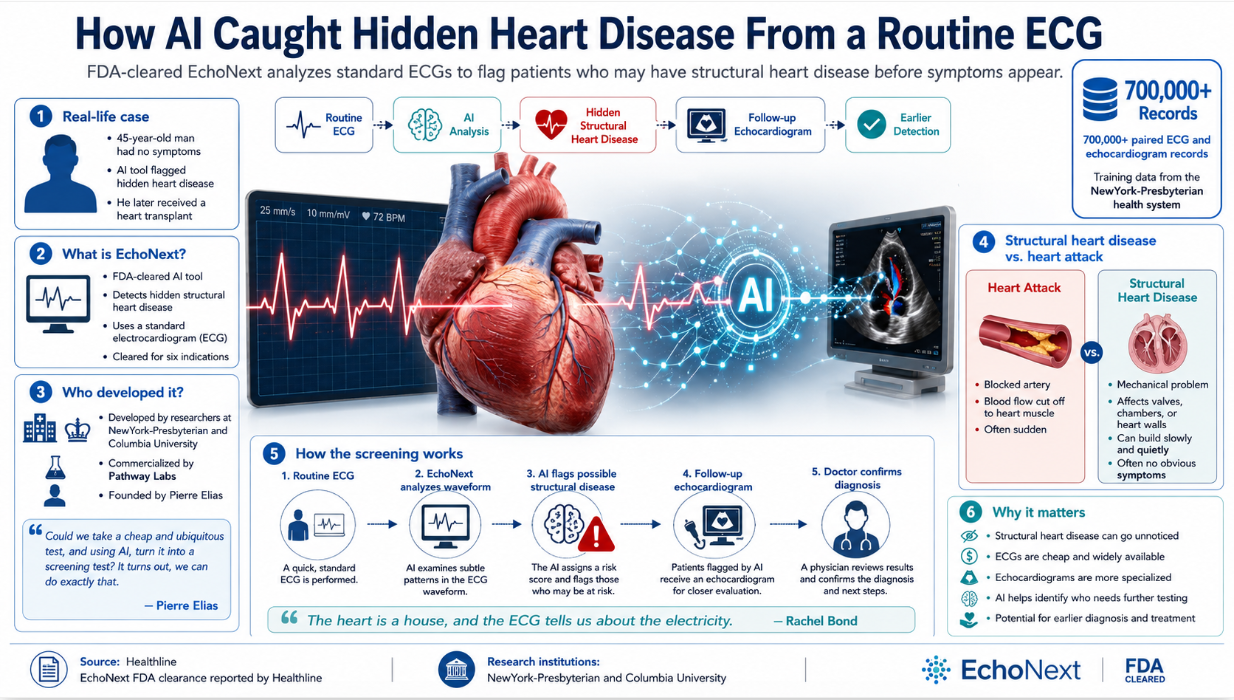
That case helped drive the FDA clearance of EchoNext, a tool built to find hidden structural heart disease in patients who show no symptoms. The clearance, reported by Healthline, marks the first time the agency has approved an AI tool to detect this kind of heart condition from a standard ECG. The clearance covers six separate indications.
EchoNext was developed by researchers at NewYork-Presbyterian and Columbia University. The company behind it, Pathway Labs, was founded by Pierre Elias, an assistant professor of Medicine in the Department of Biomedical Informatics at Columbia University Data Science Institute. Elias has described the problem the tool is trying to solve in direct terms.
"We don't have a screening test for the most common cause of death in the world, which is most forms of cardiovascular disease," Elias said in a video released by NewYork-Presbyterian. "So we asked ourselves, could we take a cheap and ubiquitous test, and using AI, turn it into a screening test? And it turns out, we can do exactly that," he continued.
Structural heart disease is different from a heart attack. A heart attack happens when a blocked artery cuts off blood flow to the heart muscle. Structural disease is mechanical. It involves problems with the heart's valves, chambers, or walls. A valve can stiffen and fail to open fully, forcing the heart to work harder. A valve can leak, allowing blood to flow backward. The heart muscle itself can grow too thick or too weak to pump blood efficiently. These conditions often build slowly and quietly, without obvious warning signs.
The ECG has long been the go-to tool for spotting irregular heart rhythms and signs of a heart attack. It was not designed to find structural problems, which typically require a separate imaging test called an echocardiogram. EchoNext is built to bridge that gap. According to Pathway Labs, the tool analyzes the ECG waveform and flags patients who should then proceed to an echocardiogram for further evaluation.
Rachel Bond, a cardiologist and co-chair of the Women and Children Committee for the Association of Black Cardiologists, described the relationship between the two tests this way: "The heart is a house, and the [ECG] tells us about the electricity. Sometimes, if the electricity demonstrates that there may be issues, we may need additional tests."
The model was trained on more than 700,000 paired ECG and echocardiogram records collected across the NewYork-Presbyterian health system. That scale of training data is central to how the tool learned to recognize patterns in ECG waveforms that point toward underlying structural disease.
Pathway Labs has said it raised $8.5 million to expand the tool into more health systems. Larger clinical trials are also underway. The company has publicly shared five of the six conditions EchoNext is cleared to flag, though all six are described as conditions that tend to develop without noticeable symptoms until they reach an advanced stage.
The clearance arrives at a moment when AI tools in medical imaging and diagnostics are drawing significant attention from both health systems and federal regulators. EchoNext stands out because it works from a test that is already widely available, inexpensive, and routinely performed in primary care offices, emergency rooms, and hospitals around the world. If the tool performs in broader health systems the way it did in early trials, it could change how structural heart disease is first identified, potentially catching conditions years before a patient feels anything is wrong.