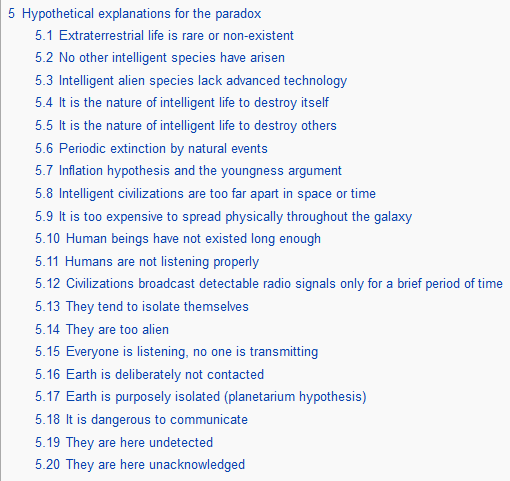
The universe is about 13.8 billion years old. Yet despite the vast number of stars and planets, no confirmed signal from an alien civilization has ever been detected. A new paper proposes that superintelligent artificial intelligence may be the reason why.
According to Live Science, the paper was written by Sergey Ivliev, a Ph.D. in Mathematical Economics and founder of environmental project consultancies including Peatland Ecosystems and Vlinder. It is currently available in pre-print on arXiv.
The question Ivliev addresses has roots going back to the 1950s. Physicist Enrico Fermi famously asked "Where is everybody?" during a lunchtime discussion at Los Alamos. Though never formally published by Fermi himself, his lunch partners passed down an account of that conversation, and it eventually became a central problem in the Search for Extraterrestrial Intelligence. Physicist Michael Hart formally laid out the mathematics behind the question in a 1975 paper.
Ivliev proposes a new answer he calls the Quiet Expansion filter. His central argument is that once a civilization reaches what he terms the threshold of Autonomous AI-Cosmoindustry, or AICI, large and visible expansion driven by prestige or conquest becomes irrational. That threshold is reached when a civilization possesses a self-sustaining off-planet industrial and computational system capable of designing, manufacturing, repairing, and launching space hardware through AI-mediated autonomy.
At that point, a rational AI system would not pursue the kind of loud, resource-hungry empire that humans might expect to see lighting up the night sky. Instead, expansion would shift to a quiet mode driven by goals like survival diversification, knowledge preservation, and scientific observation.
Ivliev draws on work by astrophysicist Sergey Popov, who noted that a truly rational AI would reject human motivations for space travel such as romance, conquest, or prestige. To an AI, spreading across multiple locations is straightforward risk management. Concentrating everything in one place, whether a planet, a solar system, or a galaxy, creates a single point of failure.
Humanity has already taken early steps in the direction AICI describes, with the development of space-based data centers. But true AICI, where a civilization can extend its infrastructure beyond its home planet without continuous biological involvement, remains far beyond current capabilities.
The paper does not claim to prove the existence of alien civilizations. It offers a framework for understanding why an advanced civilization might be functionally invisible even if it is actively expanding across space.