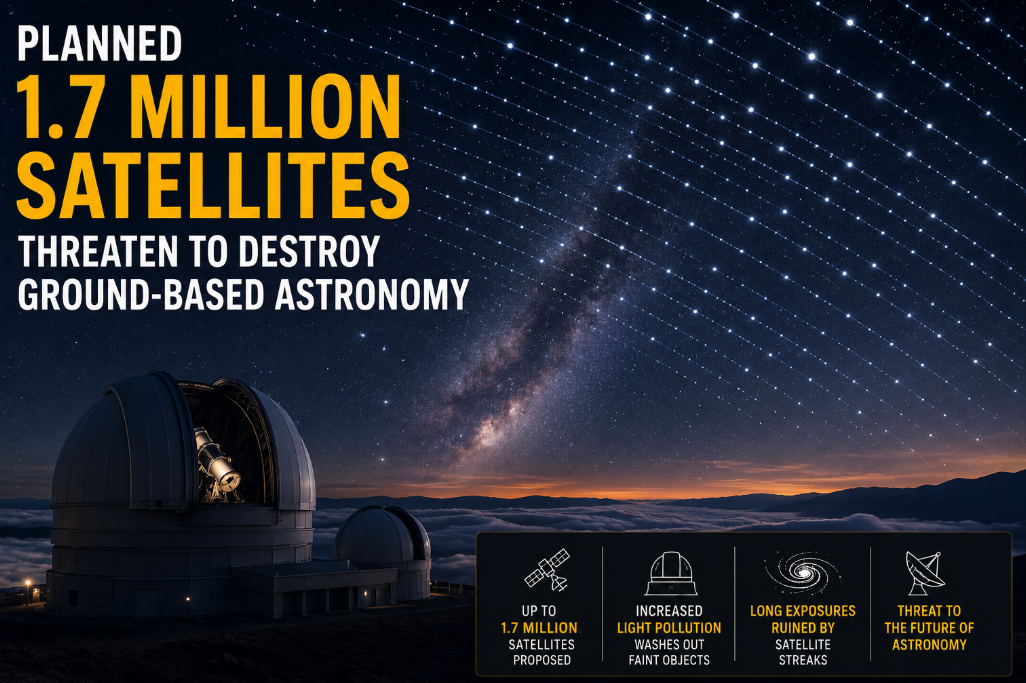
The night sky may soon look nothing like it does today. More than 1.7 million satellites could be orbiting Earth within a few years, and a new study warns the consequences for astronomy would be severe. The European Southern Observatory, which conducted the research, called the planned satellite swarms an existential threat to ground-based telescopes worldwide.
According to a report by Phys.org, the study is the first to calculate how much the constellations of large, bright satellites being planned would affect astronomical observations by making the night sky brighter. Researchers are calling for a hard cap of 100,000 satellites in orbit to preserve humanity's ability to study the universe.
There are currently about 14,000 satellites circling Earth, many of them part of Elon Musk's Starlink internet constellation. But that number could grow dramatically. SpaceX has announced plans to launch more than 1 million satellites by 2028 to serve as data centers powering the artificial intelligence boom. A startup called E-Space has its own "Cinnamon" constellation plans, and Chinese projects CTC-1 and CTC-2 would add hundreds of thousands more.
The most alarming proposal may come from U.S. startup Reflect Orbital, which hopes to launch 50,000 large satellites equipped with giant mirrors designed to reflect sunlight back down to Earth at night. The company says the goal is to provide illumination during nighttime hours. But ESO astronomer Olivier Hainaut, who led the study published in Astronomy and Astrophysics, says the impact on dark skies would be extreme.
"When a satellite crosses what we observe, it makes a bright streak on our image, zapping whatever is behind it," Hainaut said. Even when the Reflect Orbital mirrors are not pointed directly at an observer, the light they scatter would make each satellite as bright as Venus. All 50,000 of those satellites combined would make the entire night sky up to four times brighter, according to the ESO.
"For the past few years, this has been happening — but it is still manageable," Hainaut told AFP. "But if we go from 14,000 to 1.7 million, we are really going to have problems."
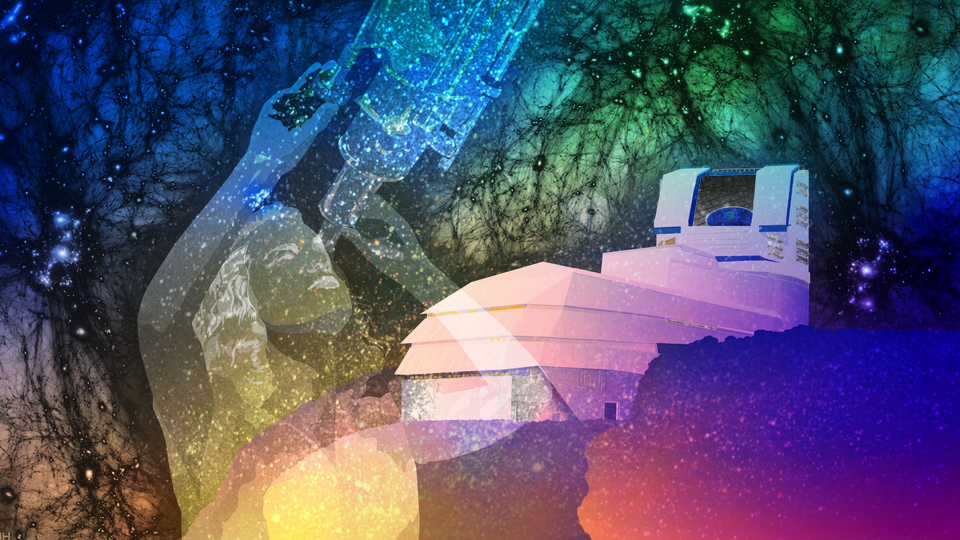
The study found that almost all images captured by the largest camera ever built, part of the new Vera C. Rubin Observatory in Chile, would be rendered unusable if the full complement of planned satellites reaches orbit. The Rubin Observatory, which houses a 3,200-megapixel camera, began its formal 10-year sky survey on June 30, according to Engadget. The observatory plans to capture a new image roughly every 40 seconds and revisit each point in the southern sky roughly 800 times over the next decade, generating about ten terabytes of data per day.
"Today, we begin filming the greatest cosmic movie ever made," said Brian Stone of the National Science Foundation at the survey's launch. The project is designed to help scientists understand dark energy, dark matter, and the expansion of the universe.
The ESO researchers warned that the satellite problem extends well beyond professional observatories. Whether observers were located in France, the Sahara Desert, or Chile, the sky "would no longer be clear, resembling instead the sky seen in the suburbs of a city," Hainaut said. In light-polluted cities, the satellites "would be the only 'stars' visible in the night sky," according to the ESO.
A Reflect Orbital spokesperson told AFP the company was commissioning its own study in response to the findings. No regulatory body has yet acted on the ESO's call for a satellite cap, and no deadline for such action has been set.