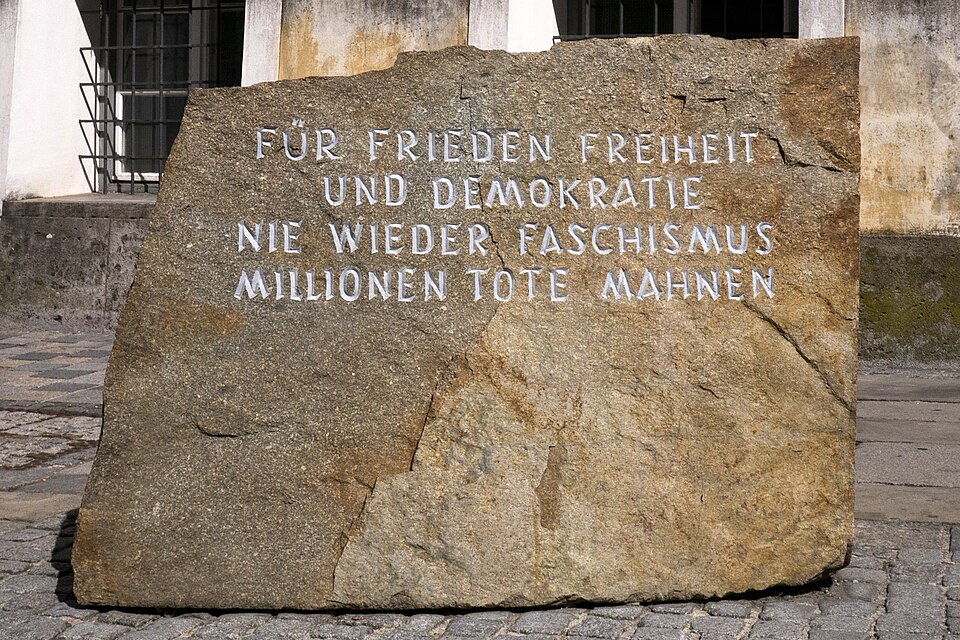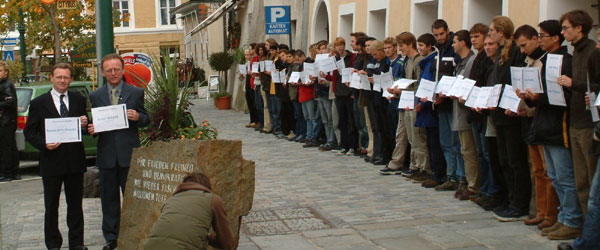
Austria has turned Adolf Hitler's birthplace into a working police station. The building at Salzburger Vorstadt 15 in Braunau am Inn opened its doors Wednesday after years of dispute over what to do with a site that Austrian authorities feared could become a destination for neo-Nazi pilgrims.
Interior Minister Gerhard Karner attended the opening ceremony, which featured police musicians playing tuba and other brass instruments. "This house will now become a place of democracy, rule of law, security, freedom and human dignity," he said. A Catholic police chaplain blessed two crosses to hang inside the new station.
Hitler was born at the address in April 1889 but lived there only a few weeks before his family moved to another address in Braunau. They left the town entirely when he was three years old. He returned briefly in 1938, passing through on his way to Vienna after annexing Austria to Nazi Germany.
The building is a 17th-century former inn. For decades, the interior ministry paid its owner, a local woman named Gerlinde Pommer, a generous rent to keep the property out of the hands of far-right groups. For many years a local charity used it as a day center and workshop for people with special needs, but Pommer blocked renovations in 2011 and forced the charity out. She also refused to sell.
The standoff dragged on for years. In 2016, Austria's parliament passed a law allowing the government to seize the building. Pommer received compensation of €812,000, or about £690,000. She took the government to court arguing the amount was too low but lost her case.
Ideas for what to do with the building ranged widely. The interior minister at the time, Wolfgang Sobotka, proposed tearing it down and building something new in its place. That suggestion echoed an earlier offer by a Russian member of parliament who said he wanted to buy the house and blow it up. Both proposals drew sharp criticism. Many argued that destroying the building would amount to denying Austria's Nazi past.
In 2019, the government settled on converting it into a police station and launched an EU-wide architectural competition. Millions of euros went into the refurbishment. The building, once yellow, is now painted white inside and out and fitted with gleaming oak woodwork. An old winding staircase and arched features remain. According to BBC News, Karner said Austria was taking "responsibility" for the "terrible legacy" of the past and that the police station marked "a new chapter" for the building.