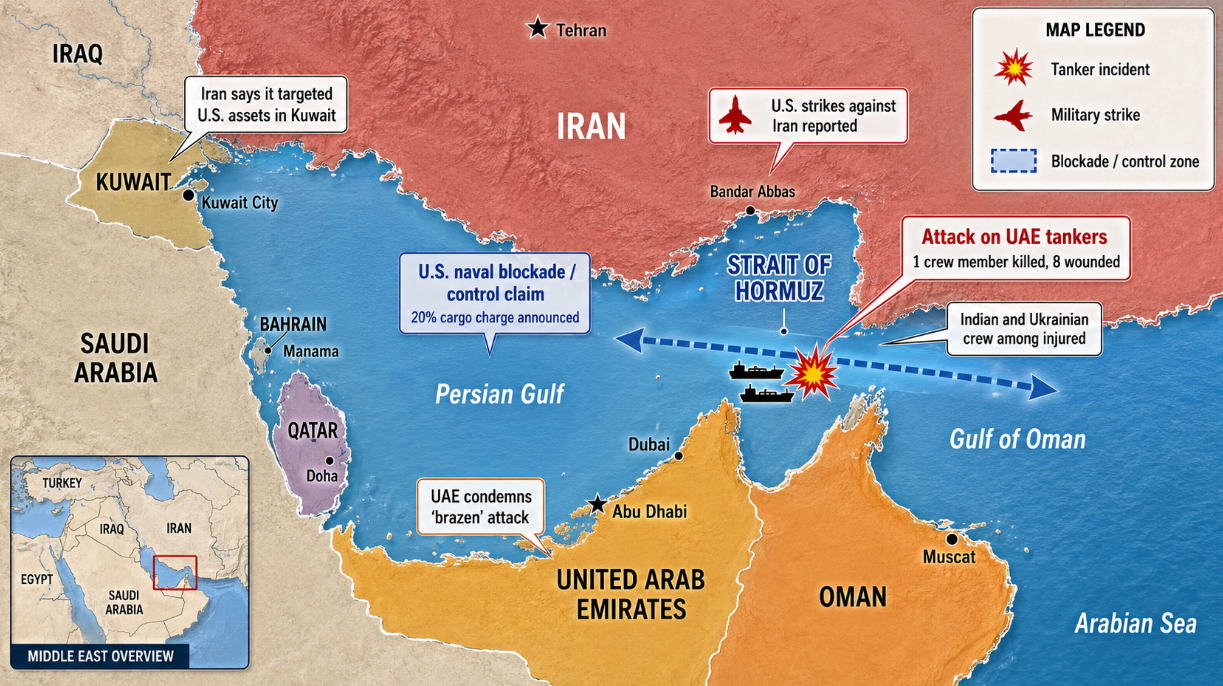
President Trump told Axios the United States is only "semi-negotiating" with Iran, signaling he would allow economic pressure to continue building on Tehran even as Iran laid out sweeping new demands for reopening the Strait of Hormuz.
Iran's demands, issued over the weekend, include the U.S. lifting its naval blockade, withdrawing military forces from the region, paying reparations for war damages, releasing frozen Iranian assets, and halting attacks, according to a report by NPR. The White House had not yet commented on the demands as of Monday.
Iran's deputy speaker of Parliament, Ali Nikzad, made clear on Monday that the strait would not return to what he called pre-war conditions. "The reopening of the Strait of Hormuz has no military solution and [they] must submit to the new regional order," Nikzad said, in remarks reported by state broadcaster IRIB. He added that Iran recognizes no route through the strait other than one agreed upon with Oman. "The route determined by the powerful armed forces of the Islamic Republic of Iran is the only possible route for the passage of ships," he said.
CBS News reported that Iranian-backed Houthi rebels in Yemen attacked the government-held port city of Mocha late Sunday for the second time in 24 hours. Those attacks threaten to extend the conflict into another critical shipping route on the Red Sea.
Israeli Prime Minister Benjamin Netanyahu also rejected the U.S.-Gaza peace plan on Sunday, vowing to remain in Gaza until Hamas, in his words, genuinely disarms. Trump had called the plan historic last month.
Iran's maximalist demands appear to be a calculated move, according to NPR's reporting. Asli Aydintasbas, a fellow at the Brookings Institution, told NPR that Iran aims to show Trump that, although it cannot defeat the U.S. militarily, it has other strategies. The tactic could force Trump into the midterm elections without an Iranian deal, a weakened economy, and a dissatisfied base.
NPR also reported that Iran is closely tracking U.S. political discourse. Many conversations inside Iran revolve around Trump's political vulnerability ahead of the midterms, according to NPR's Hadeel Al-Shalchi.
Separately, Oman said Monday it was working to contain an oil spill off its southern coast after a tanker ran aground in June inside a protected marine area. The Oman Environment Authority said the spill had affected roughly 150 square miles, according to its most recent analysis, concentrated around the Hallaniyat archipelago.