

One of the hardest problems in quantum physics is seeing something before it fully exists. Phases of matter do not always snap into place the moment a material crosses a critical temperature. Microscopic fluctuations can appear first, hinting at what is coming without yet forming a clear pattern.
According to a report by Phys.org, researchers have used ultrafast core-level spectroscopy to detect those early fluctuations in a quantum material called 1T-TiSe2, a layered compound that undergoes a phase transition at around 200 Kelvin, which is roughly negative 73 degrees Celsius.
Below that critical temperature, the material develops what is called a charge-density wave, a state in which both its electronic density and its atomic lattice become periodically modulated. For decades, researchers have debated whether a specific quantum particle called an exciton plays a central role in driving that transition.
An exciton forms when an electron is excited from one energy band to another, leaving behind a positively charged gap called a hole. The electron and hole can bind together through their mutual attraction. In 1T-TiSe2, researchers have proposed something more unusual: that excitons may form spontaneously and collectively condense into a new ground state, producing what is known as an excitonic insulator.
That possibility makes the material a valuable model for studying many-body interactions, which are situations where large numbers of quantum particles behave collectively rather than independently. Insights from that behavior could extend to other phenomena, including Cooper pairing, the process in which two electrons form a bound state inside a superconductor.
The experimental challenge has been significant. In 1T-TiSe2, the electronic and structural changes that occur during the phase transition are tightly intertwined. Isolating signatures of excitonic behavior from the broader structural shift has remained difficult, and detecting precursor fluctuations before long-range order forms has been harder still.
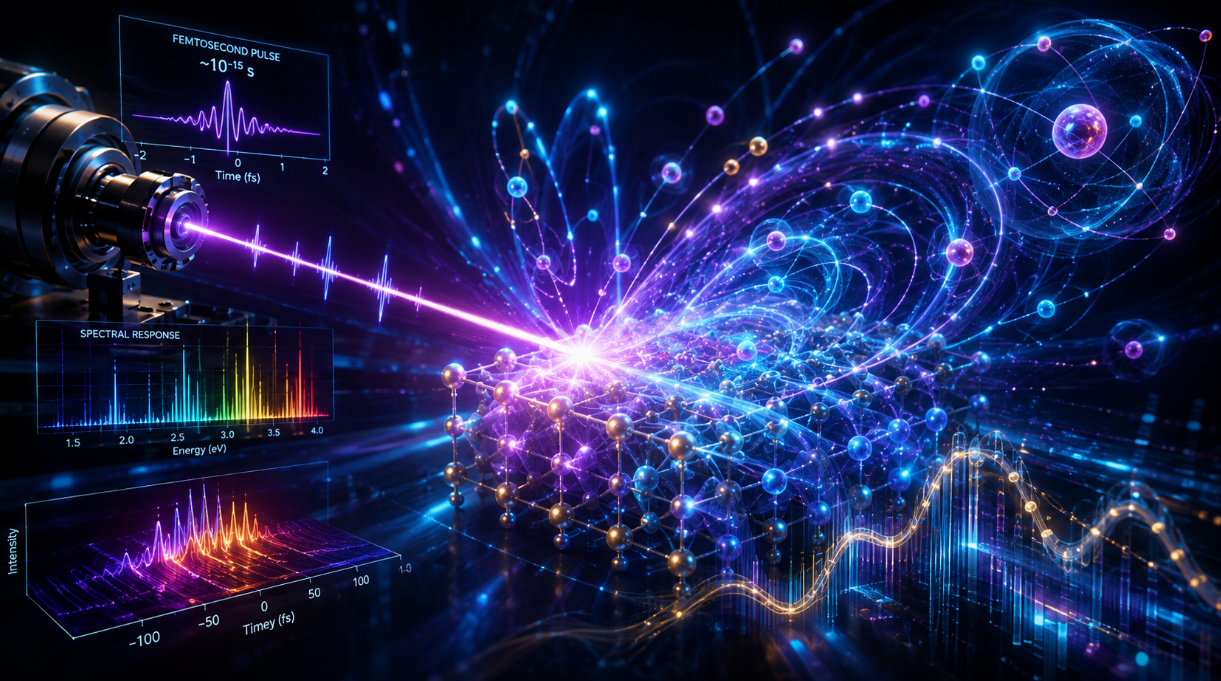
The research team approached that problem using ultrafast measurements, which capture dynamics on timescales far too short for conventional instruments. Most experimental signatures of phase transitions only become readable after long-range order has already formed, such as a new periodic structure visible in a diffraction experiment. Fluctuations that precede that order are transient and lack a well-defined spatial pattern, making them resistant to standard measurement.
The results of the study are set to appear in Nature Physics. The researchers say that understanding precursor fluctuations matters because those fluctuations can reveal which interactions are responsible for pushing a material toward an emergent phase, information that is difficult or impossible to recover once the transition is complete.