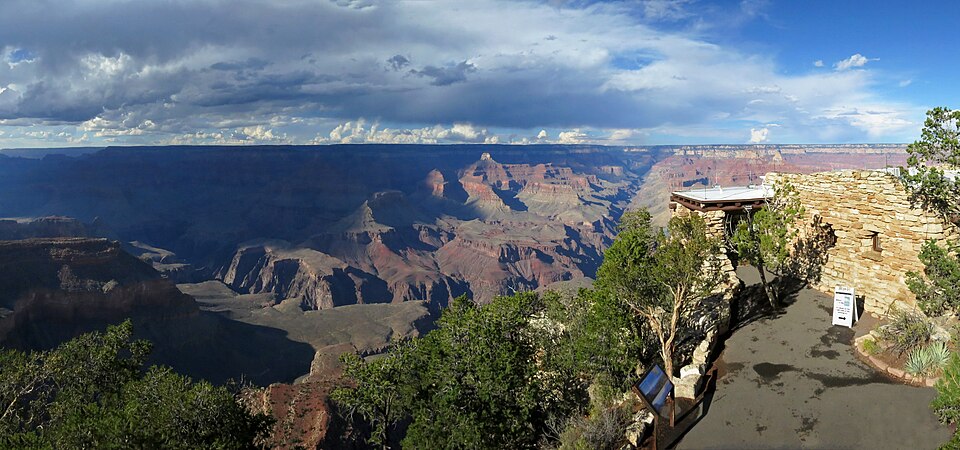
The Grand Canyon holds a geological record spanning 2 billion years. But more than half of that record appears to be missing. Now a new study thinks it knows why.
Scientists say a colossal cliff system, stretching thousands of kilometers across ancient North America, may have exposed the heart of the Grand Canyon nearly a billion years before the Colorado River ever began carving it. According to Phys.org, the study was led by researchers at the University of Southampton in the United Kingdom and published in the journal Geology.
The researchers propose that a vast great escarpment formed when the supercontinent Rodinia broke apart roughly 800 million years ago. The cliffs stood approximately 1 kilometer high, or about 0.6 miles, and extended along much of what is now western North America. As the escarpment slowly retreated inland over tens of millions of years, it stripped away an estimated 5 to 8 kilometers of rock in some places, eventually exposing an ancient crystalline basement that visitors can see today at the bottom of the Grand Canyon in southern Arizona.
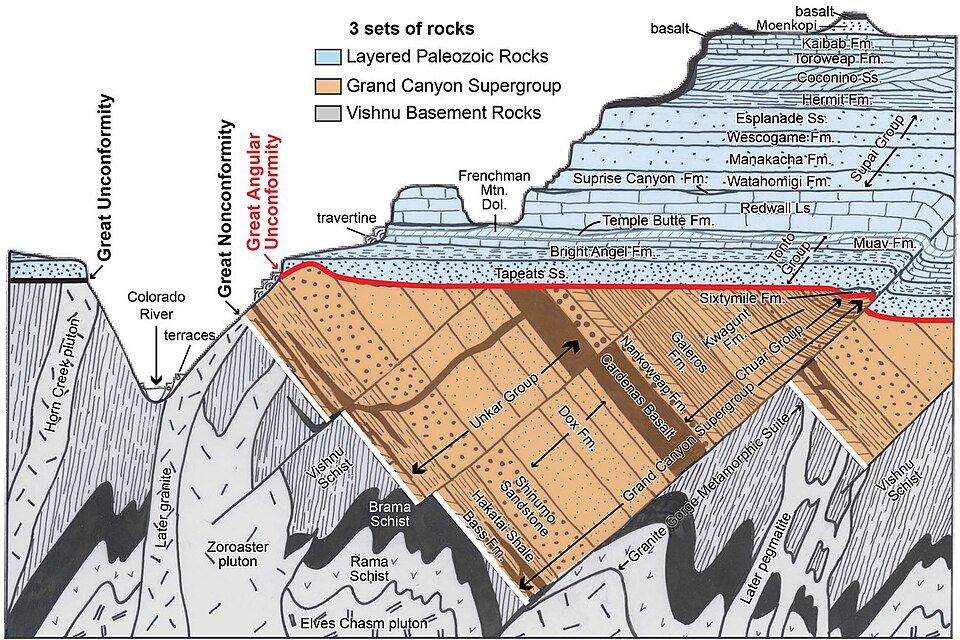
Lead author Thomas Gernon, a professor of Earth science at Southampton, explained the core problem the study addresses. "Our paper suggests the Canyon's basement rocks were progressively brought to the surface as part of an immense escarpment that developed during the breakup of an ancient supercontinent," he said. He added that "the findings also shed light on the formation of the Great Unconformity, a mysterious gap in the rock record that spans over a billion years."
The Great Unconformity is a geological phenomenon visible in canyon walls worldwide, where rock layers that should exist simply do not. In the Grand Canyon, the gap represents more than a billion years of missing time. Understanding why that gap exists, and why it varies so dramatically across the southwestern United States, has puzzled geologists for generations.
The research team combined plate tectonic reconstructions with landscape evolution data to recreate how western North America changed as Rodinia fragmented. Their reconstruction showed the Grand Canyon occupied the same position relative to the ancient continental margin as some of today's well-known great escarpments in South Africa and Brazil, lending credibility to the model.
The ancient escarpment, according to the study's findings, would have stretched across what are now Arizona, Utah, Idaho, Wyoming, Colorado, Texas, Oklahoma, Arkansas, Missouri, and Illinois. That is where intense erosion ultimately exposed some of North America's oldest rocks, the most famous example being the layers visible at the Grand Canyon. The findings are consistent with other evidence suggesting the region experienced extraordinary erosion of between 5 and 10 kilometers of rock long before the modern canyon ever formed.
Gernon explained the broader significance of the work. "This long-lived tectonic landscape provides a missing piece in understanding why erosion associated with the Great Unconformity varies so dramatically across the southwestern U.S.," he said. "Our work suggests that tectonic uplift related to continental rifting and breakup created both steep slopes and high ground, providing the moun" -- the source text cuts off there, but the implications are clear from the rest of the study.
The research team included scientists from GFZ Helmholtz Center for Geosciences and the University of Potsdam in Germany, as well as the University of Illinois Urbana-Champaign in the United States. The study represents one of the more comprehensive attempts to link the formation of the Great Unconformity to a specific tectonic event, rather than treating the missing rock record as simply an unexplained gap.