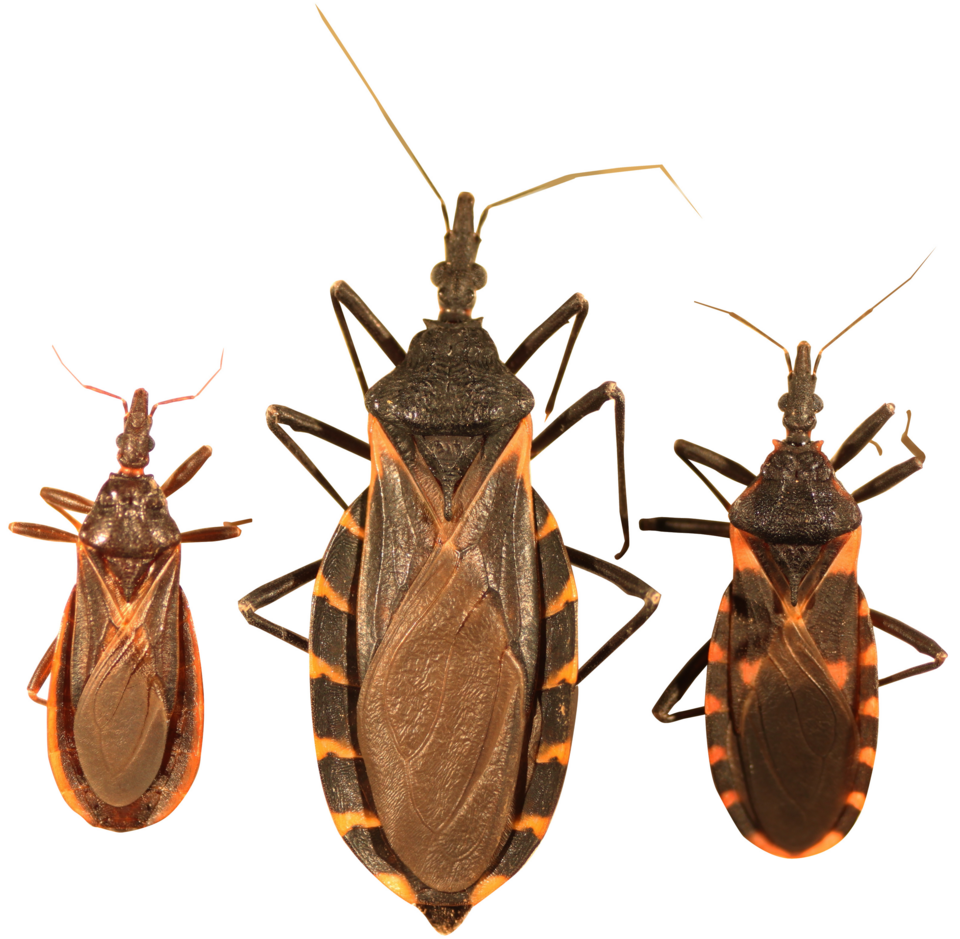
A couple preparing for a European river cruise woke up in a Lisbon hotel last August to find a bloodsucking insect staring back at them from the headboard. When they captured it in a tissue, bright red blood oozed out. One of them noticed a dark brown streak on their arm and finger. They brought the now-dead specimen home to the United States in a jewelry box and contacted an entomologist.
That entomologist was Jennifer K. Peterson, an assistant professor and medical entomologist at the University of Delaware. As Phys.org reported, Peterson and her students identified the insect as Triatoma protracta, a species of kissing bug native to the dry desert climate of the southwestern United States and northwestern Mexico. Their findings were published in the journal Parasites and Vectors.
Peterson did not immediately believe what she was hearing. "When they first contacted me, I was super skeptical," Peterson said. "My first response was, 'Is there a Lisbon, Delaware? Because they can't be referring to Lisbon, Portugal.'"
She brought the case to her Medical Entomology class, telling undergraduate and graduate students, "You'll never believe this." The students helped investigate what the researchers say appears to be the first documented live kissing bug found in Europe.
The insect had crossed roughly 5,000 miles of open ocean to get there. No one knows exactly how. Portugal imports hundreds of millions of dollars in U.S. agricultural products each year, and more than two million American tourists visit the country annually. A cargo shipment or a traveler's suitcase could both explain the journey. Peterson noted the insect's resilience. "This case demonstrates they are hardy enough to survive that journey and then continue on to do what they biologically do, which is basically eating," she said.
The biological stakes are significant. More than half of all kissing bugs carry a parasite called Trypanosoma cruzi, which causes Chagas disease. The disease can lead to serious heart problems. T. cruzi spreads not through the insect's bite but through its feces, which the couple had possibly noticed as a dark streak on their skin.
Six weeks after the incident, both members of the couple were tested for T. cruzi antibodies. The results showed they were not infected.
The case raises broader questions about how insects and the diseases they carry can move across continents through global travel and trade. Kissing bugs have long been a concern in the Americas, particularly in Latin America and the southwestern United States. Finding one alive in a European hotel, far outside its known range, suggests that accidental transport through human activity is more plausible than previously documented. The Lisbon case offers researchers a rare and concrete example of how far a single insect can travel and still remain biologically functional upon arrival.
Peterson's class at the University of Delaware continues to study the case as part of its broader work in medical entomology.