

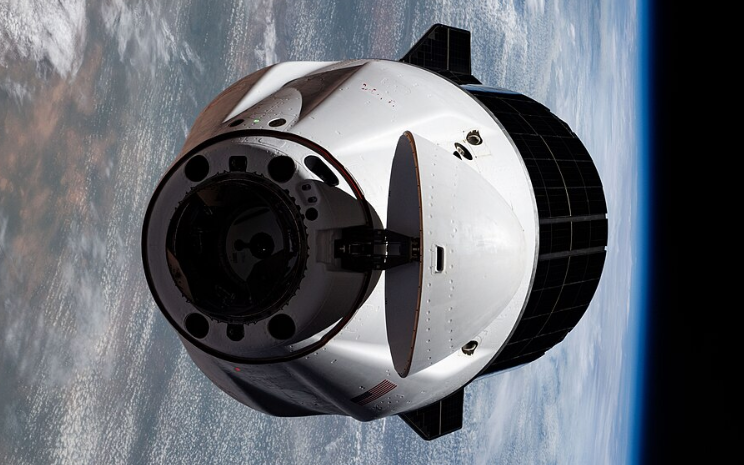
SpaceX is preparing to launch its 35th Commercial Resupply Services mission to the International Space Station on Tuesday, October 13, 2026, carrying scientific experiments, equipment and supplies for NASA. The mission includes investigations into human brain health, antibiotic-resistant bacteria and plant diseases that could improve astronaut safety and support medical research on Earth.
A Falcon 9 rocket is scheduled to lift off at 6:33 a.m. Eastern from Space Launch Complex 40 at Cape Canaveral Space Force Station in Florida. The rocket will carry an uncrewed Dragon spacecraft loaded with more than 6,300 pounds of cargo.
If the launch proceeds as planned, Dragon will arrive at the space station on Thursday, October 15. The spacecraft is scheduled to dock autonomously at approximately 11 a.m. Eastern with the space-facing port of the station's Harmony module.
The cargo mission will support research designed to address challenges astronauts face during extended stays in space. Several experiments could also provide useful information for treating diseases and improving agriculture on Earth.
Scientists Send Human Brain Models Into Space
One of the mission's most significant investigations involves small, laboratory-grown models of human brain tissue.
These three-dimensional structures, commonly called brain organoids, allow researchers to study certain characteristics of human brain cells without conducting experiments on an entire human brain.
Scientists plan to expose the tissue models to conditions aboard the International Space Station for approximately five weeks.
Researchers will then compare the space-flown samples with identical models maintained on Earth. The goal is to identify changes at the cellular level and examine how spaceflight conditions affect brain tissue.
NASA says the investigation could improve understanding of how the brain responds to biological stress during spaceflight.
Long-duration missions expose astronauts to conditions that differ substantially from those experienced on Earth. Microgravity changes how fluids move through the body, while radiation and other environmental factors may affect biological processes.
Understanding those effects will become increasingly important as NASA prepares for missions that take astronauts farther from Earth.
The research could also contribute to investigations into neurological disorders, including Alzheimer's disease, Parkinson's disease and multiple sclerosis.
However, brain organoids do not reproduce the full complexity of the human brain. Any discoveries would require additional research before scientists could determine whether they lead to effective medical treatments.
Crop Research Could Improve Future Space Farming
Another investigation focuses on how plant diseases develop in microgravity.
Scientists will compare plants grown aboard the space station with plants maintained under controlled conditions on Earth. Both groups will be exposed to a disease-causing fungus.
The experiment will examine molecular and structural changes to determine whether the space environment influences how quickly or severely the infection develops.
NASA hopes the findings will help researchers identify traits that make crops more resistant to disease.
Growing food in space could become essential during future missions to the Moon and Mars, where transporting fresh supplies from Earth would be expensive and difficult.
Plants provide several potential advantages for astronauts.
They can supplement packaged food with fresh produce, increase dietary variety and provide psychological benefits during long periods away from Earth.
Plants also absorb carbon dioxide, release oxygen during photosynthesis and participate in water recycling processes.
These characteristics could make plant cultivation an important part of future life-support systems, although space farming would not immediately replace existing equipment.
The experiment could also benefit agriculture on Earth by helping scientists understand plant responses to disease under unusual environmental conditions.
New Device May Speed Up Astronaut Health Tests
The CRS-35 mission will support testing of a compact laboratory instrument designed to analyze biological samples aboard the station.
The device, called a microplate reader, can measure indicators such as antibodies, antigens and proteins.
These substances can provide information about biological activity and possible health problems.
NASA's Commercially Enabled Rapid Space Science initiative will evaluate how effectively the instrument operates in the station environment.
The microplate reader arrived at the station earlier in 2026. This mission carries materials needed for its first planned test.
Currently, some experiments require samples to be returned to Earth before scientists can conduct detailed laboratory analysis.
That process can delay results because returning cargo depends on spacecraft schedules and available transportation.
An instrument capable of producing useful measurements in orbit could shorten that delay.
Faster analysis could eventually help astronauts and medical teams recognize possible infections and other health concerns before they become more serious.
The technology may become especially valuable during missions beyond low Earth orbit, where returning samples to terrestrial laboratories would take considerably longer.
The current investigation is intended to evaluate the instrument's capabilities, rather than demonstrate that it can independently diagnose medical conditions.
NASA Tracks Antibiotic-Resistant Bacteria
The mission also includes the final planned phase of an investigation into antibiotic-resistant bacteria aboard the International Space Station.
Researchers are studying how these organisms survive and change under microgravity conditions.
During the experiment, astronauts repeatedly collect samples from surfaces throughout the station.
Scientists then analyze the samples to monitor organisms that may resist commonly used antibiotics.
Antibiotic resistance is a major public health concern because certain bacterial infections can become difficult to treat when medications lose their effectiveness.
Understanding how these organisms behave inside spacecraft could help NASA develop better procedures for protecting astronauts.
The station provides a distinctive environment for studying microbial behavior because people live in an enclosed setting with limited opportunities to introduce new supplies or equipment.
NASA's investigation is entering its fourth and final planned station phase.
Researchers hope the findings will improve understanding of microbial adaptation and support future infection-prevention strategies.
The results could also contribute to research on antibiotic resistance on Earth, although conditions aboard the space station differ from those found in hospitals and other terrestrial environments.
Artificial Retinas and Heart Tissue Among Additional Experiments
Other cargo aboard Dragon will support research involving artificial retinas and three-dimensional heart tissue models.
The artificial retina investigation will examine manufacturing processes under microgravity conditions.
Researchers hope the unusual environment may help them develop materials or structures that could eventually support treatments for vision loss.
The heart tissue research involves three-dimensional models intended to improve understanding of biological responses and support future drug testing.
Studying these materials in space may reveal differences that are difficult to observe under normal gravitational conditions.
The mission will also transport materials for examining how a new type of glass forms in microgravity.
NASA is using these experiments to explore whether space-based manufacturing can produce materials with useful properties for medical or industrial applications.
These investigations remain experimental. Their presence aboard the station does not establish that they will produce successful commercial products or medical treatments.
Dragon Also Carries New Solar Arrays
Scientific investigations represent only part of the CRS-35 cargo.
The spacecraft will also deliver the final set of International Space Station Roll-Out Solar Arrays, known as iROSAs.
These arrays are designed to provide additional electrical power for station operations and research equipment.
Reliable power generation is essential because astronauts depend on electrical systems for communications, scientific instruments and life-support functions.
The additional solar arrays will help support continued station operations, including preparations associated with the station's eventual controlled deorbit.
NASA and SpaceX have used commercial cargo missions for years to deliver supplies, replacement equipment and scientific investigations to the orbiting laboratory.
The partnership allows NASA to obtain transportation services from a commercial provider while focusing its own resources on research and exploration.
Dragon Scheduled to Return in November
The Dragon spacecraft assigned to CRS-35 has previously completed three cargo missions to the International Space Station: CRS-26, CRS-29 and CRS-33.
After reaching orbit, the spacecraft will approach the station and dock without requiring astronauts to control the maneuver manually.
Dragon is expected to remain attached until mid-November.
Before departing, astronauts will load the spacecraft with completed research samples and equipment intended for analysis on Earth.
Dragon is designed to survive atmospheric reentry and return cargo by parachuting into the ocean.
NASA expects the spacecraft to splash down off the California coast after completing its mission.
That return capability is particularly important for biological experiments involving samples that scientists must examine in terrestrial laboratories.
Other cargo spacecraft, including Russia's Progress and Japan's HTV-X, are designed for destructive atmospheric reentry rather than returning scientific cargo intact.
SpaceX has also identified Wednesday, October 14, at 6:08 a.m. Eastern as a backup launch opportunity if Tuesday's attempt is postponed.
NASA plans to provide live coverage of the launch and spacecraft arrival.
The mission will give scientists another opportunity to examine how living organisms, human tissue models and specialized laboratory instruments behave in space. Its findings could help NASA prepare for longer exploration missions while supporting research into health and agriculture on Earth.