A supermassive black hole at the center of a galaxy cluster erupted in X-rays in early 2023, and roughly 300 days later its radio jets flared as well. The sequence, captured using nearly two decades of telescope data, offers astronomers one of the clearest looks yet at how a black hole's feeding behavior connects to the powerful jets it launches into space.
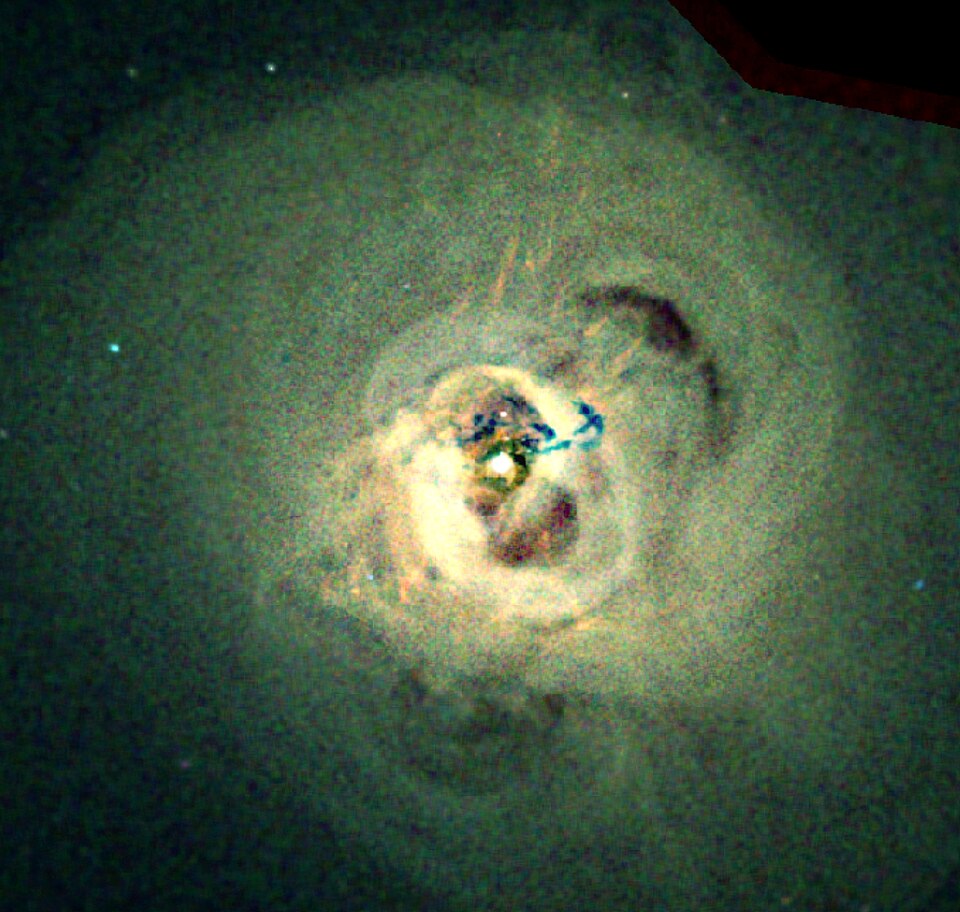
The black hole sits inside NGC 1275, the brightest galaxy at the center of the Perseus Cluster. The galaxy is described as chaotic and complicated, showing signs of an ongoing merger and glowing filaments of gas trailing behind bubbles blown outward by its central black hole. Astronomers consider it a natural laboratory for studying what they call disk-jet coupling, the relationship between what a black hole consumes and the jets that follow.
The research, reported by Phys.org, was submitted to the arXiv preprint server on August 13 and accepted for publication in the Astrophysical Journal Letters.
To track changes over time, Sarah Ketchum of the University of Michigan and her team turned to NASA's Swift X-ray Telescope. The more powerful Chandra X-ray telescope cannot observe this galaxy frequently enough to catch rapid changes. Swift, though less powerful, is far more available, and the team assembled nearly 20 years of monitoring data from it.
What they found starting around February 2023 was the strongest X-ray flare ever recorded from NGC 1275. The galaxy's X-ray brightness jumped by a factor of about two. The flaring episode lasted less than 60 days and appeared to consist of at least two distinct bursts, each lasting only about five days.
The team tested several explanations. One possibility was a tidal disruption event, where a star wanders too close to the black hole and gets torn apart. Those events fade in a specific, predictable pattern. The observed flare faded much more slowly. As the researchers wrote in their paper: "It is unlikely that they are related to a TDE."
The more likely explanation is a fluctuation in the black hole's feeding rate, or possibly a disturbance further along the jet. The team identified three lines of evidence pointing toward an accretion origin. "Three lines of circumstantial evidence may favor an accretion origin for the observed X-ray flares," the team writes. The evidence includes the shape of the X-ray light spectrum and the rapid way the brightness changed.
The 300-day delay between the X-ray flare and the radio jet flare is significant. It gives astronomers a measurable timeline for how a change in what the black hole is consuming eventually shows up as a change in the jets it launches. That kind of timing data is difficult to obtain and helps build a clearer picture of how black holes influence the growth of the galaxies around them.
The black hole's mass remains a subject of debate among scientists, with estimates spanning nearly two orders of magnitude. That uncertainty has made it harder to study, but the long baseline of Swift observations helps compensate by revealing patterns that shorter observation windows would miss entirely.