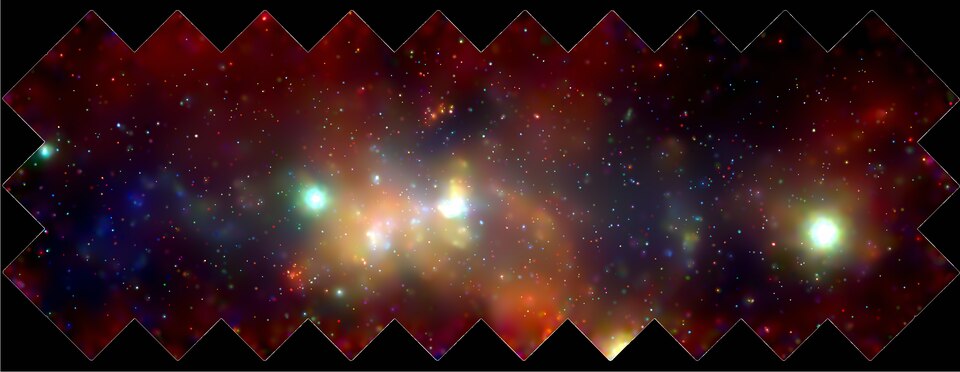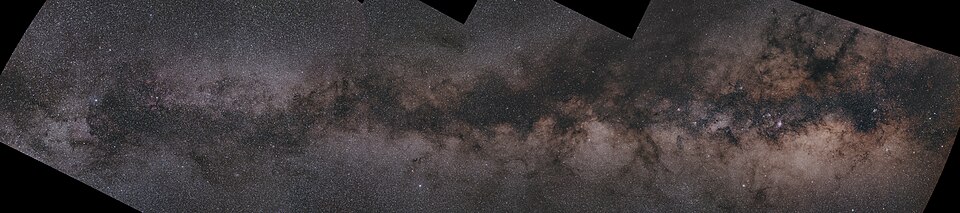
A cloud of gas near the center of the Milky Way has turned out to be one of the richest collections of molecules ever found in interstellar space, according to a paper posted to the arXiv preprint server on August 14. Astronomers identified more than 120 molecular species inside the cloud, including several linked to the chemical building blocks of life. The discovery makes it only the second cloud of its kind ever confirmed near the galaxy's core.
The cloud is designated G+0.633-0.0604, shortened to G+0.633. It sits just 32 light-years, or roughly 190 trillion miles, from the most famous molecule-rich cloud in the galaxy, G+0.693-0.027. That neighboring cloud contains roughly 40 percent of all molecules ever detected in interstellar space and has long been studied as a potential window into prebiotic chemistry. Astronomers had wondered whether its unusual chemical richness was unique.
It is not. As the researchers write in the paper, "This survey has revealed over 120 molecular species containing all six essential biogenic elements (C, H, O, N, P and S), including the aromatic cycle benzonitrile, immediately placing G+0.633 among the richest molecular reservoirs in the galaxy."
The study was led by David San Andrés of the Center for Astrobiology in Spain. His team found emission patterns revealing velocities consistent with a shock-dominated environment, similar to what is seen in the neighboring cloud G+0.693. They also found a similar temperature mismatch pattern between the two clouds. Both clues pointed to a shared physical history.
The chemical richness of these clouds is thought to come from low-velocity shock waves, likely caused by colliding gas clouds. Those shock waves blast icy coatings off dust grains and release molecules that had been frozen inside. That process moves more molecules into the gas phase, where they become detectable by radio telescopes. G+0.693 was already known to work this way. The new findings suggest G+0.633 operates by the same mechanism.
Phys.org reported that the researchers called G+0.633 a "new goldmine for astrochemistry" and described it as the first confirmed chemical twin of G+0.693. Three of the molecules detected in the new cloud are specifically tied to life's basic chemistry, though the paper does not claim life is present. The significance lies in the sheer concentration of prebiotic molecules in a single location outside any star-forming region.
Neither cloud is actively forming stars. Their chemical richness comes not from the heat of star formation but from the physical and chemical conditions specific to the region surrounding the Milky Way's central black hole. That environment is extreme, crowded, and violent enough to keep the shock processes running. So far, astronomers have identified almost 350 different molecules in interstellar space total. G+0.633 alone now accounts for more than a third of that number.