

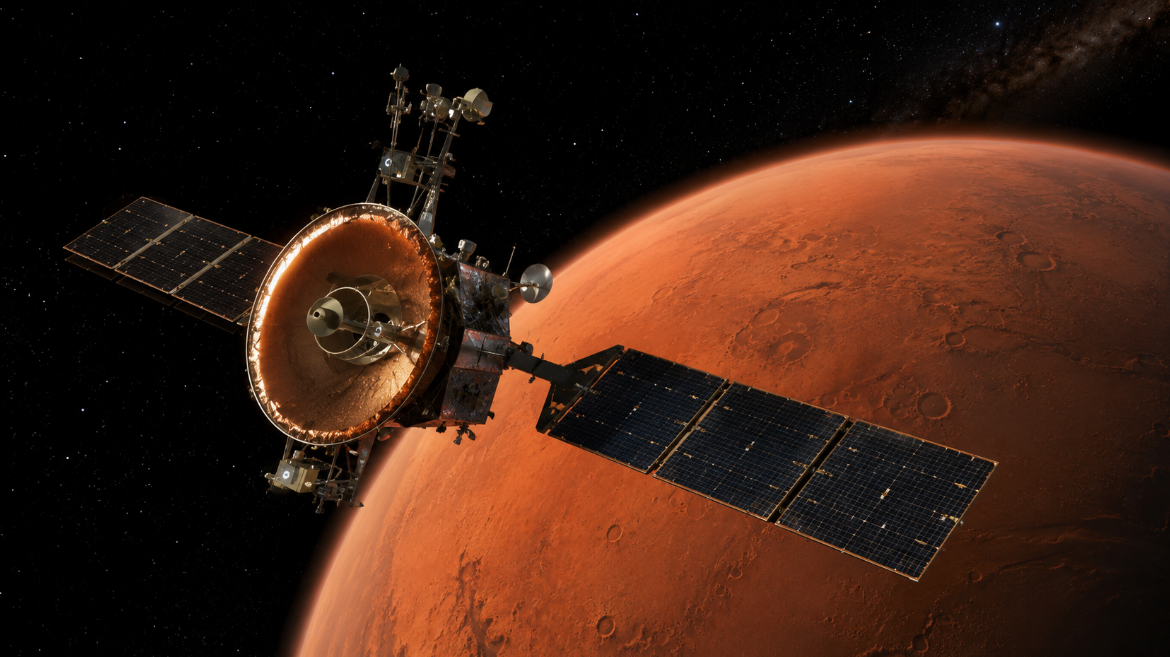
NASA has selected Blue Origin to build a new communications network around Mars, awarding the space company a contract with a maximum potential value of approximately $700 million. The project is intended to create a much more capable communications link between Earth and spacecraft operating on or around the Red Planet as NASA prepares for increasingly ambitious robotic missions and, eventually, human exploration.
According to NASA, Blue Origin will design, develop, integrate, launch, and operate the Mars Telecommunications Network under a firm-fixed-price contract. The company is required to deliver a high-performance telecommunications orbiter to NASA no later than December 31, 2028. NASA expects the network itself to become operational at Mars by 2030.
The spacecraft will essentially serve as a communications hub in orbit around Mars. Rather than requiring every rover, lander, or other spacecraft on the planet to communicate directly with Earth, missions will be able to transmit information to the orbiter, which can then relay that data across the enormous distance separating Mars and Earth.
According to NASA, the system will carry science data, high-resolution imagery, navigation information, and critical mission communications for spacecraft operating both on the Martian surface and in orbit. The agency says demand for communications capacity is expected to increase substantially as the number and complexity of Mars missions grows.
That communications infrastructure could become increasingly important as NASA moves beyond individual robotic missions toward sustained operations around Mars. Modern spacecraft can collect enormous amounts of scientific information, including detailed photographs, atmospheric measurements, geological data, radar observations, and other information. Collecting the data is only part of the challenge. Scientists must also have a reliable way of sending it back to Earth.
NASA said when it began seeking commercial proposals for the project in May that future Mars missions would require reliable, high-bandwidth communications capable of handling science information and high-definition imagery. The agency described the planned network as supporting surface missions, spacecraft in orbit, and eventually human exploration.
The Mars Telecommunications Network represents an attempt to address that problem before communications limitations become a larger obstacle to exploration. A dedicated relay spacecraft can receive transmissions from vehicles that may have smaller antennas or less electrical power than would otherwise be required for frequent direct communications with Earth.
A Mars orbiter can also provide communications opportunities when the geometry between a surface spacecraft and Earth is unfavorable. Rovers and landers do not always have an uninterrupted line of sight to Earth, and the rotation of Mars can further restrict communications windows. An orbital relay provides another path through which information can be stored and transmitted.
Blue Origin says its proposed Mars Telecommunications Orbiter is based on technology from the company's Blue Ring spacecraft platform. According to information released by Blue Origin, the spacecraft is designed to provide high-rate communications while using a combination of solar-electric and chemical propulsion. The company has also described a system involving additional deployable UHF relay satellites to expand communications coverage around Mars.
Blue Origin says the spacecraft could also provide onboard data storage and processing capabilities. Those features could become increasingly useful as spacecraft gather larger amounts of information and become more autonomous.
The contract further expands Blue Origin's relationship with NASA at a time when the company is already deeply involved in American lunar exploration.
NASA is working with both Blue Origin and SpaceX on lunar landing systems intended to support future Artemis missions. According to NASA's Office of Inspector General, the two companies are developing systems that will eventually allow astronauts to travel between lunar orbit and the Moon's surface.
Blue Origin is also preparing its uncrewed Blue Moon Mark 1 lander, known as Endurance. According to NASA, the spacecraft is intended to demonstrate technologies including precision landing, cryogenic propulsion, and autonomous guidance and navigation while delivering NASA science and technology payloads to the lunar south polar region.
NASA announced in May that Blue Origin's Mark 1 lander would be used for the first Moon Base mission, an effort designed to begin establishing infrastructure for longer-term operations on the lunar surface. The agency has described those robotic missions as important steps toward reducing the risks associated with later crewed missions.
Blue Origin's growing role in NASA's exploration plans has not been without setbacks.
On May 28, Blue Origin experienced a major accident during a hot-fire test of its New Glenn heavy-lift rocket at Launch Complex 36 at Cape Canaveral Space Force Station in Florida. According to Blue Origin, the incident damaged or destroyed several pieces of launch infrastructure, including the lightning tower, transporter-erector, and hydraulic equipment. The company said its tank farm, integration facility, vehicle access tower, and water tower survived in relatively good condition.
Reuters reported that the New Glenn rocket erupted in a large fireball while undergoing the ground test. No crew was aboard, and the satellites intended for the rocket's next mission had not yet been installed.
The accident created uncertainty over how quickly New Glenn could return to flight. Blue Origin CEO Dave Limp said the company intended to fly New Glenn again before the end of 2026. NASA Administrator Jared Isaacman offered a considerably more cautious assessment shortly after the accident.
According to a report by Engadget, Isaacman said repairing the damaged launch complex would take considerable time and that a 2028 recovery timeframe was within the realm of possibility. Blue Origin, however, has maintained that it can rebuild the necessary infrastructure much sooner.
NASA has since taken additional steps to support Blue Origin's rocket development. In July, the agency announced an agreement allowing Blue Origin to conduct second-stage hot-fire testing of New Glenn hardware at NASA's Stennis Space Center in Mississippi. NASA said the arrangement would help advance rocket development for future Artemis missions.
The Mars communications award therefore arrives at an important time for Blue Origin. The company is simultaneously developing launch vehicles, lunar landers, orbital spacecraft, and now infrastructure intended for another planet.
NASA's broader strategy is increasingly dependent on this type of commercial partnership. Instead of designing and operating every spacecraft entirely within the government, the agency is turning to private companies for launch services, lunar transportation, communications systems, and other capabilities.
The Mars Telecommunications Network applies that model to deep-space communications.
NASA said the project is intended to become part of its broader space communications and navigation infrastructure. The agency hopes commercial technology can provide greater communications capacity and flexibility while allowing NASA to concentrate more resources on science and exploration.
The timing also fits into NASA's larger Moon-to-Mars strategy.
NASA's Artemis program is using lunar missions to develop and test technologies that could eventually be required for human expeditions to Mars. The Moon provides a much closer environment in which NASA can practice deep-space operations, life support, navigation, landing, surface exploration, and extended missions away from Earth.
That effort reached an important milestone in April 2026 when Artemis II carried four astronauts around the Moon. According to NASA and subsequent reporting, Artemis II became the first crewed mission of the Artemis program and the first human voyage beyond low Earth orbit since the Apollo era. The crew returned safely after its lunar flight.
Future Artemis missions are expected to test docking with commercial lunar landers and eventually return astronauts to the lunar surface. NASA has said lessons learned from those missions will help prepare the agency for eventual expeditions to Mars.
Mars presents communications challenges on an entirely different scale.
The distance between Earth and Mars varies dramatically as the two planets travel around the Sun. Radio transmissions can take several minutes to travel from one planet to the other even under relatively favorable conditions, and considerably longer when the planets are farther apart. That delay means astronauts on Mars could never communicate with mission control in real time in the way astronauts aboard the International Space Station can.
A strong communications network therefore cannot eliminate the fundamental delay imposed by the speed of light, but it can make the available connection more dependable and capable of carrying much larger amounts of information.
For robotic missions, that means returning more photographs and scientific measurements. For future astronauts, it could mean transmitting mission instructions, medical information, navigation data, engineering information, video, and other essential communications.
A high-capacity Mars relay network could also allow future spacecraft designers to rely on infrastructure already waiting around the planet rather than requiring every new mission to carry all of the equipment needed for long-distance communications with Earth.
That is what makes the Blue Origin contract more significant than a single spacecraft. If NASA's plans succeed, the orbiter could become an early piece of permanent infrastructure around Mars — similar in concept to building communications systems before dramatically increasing activity in a remote region on Earth.
NASA expects robotic spacecraft to continue preparing the way for eventual human missions. As those missions multiply, the volume of information traveling between Mars and Earth is likely to grow sharply.
The $700 million Mars Telecommunications Network contract is intended to prepare for that future before the communications bottleneck becomes critical.
NASA's astronauts may still be years away from setting foot on Mars, but the agency is beginning to build some of the infrastructure they — and the robotic explorers traveling ahead of them — will need when they get there.