

Scientists studying the relationship between the digestive system and the brain have identified specific biological pathways that may help explain why gut health appears connected to mental health. The findings give researchers more concrete targets to investigate as they try to understand the complicated communication network linking the gut microbiome with the human brain.
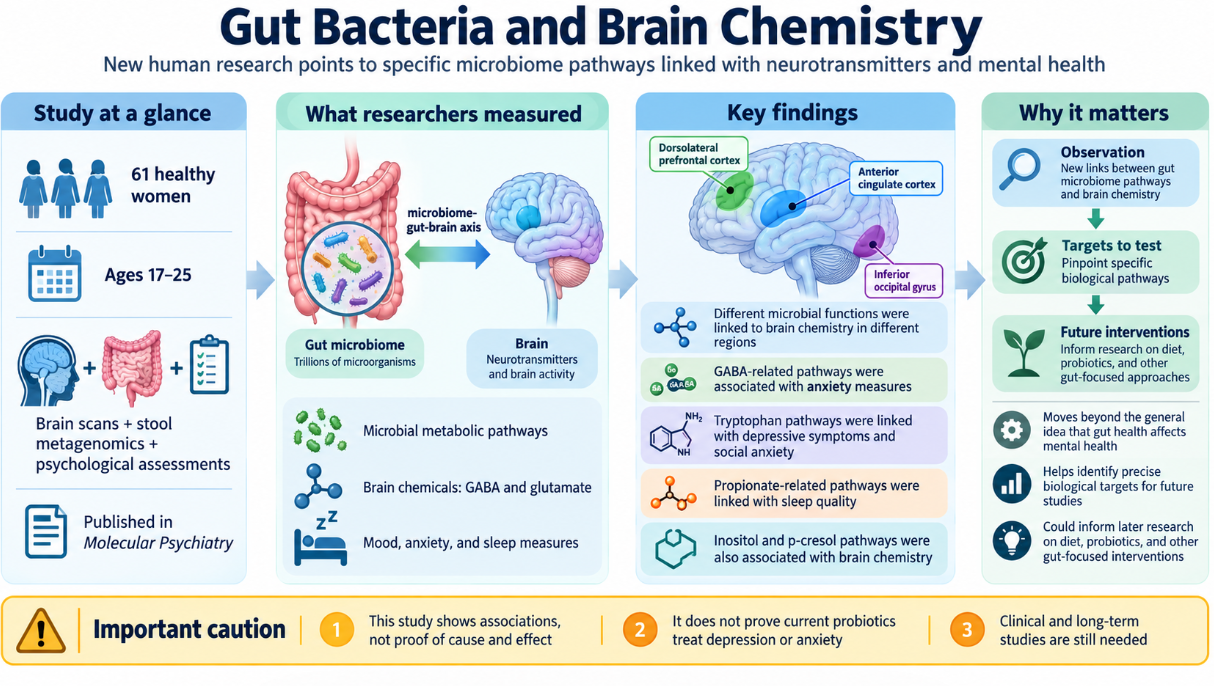
The research was published August 25 in Molecular Psychiatry and involved scientists from the University of Roehampton and the University of Surrey in the United Kingdom. The researchers examined 61 healthy women between the ages of 17 and 25, combining detailed analysis of their gut microbiomes with brain scans and psychological assessments.
The gut-brain connection has been a growing area of scientific interest for years. Researchers have observed associations between digestive disorders and psychiatric symptoms, while anxiety, depression and prolonged stress can themselves affect digestion. The relationship appears to work in both directions rather than simply involving the gut sending messages to the brain.
Much of the strongest experimental evidence for the microbiome's influence on brain function has come from animal studies. Demonstrating comparable relationships in living human beings has been considerably more difficult.
The new study is important because researchers measured gut microbial functions and brain chemistry in the same people.
A diet built around a wide variety of vegetables, along with beans, lentils, whole grains, fruits, nuts and seeds, can provide the fibers and plant compounds that gut microbes use for energy. Many of these foods contain fermentable material that intestinal bacteria can convert into short-chain fatty acids and other metabolites being studied for their effects on the gut-brain axis. By contrast, diets that are low in fiber and heavily dependent on ultra-processed foods have been associated with lower microbial diversity and less favorable characteristics of the gut microbiome.
Instead of simply identifying which species of bacteria were present in participants' stool samples, the scientists used metagenomic analysis to examine what those microbes appeared genetically capable of doing. They looked at microbial pathways involved in producing or breaking down compounds such as GABA, glutamate, short-chain fatty acids, inositol and p-cresol.
At the same time, researchers used proton magnetic resonance spectroscopy, or 1H-MRS, to measure concentrations of two particularly important brain chemicals: gamma-aminobutyric acid, better known as GABA, and glutamate.
GABA generally acts as an inhibitory neurotransmitter, reducing activity among neurons. Glutamate generally has the opposite effect, encouraging neural excitation. The balance between the two helps regulate how brain circuits function and has been associated with learning, cognition, neuroplasticity and mental health.
Researchers measured those chemicals in three areas of the brain.
One was the dorsolateral prefrontal cortex, an area involved in cognitive control, planning and emotional regulation. Another was the anterior cingulate cortex, which plays roles in attention, decision-making and emotional processing. The third was the inferior occipital gyrus, a region more closely associated with visual processing.
The results were not uniform across the brain.
That may be one of the study's most significant findings.
Different microbial functions were associated with GABA and glutamate in different brain regions, suggesting the gut-brain relationship is considerably more specific than the broad idea that a healthy gut simply produces a healthier brain.
In the dorsolateral prefrontal cortex, researchers found a relatively selective relationship involving a microbial pathway associated with GABA production.
The anterior cingulate cortex showed a different pattern involving microbial pathways related to glutamate and propionate, one of the short-chain fatty acids produced when gut bacteria ferment certain foods.
The inferior occipital gyrus produced the largest number of observed relationships. Microbial glutamate degradation and inositol synthesis were associated with the balance between excitation and inhibition in that brain region. GABA levels there were also associated with pathways involving inositol and p-cresol.
Those findings do not mean GABA produced by bacteria in the intestine simply travels directly into the brain.
Researchers believe the communication is probably much more complicated.
Gut microbes could potentially affect the brain through the vagus nerve, immune-system signaling, changes in the intestinal barrier or metabolites that enter the circulation. Short-chain fatty acids produced by gut bacteria may also influence inflammation, immune activity and the integrity of the blood-brain barrier.
The vagus nerve is particularly interesting because it provides a major communication route between organs in the body and the brain. Signals originating in the digestive tract can travel through neural pathways without requiring a bacterial neurotransmitter itself to reach brain tissue.
Researchers therefore increasingly describe the microbiome-gut-brain axis as a network rather than a single pathway.
The study also went beyond brain imaging by asking whether the microbial pathways were associated with psychological characteristics reported by participants.
Some were.
A microbial pathway involving GABA was associated with both trait anxiety and social anxiety. Pathways related to tryptophan metabolism were associated with depressive symptoms and social anxiety, while a pathway associated with production of the short-chain fatty acid propionate was linked with poorer sleep quality.
Tryptophan is particularly interesting because the body uses the amino acid in several biochemical pathways, including the production of serotonin. Gut microbes can influence how tryptophan is metabolized, potentially changing which compounds are produced and available elsewhere in the body.
Serotonin itself is often mentioned in discussions about the gut-brain connection because most of the body's serotonin is produced outside the brain, particularly in the gastrointestinal tract. However, serotonin produced in the gut does not simply cross the blood-brain barrier and become serotonin in the brain. Researchers are instead studying the more complicated ways in which gut metabolism may influence neural and immune signaling.
That distinction is important because popular descriptions of the gut as a "second brain" can make the relationship sound much simpler than scientists believe it actually is.
The digestive tract does contain an extensive network of neurons known as the enteric nervous system, but the microbiome adds another layer to the system. Trillions of microorganisms live in the digestive tract, processing nutrients and producing chemical compounds that can interact with intestinal cells, immune cells and nerve pathways.
Scientists are increasingly interested not merely in identifying which bacteria are present but in understanding what those microbial communities are doing.
That was a major feature of the new research.
Two people could have somewhat different collections of bacterial species while their microbiomes perform some of the same metabolic functions. Focusing on microbial genes and metabolic capabilities may therefore provide more useful clues than focusing entirely on individual species.
Dr. Nicola Johnstone, the study's lead author, said the researchers were able to connect information at several biological levels: microbial genes in the intestine, neurochemistry in the brain and psychological measurements in the same participants.
That does not establish cause and effect.
The study was cross-sectional, meaning researchers essentially examined the participants at a particular period rather than deliberately changing their gut microbiomes and observing what happened afterward.
It is therefore possible that gut microbial differences influence brain chemistry. It is also possible that differences in stress, behavior, diet or brain function alter the gut microbiome. A third biological factor could influence both.
The study also measured the genetic potential of bacteria to perform particular metabolic activities rather than directly measuring how much of every relevant metabolite those bacteria actually produced.
The participant group presents another limitation. All 61 participants were healthy young women between 17 and 25 years old. Researchers cannot assume that identical relationships exist in men, older adults, children or people diagnosed with major depression, anxiety disorders or other psychiatric conditions.
Larger studies involving more diverse groups will be necessary.
Researchers will also need longitudinal studies that follow people over time and intervention trials in which scientists deliberately alter aspects of the microbiome to determine whether corresponding changes occur in brain chemistry or mental health.
That is where the research could eventually become particularly significant.
If scientists determine that changing a particular microbial pathway reliably changes brain chemistry, it could open possibilities for highly targeted interventions. Those could eventually involve diet, prebiotics, probiotics, microbial metabolites or other approaches designed to alter specific functions of the gut microbiome.
That possibility should not be confused with evidence that existing probiotic products can treat depression or anxiety. The current study does not demonstrate that, and researchers have emphasized that much more work is required before the findings can be translated into clinical treatment.
The research nevertheless moves the field beyond the vague observation that the gut and brain appear connected.
Instead of simply asking whether gut bacteria might influence mental health, researchers can begin asking more precise questions: Which microbial metabolic functions matter? Which brain chemicals are associated with them? Which brain regions show those relationships? And what biological mechanism connects the two?
Professor Kathrin Cohen Kadosh of the University of Surrey said the region-specific nature of the findings suggests that the gut-brain axis is not a single system operating uniformly throughout the brain. Instead, different microbial functions may be associated with different areas and different aspects of brain chemistry.
The study was funded through a collaboration with FrieslandCampina, a Netherlands-based dairy and nutrition company. The authors reported no competing interests.
For now, the findings provide evidence of association rather than a new treatment for mental illness. But they offer something researchers have been seeking for years: specific biological targets that can be tested.
The next stage will be determining whether changing those targets actually produces measurable changes in the brain.
If that relationship can eventually be demonstrated, the gut microbiome could become much more than an interesting correlate of mental health. It could become one of the biological systems scientists learn to manipulate as part of future approaches to maintaining or improving brain health.