Proteins do not hold still. They shift shape constantly, and those shifts are what allow them to carry out most of their work inside living cells. For decades, predicting exactly how proteins fold was one of biology's hardest problems. Then Google DeepMind built AlphaFold, and that changed. But a new limitation quickly became clear: AlphaFold could predict a protein's shape, but usually only one of them.
According to Phys.org, researchers at the Institute for Molecular Science in Japan and the Graduate University for Advanced Studies, SOKENDAI, have now developed a method to push past that limitation. Their results are published in JACS Au.
Proteins are chain-like molecules built from amino acids. The sequence of those amino acids determines how the chain folds into a three-dimensional structure. When something binds to a protein, such as a drug molecule or a signaling compound, the protein can shift into a different shape. Those shifts, called conformational changes, are how proteins carry out functions like synthesizing or transporting substances. Missing them means missing a large part of how proteins actually work.
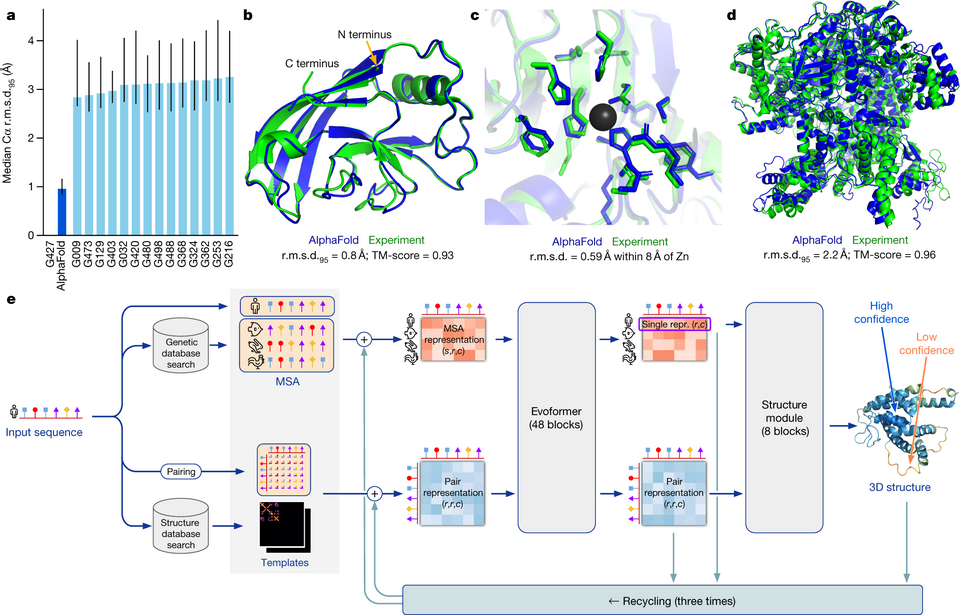
AlphaFold, developed by Google DeepMind, solved the original folding problem well enough that its creators John Jumper and Demis Hassabis shared the 2024 Nobel Prize in Chemistry. The latest version, AlphaFold 3, uses a diffusion generative model, the same class of AI behind many image generation tools, to predict structure. The model starts with atoms scattered randomly, then moves them toward positions of lower energy until they settle into a folded shape.
That process works, but it has a built-in tendency to land in the same place every time. Because one conformational state sits at a lower energy than the others, AlphaFold 3 tends to find that state and stop there. For many proteins, the program predicts only that single conformation, no matter how many times it runs.
The Japanese research team, led by Jun Ohnuki and Kei-ichi Okazaki, developed a way to steer the model away from that trap. They introduced a repulsive force between predicted structures. Each time AlphaFold 3 generates a prediction, a bias energy term raises the energy of that conformation, making it less likely to land in the same spot again on the next run. By repeating the prediction multiple times with this bias applied, the model is pushed toward conformational states it would otherwise skip entirely.
The approach allows AlphaFold 3 to sample multiple shapes for proteins that its default settings rarely capture. That matters especially for drug design, where a drug needs to fit a specific shape of its target protein. If the model only ever shows one conformation, researchers might miss the shape the protein takes when it is active, inactive, or bound to another molecule. Any of those states could be the right target for a new treatment.
The work does not replace AlphaFold 3. It builds on top of it, using the same underlying model but changing how it is sampled. The researchers describe it as a novel AlphaFold-based method rather than a competing system. Whether the technique will be adopted broadly or integrated into future versions of AlphaFold remains to be seen, but the findings add a tool that structural biologists and drug designers have been waiting for since AlphaFold first made protein structure prediction practical.