

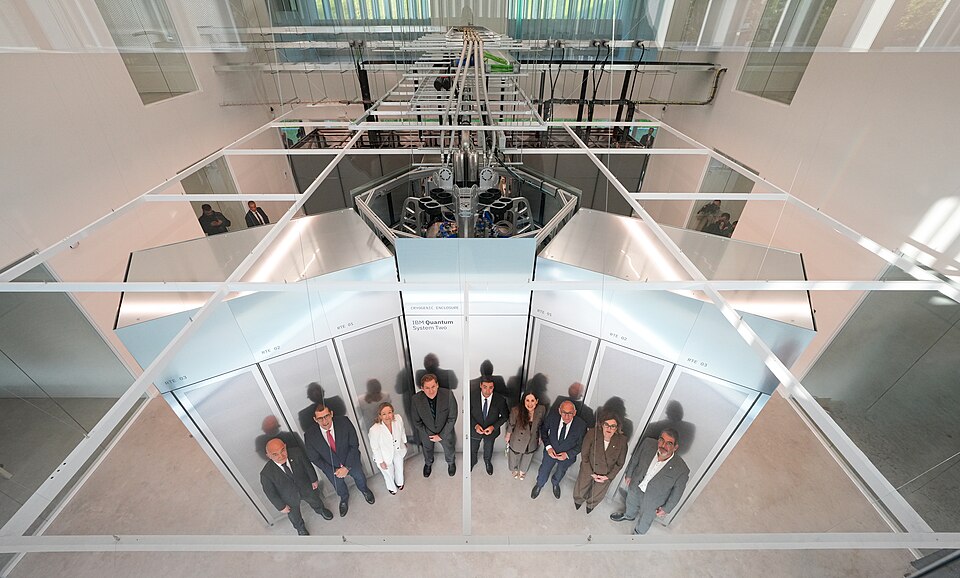
International Business Machines Corporation, known as IBM, made two significant technological moves on September 10, 2026. The company and Lockheed Martin established a quantum innovation hub in Switzerland that is tied to the country’s F-35 defense procurement. It also released an open-source artificial intelligence model designed to map the moon’s surface.
This dual approach marks a departure from typical corporate strategies where companies usually focus on one narrative, according to thestreet.com. IBM chose to pursue both quantum computing and lunar technology simultaneously with two different partners: a defense contractor and a space agency.
The Swiss quantum lab is not just a research project but also part of a larger military context. Switzerland’s purchase of F-35A fighter jets from Lockheed Martin created an offset obligation worth about $3 billion. Much of that money went toward manufacturing components like engine training systems and ammunition. However, part of the offset program is now supporting a quantum innovation hub at ETH Zurich. Switzerland’s first IBM Quantum System Two will be installed at the Swiss National Supercomputing Centre in Lugano by the end of 2026. IBM will operate the quantum computer while ETH Zurich will coordinate access and Lockheed Martin receives offset credit through the agreement. ETH Zurich said the agreement with IBM covers installation and operation of the system for three years.
IBM’s acquisition of HRL Laboratories just weeks earlier added expertise in quantum sensing to its portfolio. Quantum sensing for navigation is one of the two joint research areas at the new hub. This capability was exactly what IBM had recently acquired through its purchase of HRL. IBM will operate its own Quantum System Two while its joint research with Lockheed Martin can draw on quantum-sensing expertise added through the HRL acquisition. IBM completed its purchase of HRL on August 26.
The timing of this development suggests strategic positioning ahead of future opportunities. Just hours after the Zurich announcement, IBM partnered with NASA to release a lunar AI model. The NASA IBM Lunar Foundation Model is trained on decades of lunar observation data and made freely available. It helps identify ice deposits, craters, and volcanic formations with better accuracy than current methods. For potential lunar ice, the model reduced error by up to 22% compared with the SwinV2-B model. NASA said the model was trained primarily on data from its Lunar Reconnaissance Orbiter and is publicly available through Hugging Face.
However, the improvement is less significant for volcanic features, around 3%, according to another report. The AI model runs on TerraTorch, an open-source toolkit IBM developed for geospatial AI. The model is integrated with TerraTorch and can be used by researchers for lunar mapping and other scientific work. The lunar model is open-source and publicly available rather than being separately licensed to civilian and military users. NASA said the codebase is also available through GitHub for testing and research.
The company trades on the New York Stock Exchange and is widely held by pension funds and index investors. IBM’s stock fell 2.47% on September 10 to close at $234.02 despite the two announcements and a rough year overall for the company. CEO Arvind Krishna admitted that IBM had not adapted quickly enough to changing market conditions. Infrastructure sales, including mainframe hardware, have declined significantly in recent quarters. IBM shares were nearly 30% below their 52-week high after the September 10 session.
Some analysts argue that investors are getting exposure to IBM’s quantum initiatives at a low cost. Wall Street maintains a Buy consensus on IBM stock overall.
The next major test for IBM will come during its October earnings report. Switzerland is not the only country with an F-35 offset obligation like this one. Finland’s F-35 purchase is worth about $10 billion and includes an industrial participation requirement equal to at least 30% of the actual contract price. So far, most of that funding has gone to fuselage and engine assembly work, not laboratories. Finland’s program includes production of F-35 forward fuselages and assembly and maintenance of F135 engines.
Switzerland’s approach with a tech hub is a new model in such offset agreements. IBM also continues to support sports events through digital platforms and AI tools, according to a report from entrepreneur.com. It works with the USTA on major tennis tournaments such as the US Open. The company helps manage data and infrastructure during these events using AI and human oversight. IBM protects against nearly 500 million suspicious requests targeting the USTA’s digital platforms. AI agents help identify and prioritize threats to keep the tournament secure. IBM and the USTA have worked together on US Open digital experiences since 1992.
Fans can now use Match Chat, an AI assistant that answers questions about live matches instantly. Another feature called Live Likelihood to Win shows real-time updates on a player’s chances of winning. Key Moments uses generative AI to explain how match momentum shifted based on specific points and rallies.
IBM found that 80% of sports fans see value in AI-powered experiences. Among tennis fans, 64% trust AI-generated content. Most fans use sports apps regularly, especially during live events. IBM’s 2026 survey found that 91% of tennis fans surveyed use sports apps during live events.
IBM also collaborates with other major sporting events like the UFC and Wimbledon. It is involved in grassroots innovation through programs like the USTA Connect Innovation Challenge. This challenge invites startups and engineers to build digital solutions for tennis. Submissions are evaluated by a panel including USTA reps, venture capitalists, and IBM experts. The challenge offered a $10,000 prize and gave three finalists the opportunity to present their work at the 2026 US Open.