

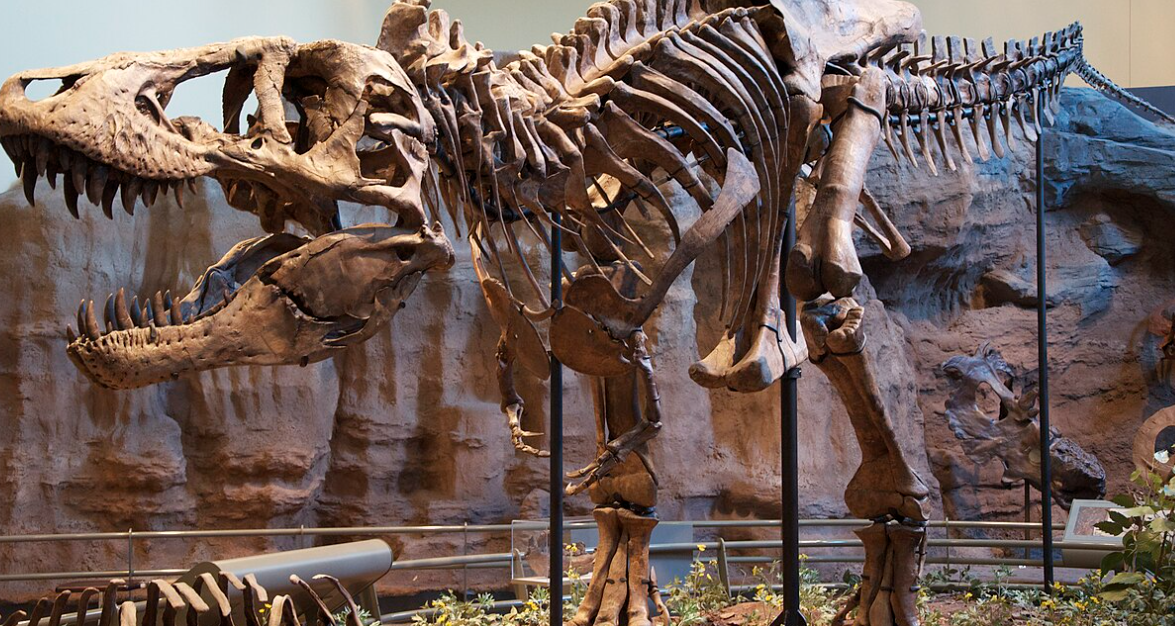
A new study provides direct evidence that Tyrannosaurus rex maintained a warm body temperature comparable to modern humans and other endotherms. This conclusion comes from a study published in the journal Science Advances. The research team used a refined method to measure the internal temperature of the dinosaur.
They focused on fossilized tooth enamel, which is very durable and can last for millions of years, according to popsci.com. The technique involved drilling small amounts of tooth enamel and dissolving the resulting powder in phosphoric acid to release carbon dioxide gas. They then used a mass spectrometer to analyze the chemical composition of that gas.
The results showed that T. rex’s body temperature was about 97 degrees Fahrenheit. The study estimated an average temperature of 36.3 degrees Celsius, or 97.3 degrees Fahrenheit, from three T. rex teeth from the Hell Creek Formation. This is similar to the temperature of today’s warm-blooded animals like humans. It is higher than cold-blooded reptiles and even sloths, but lower than birds.
Study co-author Robert Eagle from UCLA said this was the first time researchers had obtained a direct temperature estimate like this for T. rex. He added that the findings matched his expectations based on earlier evidence. The method used in this study required only a small amount of fossil material.
This made it possible for museums to provide rare T. rex tooth material while limiting the amount destroyed during testing. The research team used tooth samples from Thomas the T. rex at the Natural History Museum of Los Angeles County. UCLA said the museum provided portions of two teeth from Thomas after improvements cut the amount of material needed by about 90%.
Previous theories suggested that dinosaurs were slow-moving and cold-blooded. But more recent studies have shown that many dinosaurs were active and fast. These findings led scientists to rethink how dinosaurs regulated their body heat.
A warm-blooded metabolism would have supported high levels of activity and helped T. rex survive in different climates. Climate modeling indicates that T. rex could potentially have lived across much of prehistoric North America including colder northern regions. The study’s co-author Aradhna Tripati said the teeth showed T. rex was warmer than its surroundings. This supports the idea that T. rex maintained a high internal temperature.
The researchers also tested crocodilian teeth from the same Hell Creek area. Those animals registered about 86 degrees Fahrenheit compared with roughly 97 degrees for T. rex. The comparison helped researchers determine that geological changes to the fossils were unlikely to explain the warmer T. rex reading.
The breakthrough in analysis technology made this study possible. Earlier methods needed large fossil samples and often damaged the specimens. The new method allowed researchers to work with just a few milligrams of material.
This convinced museum curators to allow the use of rare T. rex teeth for research. The results support the view that T. rex was an energetic predator or scavenger with an endothermic metabolism. This new evidence adds to the growing understanding of dinosaur biology.
It shows that T. rex maintained a warm internal temperature despite being a giant reptile. The research adds to evidence that warm-blooded physiology developed within dinosaur groups long before modern birds appeared. Scientists now believe T. rex was capable of surviving in a wide range of climates.
This study helps explain how T. rex could potentially have survived in cold high-latitude regions where many cold-blooded reptiles would struggle. Climate models used by the researchers showed that most of the North American paleocontinent including colder higher latitudes may have been accessible to the species. The findings also suggest that T. rex had a high energy lifestyle. Its body temperature was well above the environment it lived in.
The research team’s work brings clarity to a long-standing debate in paleontology. It also opens new ways for studying extinct animals using fossil evidence. The study marks a major step forward in how scientists understand ancient life.
It shows that even the most fearsome creatures had complex biological systems. The results also provide new information about how temperature regulation developed among dinosaurs and their bird relatives. This research helps bridge the gap between ancient and modern biology.
It also supports the idea that T. rex was not just a brute force predator. Instead, it likely had an energy-demanding metabolism that supported sustained activity. The new method used in this study may be applied to other ancient species as well. Researchers said testing other dinosaur species could show how different groups regulated body temperature.
This could lead to more discoveries about how extinct animals lived and functioned. The study’s findings are a reminder that the past is still full of surprises. They also show how science continues to evolve and improve.