

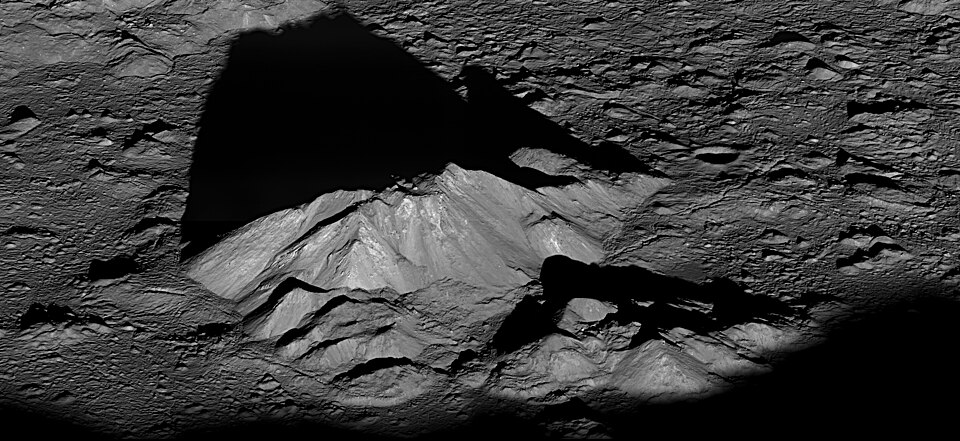
NASA's spacecraft has identified a significant new crater on the surface of the Moon. The discovery was made during a routine data-quality check of images from NASA's Lunar Reconnaissance Orbiter.
Robert Wagner, an image-processing specialist with Intuitive Machines who works with LRO camera data, discovered the crater on October 24, 2025. Wagner was comparing large maps made from images taken years apart when he spotted an unusually bright area surrounded by a dark halo.
The newly found feature is the largest newly formed crater ever identified in the solar system, according to NASA. It has been officially named McGetchin crater after pioneering lunar scientist Thomas McGetchin.
Initial measurements show that it has a diameter of about 728 feet, or 222 meters. The crater is about 141 feet, or 43 meters, deep. It is roughly as wide as two American football fields placed end to end.
Scientists believe a comet or asteroid fragment about the size of a three- to six-story building created the crater. Researchers narrowed the impact to between April 11 and May 22, 2024 by comparing images taken before and after the collision.
The crater is located near the Moon's eastern edge. Researchers say it appears to have formed near the boundary between rugged lunar highlands and a broad flat mare.
The Moon's surface continues to reveal secrets through ongoing exploration efforts. This latest finding adds to the growing understanding of how the lunar landscape has changed over time.
Scientists estimate that an impact large enough to create a crater of this size happens on the Moon about once every century or longer. The Lunar and Planetary Institute puts the estimate at about once every 130 years.
LRO has been circling the Moon for more than 17 years. Its science team has identified at least 1,000 new impact craters during the mission. Scientists have also detected about 100,000 other surface changes caused by impacts or material thrown from impact sites.
The presence of such a large crater highlights the dynamic nature of the Moon's surface. Unlike Earth, the Moon has essentially no atmosphere to burn up or slow incoming space rocks before they hit the ground.
NASA says impacts capable of producing craters about 30 feet wide occur around 140 times per year across the Moon. Most impacts are much smaller than the collision that created McGetchin.
Scientists also discovered an unusual temperature change around the new crater. LRO's Diviner instrument detected a cold area about four miles wide surrounding the impact site. The area is about 16 degrees Fahrenheit cooler at night than nearby terrain.
Researchers believe the impact loosened or fluffed up the lunar soil known as regolith. The disturbed material is less dense and does not retain heat as well as undisturbed soil. The finding shows that a major impact can alter lunar terrain well beyond the crater itself.
NASA researchers say that information could become important for future lunar exploration. Changes in the density of the surface could affect how rover wheels and other equipment interact with lunar soil.
NASA continues to use its fleet of spacecraft to map and analyze celestial bodies, according to science.nasa.gov. The agency's work helps expand knowledge about the solar system and beyond.
LRO's camera system operates from roughly 60 miles above the Moon. It includes two cameras that take detailed black-and-white images and another camera that collects moderate-resolution images in several wavelengths. These observations allow scientists to identify craters, landslides, faults, landing sites and other changes.
Each new discovery brings researchers closer to understanding how planetary surfaces evolve. The Moon remains an important target for scientific study and exploration.
This new crater will likely be a focus of future research projects. Its size and location make it a valuable subject for geologic analysis.
Scientists say the crater provides an unusually fresh example of what happens immediately after a major lunar impact. Older craters have been changed over time by smaller impacts and exposure to the space environment. McGetchin gives researchers an opportunity to study impact processes before much of that weathering occurs.
The findings support ongoing efforts to chart the Moon's geological history. Scientists are eager to learn more about how this feature compares with others on the lunar surface.
The discovery underscores the importance of continued space exploration. It also shows how even familiar worlds can still surprise us with new discoveries.