

President Donald Trump has restricted CNN from covering his activities at the White House, a move that has drawn criticism and legal action. The ban was part of a broader action against media outlets Trump has accused of unfavorable or false coverage, including MS NOW and Politico. Reporters from all three organizations were denied access to the White House after Trump announced the ban on September 18.
CNN had been assigned to provide television pool coverage of the president on Monday. The White House decision prevented the network from fulfilling those duties. The television pool consists of CNN, ABC, CBS, Fox and NBC, which normally take turns providing video of presidential events to other news organizations.
After Trump imposed the ban, other media outlets in the pool chose to suspend their coverage in solidarity with CNN. ABC, CBS, Fox and NBC said they would not take CNN's place in the rotation. The print, radio and wire-service pools continued operating.
The Washington Post also decided not to publish photographs of presidential events until midnight Eastern time during the protest. Other photographers took similar steps.
A lawsuit was filed by CNN, MS NOW and Politico on Monday, arguing that the ban was selective and unconstitutional. The organizations allege violations of the First Amendment and the Fifth Amendment's due-process protections. They are asking the court to restore their White House access.
The case was scheduled for a hearing Wednesday afternoon before U.S. District Judge Timothy Kelly. Kelly previously ordered the White House to restore CNN reporter Jim Acosta's press credentials during a dispute in 2018.
Trump has defended the new restrictions by saying the outlets spread what he calls "fake news." The White House has argued that access to its grounds is a privilege rather than a right. The news organizations and several press-freedom groups dispute that position and argue that the government cannot selectively punish journalists because of their coverage.
The conflict between Trump and media organizations has intensified during his second term, with the president often responding through legal or regulatory actions.
CNN’s Kaitlan Collins confronted Trump during a press briefing, noting that the network had not said it would stop covering him. The exchange actually occurred at the United Nations rather than at the White House. Trump told Collins he was surprised CNN was covering him and said the network should not be there. Collins responded that CNN had been credentialed by the United Nations.
Despite the White House ban, Trump was still visible to global audiences through UNTV, the official United Nations broadcast operation. CNN and other organizations were able to use United Nations feeds while covering events in New York.
The dispute has raised new legal questions about press access to the president. The White House press pool has traditionally allowed a small rotating group of journalists to cover events when space prevents every organization from attending.
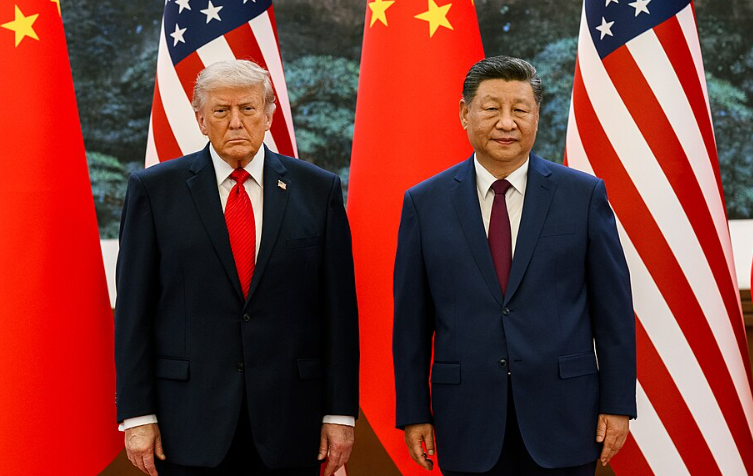
Meanwhile, trade relations between the U.S. and China remain strained ahead of talks between Trump and Chinese President Xi Jinping. Xi arrived in the Washington area Wednesday for a three-day state visit. Trump and Xi are expected to discuss trade, rare earth minerals, technology and other disputes.
Recent developments in soybean trade have been seen as an important measure of progress. China purchased about 1 million metric tons of U.S. soybeans during one week in September. The purchases brought China close to halfway toward its annual commitment to buy 25 million metric tons under an earlier agreement.
However, progress has been less clear in other areas. China previously agreed to purchase 200 Boeing aircraft. CNBC reported that about 140 of those planes were considered to be in a good position to move forward, although details about customers and delivery schedules remained unclear.
Access to Chinese rare earth materials is also expected to be an important part of the talks. Rare earths are used in products ranging from automobiles and electronics to weapons systems. China dominates processing of many of these materials, giving Beijing significant leverage in trade negotiations.
Both sides are aware of each other’s vulnerabilities, and both have an interest in maintaining stability before high-level talks. The existing trade truce has kept commerce moving but has not ended disagreements over tariffs, technology and strategic industries.
Artificial intelligence is another issue expected to receive attention. U.S. and Chinese officials have discussed the possibility of creating channels for reporting serious AI incidents. At the same time, the two countries remain competitors in advanced computing and semiconductor technology.
In addition to trade issues, global leaders are meeting at the United Nations General Assembly in New York to discuss AI and ongoing wars.
Ukrainian President Volodymyr Zelenskyy met with Trump during the assembly and discussed ways to end the war in Ukraine. Zelenskyy emphasized the importance of an energy ceasefire and said he was ready to meet with Russian President Vladimir Putin directly if needed.
He also suggested that Trump could organize a trilateral meeting involving Trump, Putin and Zelenskyy. Zelenskyy separately urged Trump to use his upcoming discussions with Xi to encourage China to put pressure on Russia.
Trump said he believes a solution to the war can be found. Zelenskyy has argued that China has influence over Russia and could play a role in diplomatic efforts.
Ukraine has continued to strike Russian oil facilities and logistics infrastructure, which it sees as legitimate military targets. Russia has also continued attacks against Ukrainian territory.
Russia’s Defense Ministry warned in late August that it was preparing large-scale strikes against Ukraine's energy infrastructure in response to Ukrainian attacks on Russian energy facilities. That warning has increased concern about another winter of attacks on power and heating systems.
The White House media dispute, the Trump-Xi talks and the negotiations over Ukraine are separate issues. However, all three are unfolding during a week of unusually heavy diplomatic activity in Washington and New York.