

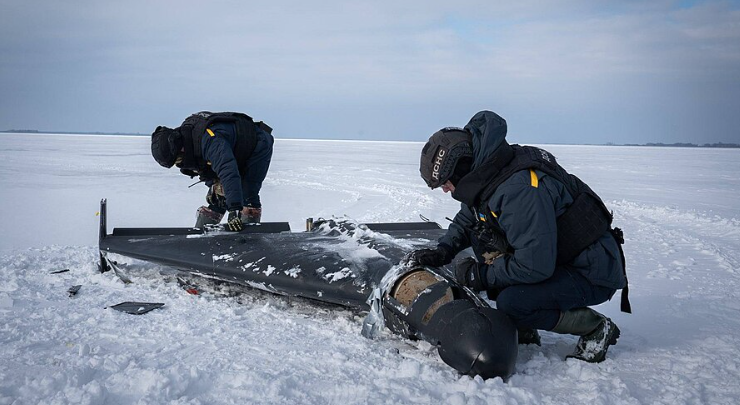
Russian drone attacks on Ukraine have intensified, with new jet-powered models causing significant concern for Ukrainian defenses. A recent Russian Geran-5 drone was captured on film by a Wild Hornets interceptor drone, showing the growing sophistication of these attacks.
Ukraine’s Defense Intelligence Directorate has identified a Chinese-made turbojet engine in the Geran-5, according to Ukrainian intelligence and Business Insider. The Geran-5 drone is shaped like a bullet with wings and can fly at speeds of about 370 miles per hour. It has a range of nearly 600 miles and carries a warhead weighing about 198 pounds, making it a serious threat to Ukrainian cities.
Ukraine’s Defense Intelligence Directorate has noted that these jet drones began appearing as Russia shifted tactics from older propeller models. The Geran-3 drone had already arrived before the Geran-5, and now the newer models are becoming more common. These newer drones resemble cruise missiles in design and pose a greater challenge than earlier models.
Russia has sharply increased its use of high-speed drones in recent months. Ukrainian military data reviewed by Reuters showed about 450 drones traveling between 240 and 500 kilometers per hour were launched in June. That number increased to about 2,850 in August.
Russia launched more than 2,800 jet-powered drones in August alone, according to Ukrainian Air Force officials. In the first three weeks of September, Russia launched about 2,100 jet-powered attack drones and 136 missiles, according to Ukrainian Prime Minister Sergii Koretskyi.
The new drones can also fly much higher than older propeller-driven models. Ukrainian air defense crews told Reuters that the jet-powered drones can operate at altitudes of four to seven kilometers. That puts many of them beyond the reach of some mobile air defense teams using shoulder-fired missiles.
Ukraine has started to develop more advanced interceptor drones as a response to the increasing threat from Russian jets. The Ukrainian military reports that it is now intercepting only about 60% of the newer jet-powered Russian drones, compared with more than 90% of the slower propeller-driven models.
Wild Hornets said one of its new Sting S interceptors recently shot down a Geran-5. The Ukrainian company said the interception was part of combat testing for a faster version of its drone defense system. The company plans to begin mass production after testing is completed.
Ukraine is also testing other high-speed interceptor designs. President Volodymyr Zelenskyy recently released footage of another interceptor that Ukraine's Security Service said had successfully destroyed a Geran-5.
Cities across Ukraine continue to feel the pressure from these attacks, which have grown both in number and destructive capability. The shift toward jet-powered drones marks a significant evolution in how Russia is conducting its air campaign.
Reuters reported that Russia has increasingly targeted railways, grain ports, warehouses, steel operations and other parts of Ukraine's economy. The attacks have also caused civilian deaths and disrupted daily life in cities including Kyiv.
Russia says its attacks are aimed at military and infrastructure targets. Ukrainian officials say Russian strikes have repeatedly damaged civilian areas and are intended in part to place pressure on the population.
This development has forced Ukrainian forces to adapt quickly and improve their defensive systems. The increasing frequency of these attacks raises the stakes for both military and civilian safety in Ukraine.
With more advanced drones entering the battlefield, Ukrainian defense teams are working to keep up with evolving threats. The situation has prompted discussions about how best to counter these new technologies and protect urban areas.
Ukraine has used fighter aircraft and surface-to-air missiles against the faster drones. However, those defenses can be expensive compared with low-cost interceptor drones. Ukrainian officials are therefore looking for systems that can be produced in large numbers.
As the conflict continues, the focus remains on improving interception rates and reducing civilian casualties. The Ukrainian government is also looking into ways to enhance its drone defense capabilities with new technologies.
Ukraine faces financial challenges as it tries to expand those defenses. Zelenskyy has said the country faces a $27 billion defense funding shortfall this year and is seeking additional help from international partners.
Meanwhile, the international community watches closely as these developments unfold in the ongoing war.