

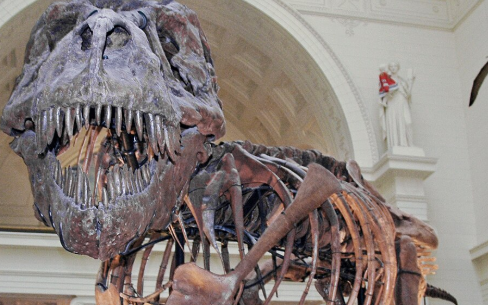
Scientists have discovered feathers preserved inside fossilized dinosaur droppings, offering new insights into how some ancient birds lived and eventually went extinct. These findings come from the remains of meat-eating dinosaurs such as juvenile Tyrannosaurus rex or Nanotyrannus. The feathers were remarkably well-preserved and are the first ever found in this type of fossilized material.
The fossilized dung was discovered in 2016 in the Hell Creek Formation in eastern Montana. Researchers believe it was produced by a large meat-eating dinosaur about 66 million years ago. CT scans later revealed additional feathers, bone fragments, and tiny fish scales inside the fossil.
This discovery may help explain why only certain bird species survived the mass extinction event at the end of the Cretaceous Period, according to Science News. The research was published in Current Biology by Jingmai K. O'Connor and colleagues in 2026.
Researchers found that some of the feathers had dense structures that may have helped repel water. Their central shafts also contained air pockets similar to features found in modern bird feathers. Scientists believe the bird that was eaten may have been an aquatic diving bird related to a group known as hesperornithiforms.
The discovery is important because hesperornithiform birds did not survive the mass extinction 66 million years ago. Modern birds did. Researchers are studying whether differences in feathers and other adaptations may have helped some bird lineages survive the effects of the asteroid impact.
The study does not provide a final answer for why modern birds survived. Researchers say factors such as habitat, diet, body size, reproduction, and feather structure may all have played roles.
Meanwhile, former vice president Al Gore continues his advocacy for climate action after the release of his documentary An Inconvenient Truth in 2006, according to a report from Scientific American. He has been urging the world to reduce fossil fuel use and avoid the worst outcomes of global warming.
Gore’s work is now focused on pushing for serious climate policies as global temperatures rise above pre-industrial levels. The United Nations recently warned that the world is on track to exceed the Paris Agreement goal of limiting long-term warming to 1.5 degrees Celsius.
In an interview published September 25 by Scientific American, Gore said he believes 2026 could become an important turning point for climate action. He pointed to the rapid growth of solar power, battery storage, wind energy, and electric vehicles.
Gore also said renewable energy is attracting a larger share of global energy investment than it did when the Paris Agreement was reached in 2015. He argued that governments still need to move faster to reduce greenhouse gas emissions.
Gore remains active in international climate discussions and continues the climate advocacy work that contributed to his 2007 Nobel Peace Prize, which he shared with the Intergovernmental Panel on Climate Change. His ongoing work reflects the growing urgency of addressing greenhouse gas emissions around the globe.
The scientific community continues to explore both ancient and modern environmental challenges. The fossilized feathers provide a rare look at life immediately before one of Earth's largest extinction events while current climate research focuses on how human activity is changing the planet today.