

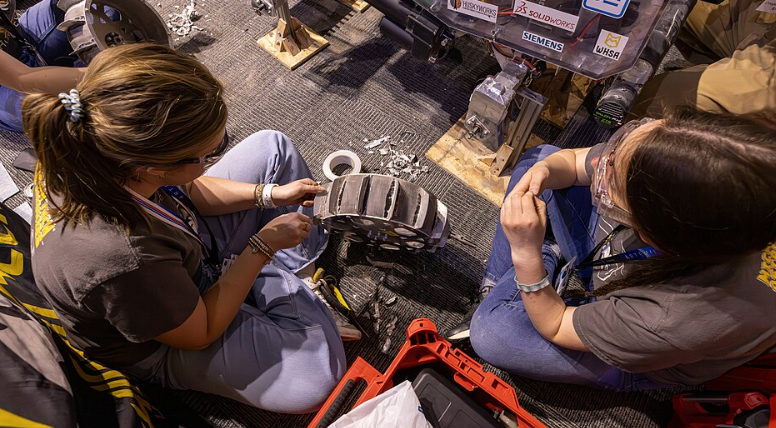
NASA has launched a $1 million student competition inviting young people across the United States to help design technologies for a future Moon base. The Moon Base Student Challenge was announced Sunday, November 8, 2026, during the MAX POWER event at Kennedy Space Center Visitor Complex in Florida.
The competition is open to eligible high school and post-secondary student teams, with proposals focused on how astronauts could live and work near the Moon's South Pole. Participants will address problems involving electricity, construction, life support, transportation, communications and astronaut safety.
NASA Administrator Jared Isaacman said the program gives students an opportunity to contribute to the agency's lunar ambitions before entering the workforce. Registration is open through January 25, 2027, and prizes totaling up to $1 million are available.
Students Invited to Help Design NASA's Moon Base
NASA plans to establish a sustained human presence near the lunar South Pole as part of its broader Artemis exploration program. The proposed base would support scientific research, technology testing and preparations for future missions to Mars.
Building such a facility presents challenges far beyond constructing a shelter. Astronauts will need dependable electricity, protection from radiation, reliable communication systems and equipment capable of operating in extreme temperatures.
The student competition asks teams to develop concepts that could help address these challenges. Rather than designing an entire lunar settlement, participants will concentrate on one of six technical categories connected to long-term operations.
"We're looking for students ready to think creatively, work as a team, and take on real problems connected to NASA's future on the Moon," Isaacman said in the agency's announcement.
He emphasized that students do not need to finish their education before contributing valuable ideas. The competition is intended to encourage teamwork, technical thinking and practical problem-solving.
Carlos García-Galán, manager of NASA's Moon Base Program, also welcomed the opportunity to involve students in early planning. He said young people can offer perspectives that help engineers consider the many requirements of living beyond Earth.
NASA has not promised to build any winning concept. The challenge is designed to generate innovative proposals while helping students develop skills that could be useful in aerospace and related industries.
Six Categories Focus on the Challenges of Lunar Living
The competition covers six areas NASA considers important for supporting astronauts on the Moon. Each category addresses a different problem involved in establishing and maintaining a permanent outpost.
Power generation and storage is one major area because equipment must function through long periods without sunlight. Students could investigate reliable energy production, distribution systems or methods of storing power during the lunar night.
Construction projects will examine how astronauts might build protective structures using materials already available on the Moon. Lunar soil, known as regolith, could potentially become a resource for construction rather than requiring every building material to be transported from Earth.
Life-support proposals will address essential needs such as breathable air, clean water and waste management. These systems must operate reliably while reducing dependence on frequent deliveries from Earth.
The remaining categories cover surface mobility, communications networks and astronaut safety. Possible concepts include improved robotic vehicles, dependable communication equipment and methods of protecting astronauts from lunar dust, radiation and micrometeorites.
NASA's competition rules require students to consider the actual operating conditions of the lunar environment. Designs should account for limited power, low gravity, restricted cargo capacity and substantial temperature changes.
Those restrictions make the competition more demanding than a general classroom exercise. Teams must explain why their proposed technology could function under realistic lunar conditions rather than simply presenting an imaginative design.
Who Can Enter the Competition?
The Moon Base Student Challenge has separate divisions for high school and post-secondary students. Teams must contain two to five eligible students and have an adult coach affiliated with their participating educational organization.
High school participants generally must be between 13 and 18 years old and enrolled in an eligible U.S. secondary education program. The rules also allow certain homeschool, career and technical education, and other approved educational organizations.
Post-secondary teams must meet separate enrollment requirements. Students must generally be at least 16 years old and attend an eligible U.S. higher education institution.
The rules also contain citizenship and residency requirements, including limited provisions for international students studying at eligible American institutions. Prospective participants should review the official eligibility rules before registering.
Students do not need previous aerospace engineering experience to participate. NASA wants the competition to attract young people with different academic backgrounds, including technical and vocational education.
Each student must register individually through NASA's STEM Gateway system using the team's agreed name. Adult coaches provide guidance and administrative support, but the submitted designs must represent the students' own work.
How the $1 Million Competition Works
The challenge will take place in several phases, beginning with registration and introductory activities. Participants will receive information about the technical categories and opportunities to ask questions before submitting their proposals.
The first major submission deadline is February 22, 2027. Teams must prepare a concept overview paper describing their proposed solution and explaining how it addresses a specific lunar challenge.
NASA's rules call for papers between five and seven pages, excluding cover pages and references. The documents must explain the concept, its technical considerations and its relevance to operations on the Moon.
Finalists are scheduled to be announced March 11. Selected teams will advance to another phase involving recorded presentations and supporting slide decks.
Final submissions are due April 19, with award winners scheduled to be announced May 6, 2027. The competition includes finalist awards, runner-up awards and grand prizes across its technical categories and divisions.
Up to $1 million in monetary awards is available across the competition. This is the overall prize pool, not a promise that one student or team will receive $1 million.
The Institute of Competition Sciences administers the challenge under a NASA contract. NASA's Office of STEM Engagement developed the program in cooperation with the Moon Base Program.
NASA Also Opens Applications for New Astronauts
The student challenge comes alongside another NASA initiative connected to future lunar exploration. On November 7, the agency opened applications for its next astronaut candidate class.
NASA is seeking qualified applicants who could eventually participate in lunar missions, work aboard a future Moon base or support preparations for human exploration of Mars. The astronaut recruitment process is separate from the student competition and has substantially different eligibility requirements.
The agency expects to select its next astronaut candidates in late 2027. Applications must be submitted by 11:59 p.m. Eastern Standard Time on December 3, 2026.
Applicants must be U.S. citizens and meet education, professional experience and medical requirements. NASA's previous selection process attracted more than 8,000 applicants, with 10 candidates chosen in 2025.
The agency currently has 32 active astronauts and has selected 370 astronaut candidates since the 1960s. New candidates undergo extensive training before becoming eligible for future assignments.
NASA's current exploration plans call for an attempted crewed lunar landing in 2028, following additional Artemis testing. The schedule remains a target rather than a guaranteed landing date.
Student Designs Could Support Future Lunar Exploration
The Moon Base Student Challenge reflects NASA's effort to involve a wider range of students in solving problems associated with human spaceflight. Participants will gain experience preparing technical proposals, evaluating competing designs and explaining their ideas to others.
Elaine Ho, associate administrator for NASA's Office of STEM Engagement, said students are an important part of imagining how future generations might live beyond Earth. Their participation could help introduce new approaches while preparing them for careers in science and technology.
The competition also gives teachers and educational organizations a structured way to connect classroom learning with real-world engineering challenges. Students can explore subjects such as energy, robotics, construction and environmental protection within a common lunar mission.
For teams interested in participating, the immediate priority is forming an eligible group, identifying an adult coach and registering through NASA STEM Gateway before January 25, 2027. Their first technical proposals will then be due February 22, with winning concepts scheduled to be announced in May.